A Middle Class and a Gospel
Introduit| English | Sens |
|---|---|
| Gospel of Wealth/ˈɡɒspl ɒv welθ/ | The argument that the rich should use their fortunes for the public good. |
| white-collar | Describing office jobs, such as clerks and managers, rather than manual work. |
| philanthropy | Giving money or property to support public causes such as libraries, universities and hospitals. |
"Dies disgraced", 1889
- In June 1889, Andrew Carnegie, one of the richest men in the world, published an essay later called "The Gospel of Wealth". "The man who dies thus rich dies disgraced," he wrote: the wealthy had a duty to give their fortunes away for the public good. Carnegie went on to pay for about 1700 public libraries in the United States.
- The new industrial economy created a large middle class, new kinds of leisure, and new ideas about wealth.
What did Carnegie argue in the Gospel of Wealth?
Difficulté 1/5 · 100 pièces + un petit bonus lors de la première réussite aujourd'hui
Dies disgraced.
About how many public libraries did Carnegie pay for in the United States?
Difficulté 2/5 · 140 pièces + un petit bonus lors de la première réussite aujourd'hui
Philanthropy.
A new middle class
- Big corporations needed managers, clerks, accountants and salespeople. These white-collar 白领 workers formed a new middle class.
- Women entered office jobs as typists and telephone operators; by 1900, most typists were women.
Which jobs belonged to the new white-collar middle class?
Difficulté 2/5 · 140 pièces + un petit bonus lors de la première réussite aujourd'hui
Office work.
Leisure and consumption
- Department stores, mail-order catalogues such as Sears's and brand-name goods let middle-class families buy more.
- Professional baseball (the National League, 1876), vaudeville theatres and amusement parks gave people new ways to spend free time and money.
A cause, a social effect, or the Gospel of Wealth?
Sort each element of increased opportunity.
Worked example: two answers to inequality
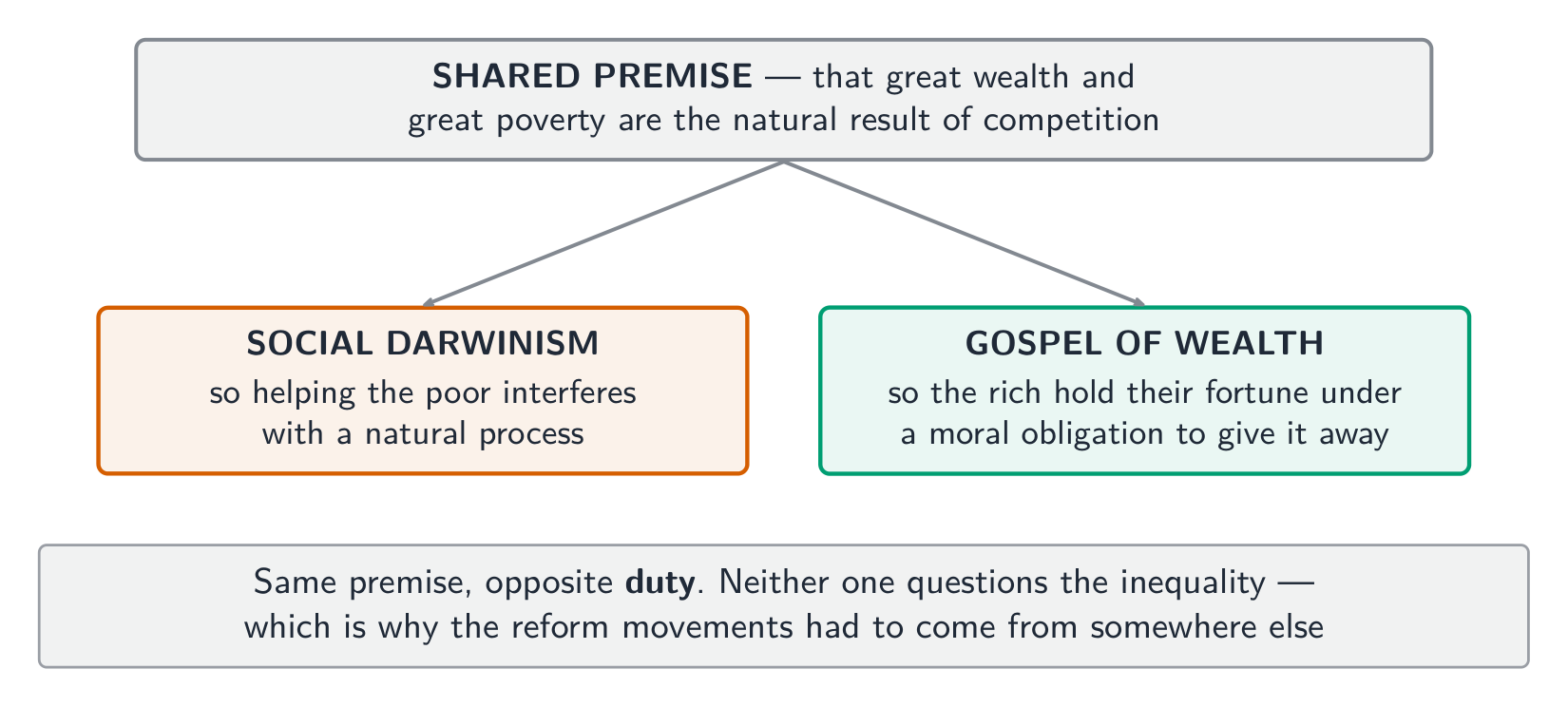
- Shared premise: both ideas accepted that competition rewarded the most able, so great wealth was deserved.
- Social Darwinism: thinkers such as William Graham Sumner argued that helping the poor interfered with natural competition, so the rich owed nothing.
- The Gospel of Wealth 财富福音: Carnegie argued that the rich were trustees of their wealth and must use it for philanthropy 慈善事业 — libraries, universities and concert halls.
Match each idea to its view.
Difficulté 2/5 · 140 pièces + un petit bonus lors de la première réussite aujourd'hui
Same premise, opposite duty.
Philanthropy in practice
- Rockefeller funded the University of Chicago (1890); Carnegie built Carnegie Hall (1891).
- Critics said philanthropy let the rich decide public priorities while workers earned low wages.
Opportunity and its limits
- Stories by Horatio Alger told of poor boys rising through hard work; a few did, but most workers stayed poor.
- Middle-class comfort grew alongside crowded tenements and child labour.
Most poor workers rose to wealth, as in Horatio Alger's stories.
Difficulté 1/5 · 100 pièces + un petit bonus lors de la première réussite aujourd'hui
A few did; most stayed poor.
The Gospel of Wealth did not challenge inequality. It accepted that the rich deserved their wealth and asked only that they give some of it away, on their own terms.
The Gospel of Wealth accepted that the rich deserved their wealth.
Difficulté 1/5 · 100 pièces + un petit bonus lors de la première réussite aujourd'hui
It did not challenge inequality.
Corporations created a white-collar middle class, including many women clerks, and new leisure and consumer habits. Social Darwinism and Carnegie's Gospel of Wealth both justified great fortunes, but the Gospel of Wealth required philanthropy — while opportunity for most workers remained limited.
Compare Social Darwinism and the Gospel of Wealth.
Comparison.