When the Party System Broke
Introduit| English | Sens |
|---|---|
| Compromise of 1850/ˈkɒmprəmaɪz ɒv wɒn ˈθaʊznd ˈeɪthʌndrɪdn ˈfɪfti/ | A package that admitted California as a free state and strengthened a fugitive-slave law. |
| Fugitive Slave Act/ˈfjuːdʒɪtɪv sleɪv ækt/ | The 1850 law requiring Northerners to help capture and return people who had escaped from slavery. |
| popular sovereignty/ˈpɒpjʊlə ˈsɒvərɪnti/ | Letting the settlers of a territory decide by vote whether to allow slavery. |
| Republican Party/rɪˈpʌblɪkən ˈpɑːti/ | The party founded in the 1850s in opposition to the spread of slavery. |
A senator beaten at his desk, May 1856
- On 22 May 1856, Congressman Preston Brooks of South Carolina walked into the Senate and beat Senator Charles Sumner of Massachusetts with a cane until it broke. Two days earlier, Sumner had given a speech attacking slavery in Kansas and insulting Brooks's relative. Sumner took three years to recover. Southerners sent Brooks new canes as gifts.
- In the 1850s, the national party system broke apart over slavery, removing a bond that had held the Union together.
What did Southern reactions to the caning of Sumner show?
Difficulté 1/5 · 100 pièces + un petit bonus lors de la première réussite aujourd'hui
Southerners sent Brooks canes.
Two attempts at compromise
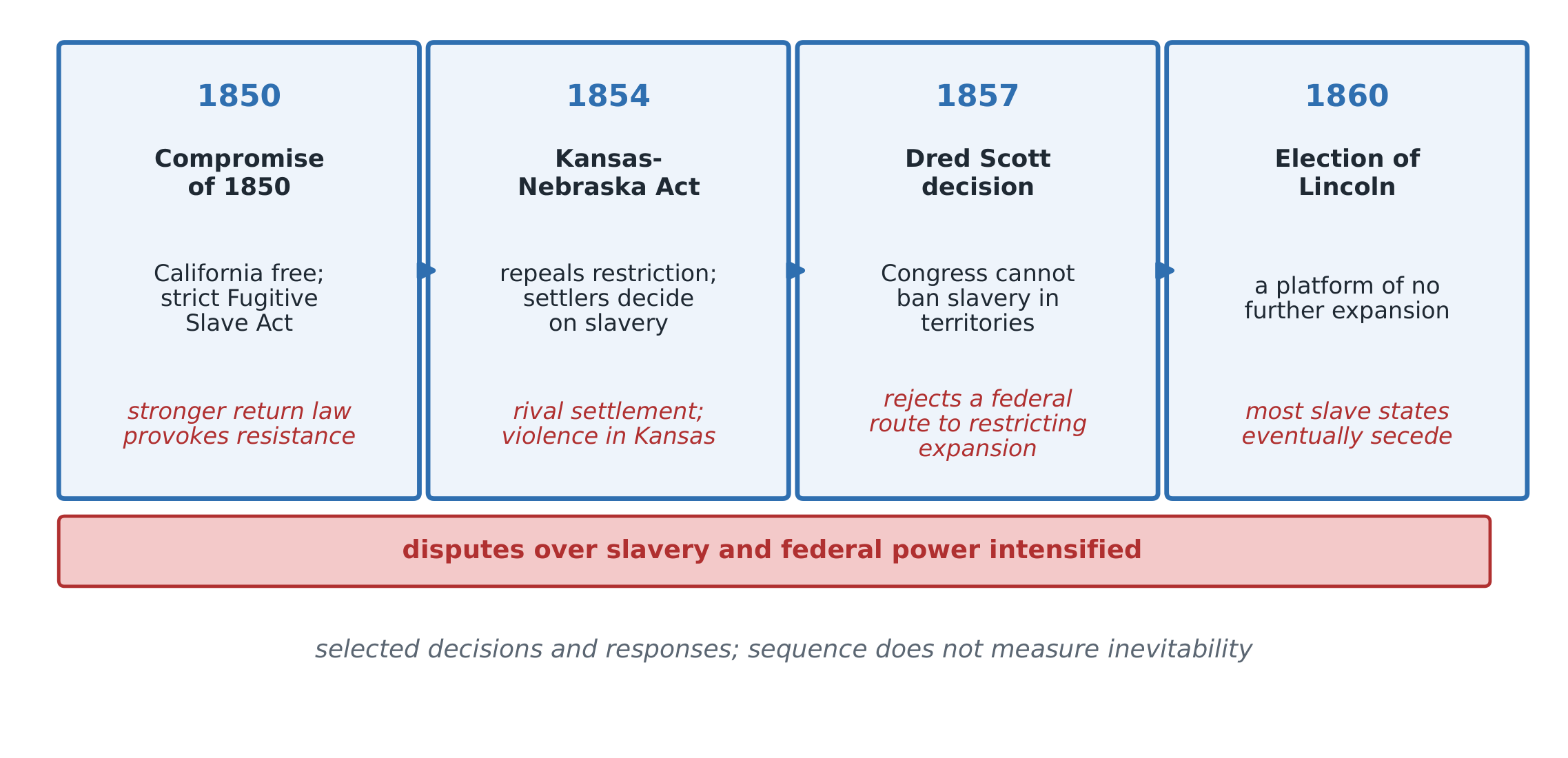
- The Compromise of 1850 1850年妥协案 admitted California as a free state but passed a strict Fugitive Slave Act 逃亡奴隶法, forcing Northerners to help return escaped slaves.
- The Kansas-Nebraska Act (1854) let settlers in those territories decide on slavery by popular sovereignty 人民主权 — overturning the Missouri Compromise line.
Match each law to its effect.
Difficulté 2/5 · 140 pièces + un petit bonus lors de la première réussite aujourd'hui
Two attempts at compromise.
The party system collapses
- Northern Whigs who opposed the Kansas-Nebraska Act left their party, and the Whigs collapsed.
- The new Republican Party 共和党 (1854) opposed the expansion of slavery and won votes only in the North.
Watch a party system break
By the 1850s slavery dominated politics, and the existing parties could not contain it.
What did the Republican Party oppose?
Difficulté 1/5 · 100 pièces + un petit bonus lors de la première réussite aujourd'hui
Formed in 1854.
Worked example: Bleeding Kansas
- The contest: pro-slavery and anti-slavery settlers rushed to Kansas to win the vote; thousands of Missourians crossed the border to vote illegally in 1855.
- The violence: pro-slavery men attacked Lawrence in May 1856; days later, John Brown and his sons killed five pro-slavery settlers at Pottawatomie Creek.
- The result: about 50 people died; popular sovereignty had produced civil war in miniature.
About how many people died in Bleeding Kansas?
Difficulté 2/5 · 140 pièces + un petit bonus lors de la première réussite aujourd'hui
Civil war in miniature.
Why national parties had mattered
- When Whigs and Democrats each had Northern and Southern members, they had to compromise to win national elections.
- Once parties became sectional, there was little reason to compromise.
The Court removes an option
- In Dred Scott v. Sandford (1857), the Supreme Court ruled that Black Americans could not be citizens and that Congress could not ban slavery in the territories.
- This made the Republicans' main policy unconstitutional — and Northern anger grew.
Put these events in order.
Difficulté 3/5 · 200 pièces + un petit bonus lors de la première réussite aujourd'hui
1850, 1854, 1856, 1857.
Compromises did not calm the conflict. The Fugitive Slave Act angered the North, and the Kansas-Nebraska Act led to violence. Each attempt to settle slavery made the division worse.
The Kansas-Nebraska Act calmed the conflict over slavery.
Difficulté 1/5 · 100 pièces + un petit bonus lors de la première réussite aujourd'hui
It led to violence.
The Compromise of 1850 and the Kansas-Nebraska Act tried to manage slavery but inflamed the conflict. Bleeding Kansas and the caning of Sumner showed rising violence. The Whigs collapsed, the sectional Republican Party rose, and Dred Scott closed the door on compromise.
Explain why the collapse of the national party system made civil war more likely.
Causation.