When Region Beats Nation
Introduit| English | Sens |
|---|---|
| Missouri Compromise | The 1820 agreement admitting Missouri as a slave state and Maine as a free state, and banning slavery north of 36°30′ in the Louisiana Purchase. |
| American System | Henry Clay's plan linking a protective tariff, a national bank and federally funded internal improvements. |
| Nullification crisis/ˌnʌlɪfɪˈkeɪʃn ˈkraɪsɪs/ | The crisis of 1832–33 when South Carolina declared federal tariffs void in the state and President Jackson threatened force. |
"A fire bell in the night", 1820
- In April 1820, the 77-year-old Thomas Jefferson wrote a letter about the Missouri Compromise, which Congress had just passed. The fight over whether Missouri could enter the Union as a slave state, he wrote, "like a fire bell in the night, awakened and filled me with terror". A line drawn between free and slave states, he feared, would never be erased.
- In the early nineteenth century, the interests of the North, South and West often mattered more to Americans than national unity.
Why did the Missouri Compromise frighten Jefferson?
Difficulté 1/5 · 100 pièces + un petit bonus lors de la première réussite aujourd'hui
A fire bell in the night.
Three regions, three interests
- North: growing factories wanted tariffs to protect them from British goods.
- South: cotton planters exported to Britain and wanted low tariffs and protection for slavery; West: farmers wanted cheap land and roads and canals.
Match each region to its main interest.
Difficulté 2/5 · 140 pièces + un petit bonus lors de la première réussite aujourd'hui
Three interests.
The American System split opinion
- Henry Clay's American System 美国体系 proposed a protective tariff, a national bank and federally funded roads and canals — "internal improvements".
- Northerners and many westerners liked it; southerners saw the tariff as a tax on them to help northern factories.
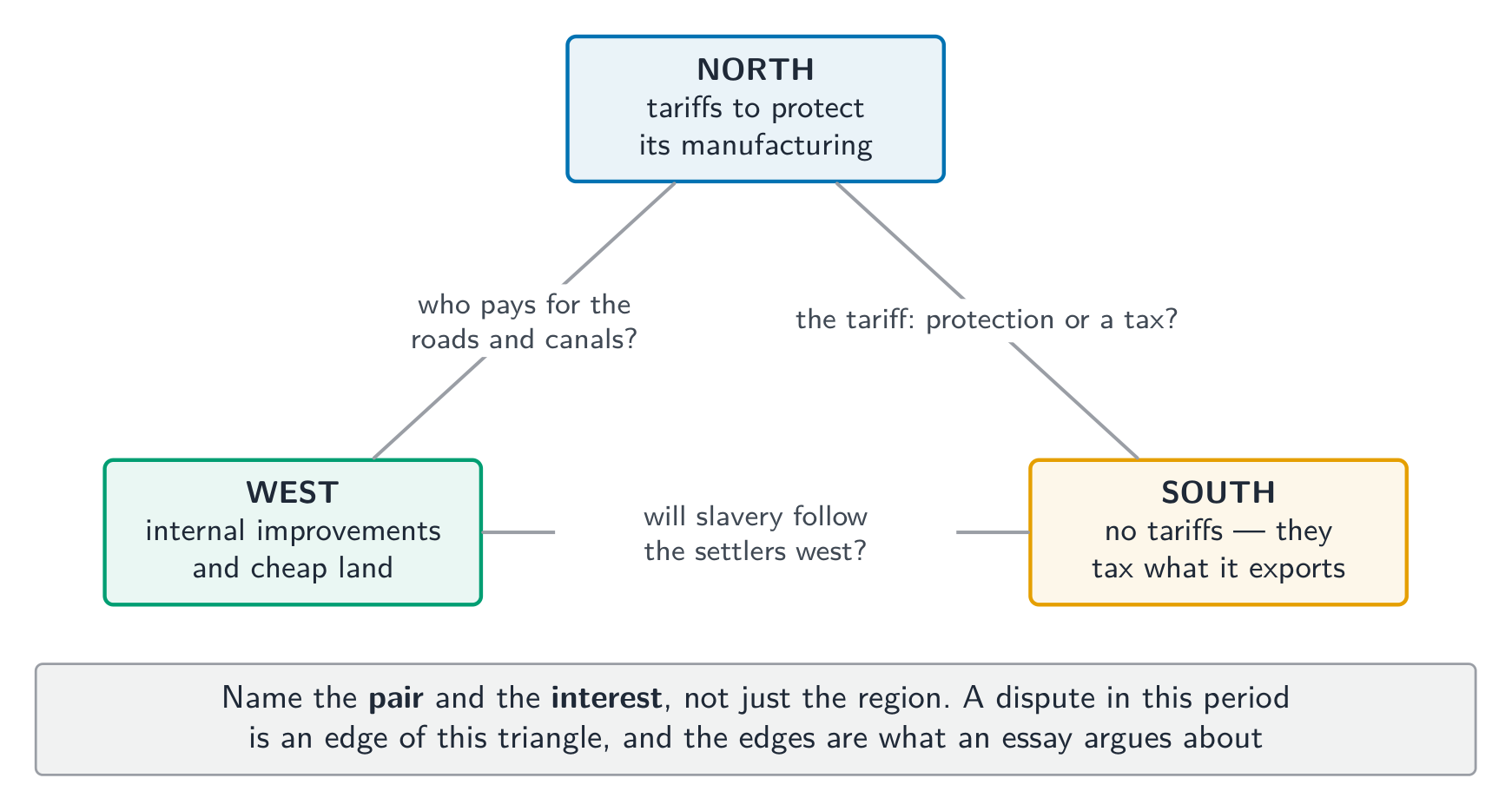
The general claim, an economic case, or a slavery case?
Sort each element of sectional politics.
What did Clay's American System include?
Difficulté 2/5 · 140 pièces + un petit bonus lors de la première réussite aujourd'hui
Clay's programme.
Worked example: compromise bought time
- Missouri Compromise 密苏里妥协 (1820): Missouri entered as a slave state and Maine as a free state, and slavery was banned in the rest of the Louisiana Purchase north of 36°30′.
- Nullification crisis 拒行联邦法令危机 (1832–33): South Carolina declared the tariffs of 1828 and 1832 void in the state. President Jackson threatened force; Clay's compromise tariff lowered rates.
- The pattern: each compromise ended a crisis but did not settle the underlying conflict.
What did the Missouri Compromise do?
Difficulté 1/5 · 100 pièces + un petit bonus lors de la première réussite aujourd'hui
And the 36°30′ line.
Why regions differed
- The North's economy depended on manufacturing and wage labour; the South's on cotton and enslaved labour; the West's on farming and transport.
- Different economies meant different views on tariffs, the bank, land and above all slavery.
The balance in the Senate
- In 1820, there were 11 free and 11 slave states. Each side wanted to keep or win the balance in the Senate.
- Every new state therefore became a fight.
In 1820, there were 11 free and 11 slave states. How many senators did that give the slave states?
Difficulté 2/5 · 140 pièces + un petit bonus lors de la première réussite aujourd'hui
Two per state.
Compromises did not solve sectional conflict. They postponed it. Show that the same disputes returned in new forms.
The compromises of 1820 and 1833 permanently solved sectional conflict.
Difficulté 1/5 · 100 pièces + un petit bonus lors de la première réussite aujourd'hui
They postponed it.
The North, South and West had different economic interests. Clay's American System divided them, the Missouri Compromise balanced slave and free states, and the Nullification crisis showed the South's anger at tariffs. Compromises bought time but did not end the conflict.
Explain how regional economic interests shaped political debates between 1815 and 1833.
Causation.