Democracy, Economy, Expansion
Introduit| English | Sens |
|---|---|
| sectional | Relating to the rival interests of the North, South and West of the United States. |
| Trail of Tears/treɪl ɒv tɪəz/ | The deadly forced march of the Cherokee and others to Indian Territory. |
Three cents an acre, 1803
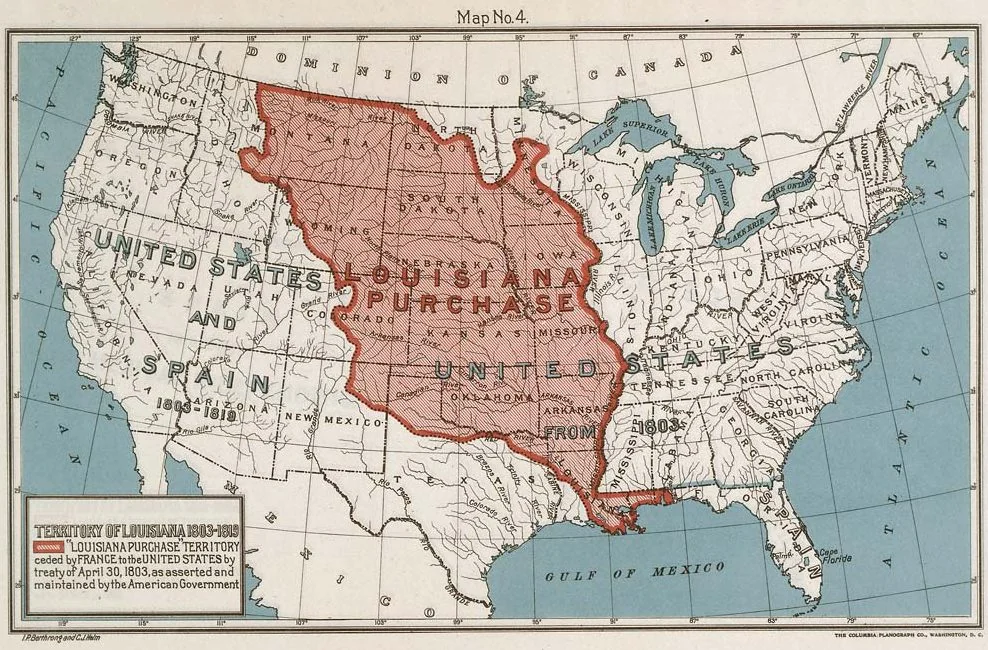
- On 30 April 1803, American diplomats in Paris signed a treaty buying Louisiana from Napoleon's France for 15 million dollars. The territory stretched from the Mississippi River to the Rocky Mountains — about 2.1 million square kilometres, roughly three cents an acre. Overnight, the United States doubled in size.
- Between 1800 and 1848, the United States expanded democracy, its economy and its territory — and argued about all three.
For how many million dollars did the US buy Louisiana?
Difficulté 2/5 · 140 pièces + un petit bonus lors de la première réussite aujourd'hui
In 1803.
Three claims for the period
- Democracy: more white men could vote, and political parties organized mass politics.
- Economy: a market revolution linked farms, factories and cities; expansion: the nation spread west, and conflict over slavery grew with it.
Match each claim to its example.
Difficulté 2/5 · 140 pièces + un petit bonus lors de la première réussite aujourd'hui
Three claims.
Democracy as a project
- By the 1830s, most states had dropped property requirements, so almost all white men could vote. Voter turnout rose from about 27% in 1824 to about 80% in 1840.
- Reformers pushed for more: an end to slavery, women's rights, public schools and temperance.
Which of unit 4's threads?
Sort each statement into its thread.
How did voter turnout change between 1824 and 1840?
Difficulté 1/5 · 100 pièces + un petit bonus lors de la première réussite aujourd'hui
Mass politics.
Worked example: one identity, split in two
- National: the War of 1812 and the "Era of Good Feelings" after 1815 encouraged pride in the nation; Francis Scott Key wrote "The Star-Spangled Banner" in 1814.
- Regional: the North industrialized; the South depended on cotton and slavery; the West wanted cheap land and roads.
- The result: Americans felt national and sectional 地区性的 loyalties at once, and the two pulled against each other.
Expansion and its costs
- Louisiana (1803), Florida (1819) and Texas (1845) added land; the Mexican War (1846–48) added California and the Southwest.
- Native nations were forced west, as in the Cherokee Trail of Tears 血泪之路 (1838–39), where about 4000 died.
Put these acquisitions in order.
Difficulté 3/5 · 200 pièces + un petit bonus lors de la première réussite aujourd'hui
1803, 1819, 1845, 1848.
About 4000 Cherokee died on the Trail of Tears.
Difficulté 1/5 · 100 pièces + un petit bonus lors de la première réussite aujourd'hui
1838–39.
Slavery and expansion
- Every new territory raised the question: would it be slave or free? The Missouri Compromise (1820) drew a line, but each new acquisition reopened the debate.
- Expansion therefore deepened the sectional conflict.
Democracy expanded for white men only. Free Black men lost the vote in several states, women could not vote, and Native nations were forced off their land. Qualify the claim.
Democracy expanded for all Americans between 1800 and 1848.
Difficulté 1/5 · 100 pièces + un petit bonus lors de la première réussite aujourd'hui
For white men only.
From 1800 to 1848, the United States widened white male democracy, built a market economy and expanded from the Louisiana Purchase to California. National pride grew, but so did sectional identities, and every new territory raised the question of slavery.
Explain how westward expansion increased sectional conflict between 1800 and 1848.
Causation.