Talent, Liberty and Common Sense
Introduit| English | Sens |
|---|---|
| republicanism/rɪˈpʌblɪkənɪzəm/ | The belief that government should be run by elected representatives, not kings, and that citizens need civic virtue. |
| natural rights/ˈnætʃərəl raɪts/ | Rights that every person has by nature, such as Locke's life, liberty and property. |
A pamphlet everyone read, January 1776
- In January 1776, a recent English immigrant named Thomas Paine published a 47-page pamphlet called Common Sense. In plain language, he called King George a "royal brute" and argued that it was absurd for an island to rule a continent. It sold over 100 000 copies within months. Six months later, Congress declared independence.
- In the 1770s, two sets of ideas — republicanism and natural rights — changed how colonists thought about government.
Why was Common Sense so influential?
Difficulté 1/5 · 100 pièces + un petit bonus lors de la première réussite aujourd'hui
Over 100 000 copies within months.
Republicanism
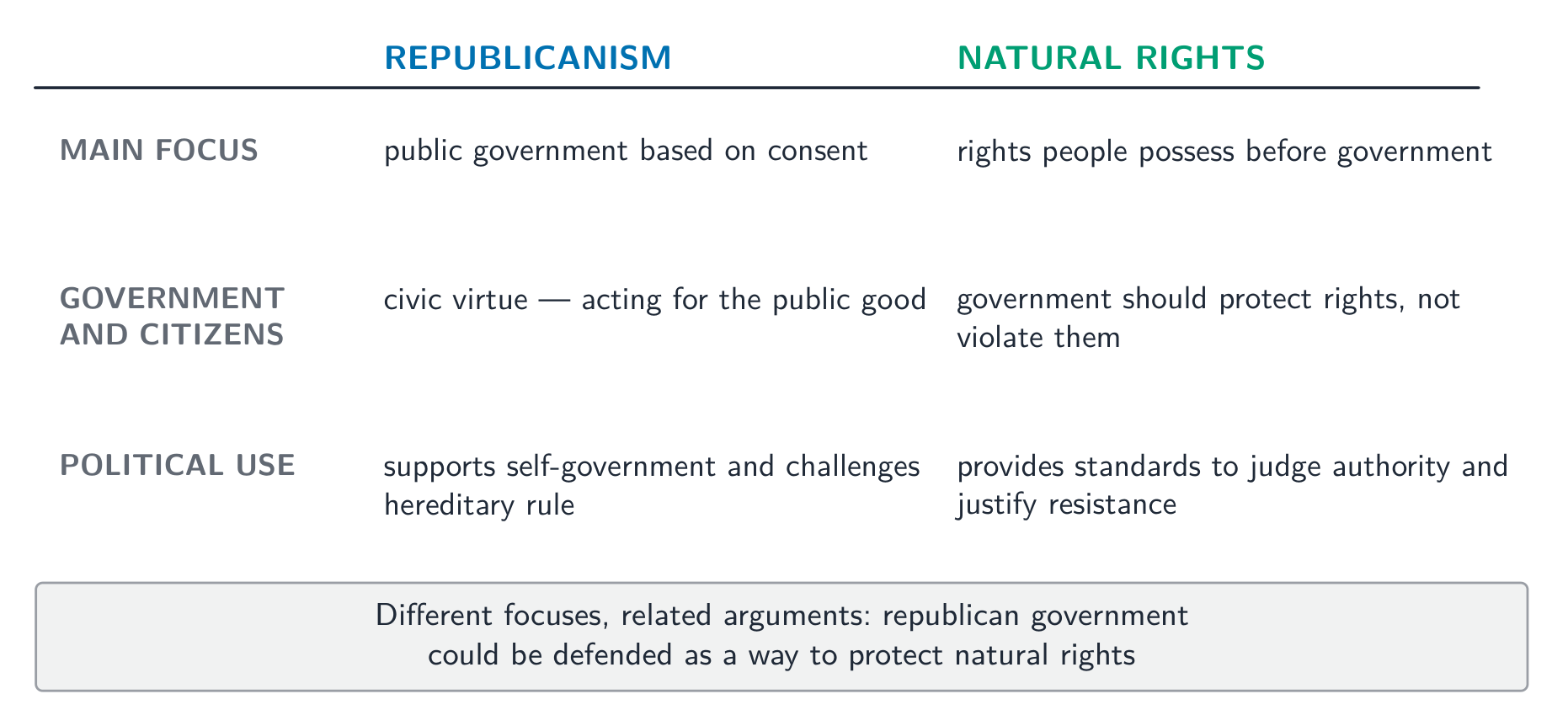
- Republicanism 共和主义 held that government should be run by elected representatives, not kings, and that citizens must have civic virtue — putting the common good before their own interest.
- Colonists admired the Roman Republic and feared that kings and courts led to corruption.
Natural rights
- Following John Locke, many colonists believed people have natural rights 自然权利 to life, liberty and property, and that government exists to protect them.
- If a government breaks those rights, the people may replace it.
Secular argument, religious self-image, or the documents?
Sort each element of changing attitudes.
Match each idea to its meaning.
Difficulté 2/5 · 140 pièces + un petit bonus lors de la première réussite aujourd'hui
Two sources.
Worked example: two documents
- Common Sense (January 1776): argued for a republic instead of monarchy, in words ordinary people could read aloud in taverns.
- The Declaration of Independence (4 July 1776): Thomas Jefferson wrote that "all men are created equal" with rights to "life, liberty and the pursuit of happiness", and that governments get their power from "the consent of the governed".
- Reach: the Declaration inspired later revolutions, in France (1789) and Haiti (1804) — and Americans who were excluded used its words against slavery.
Which phrase is from the Declaration of Independence?
Difficulté 1/5 · 100 pièces + un petit bonus lors de la première réussite aujourd'hui
Jefferson, 1776.
Where did the Declaration's ideas have influence?
Difficulté 2/5 · 140 pièces + un petit bonus lors de la première réussite aujourd'hui
Its words travelled.
How the ideas fit together
- Republicanism answered who should govern — the people's representatives. Natural rights answered why government exists — to protect rights.
- Together they justified independence and a government without a king.
Republicanism answers who should govern; natural rights answer why government exists.
Difficulté 1/5 · 100 pièces + un petit bonus lors de la première réussite aujourd'hui
They fit together.
What changed
- In 1763, most colonists were proud subjects of the king. By 1776, many saw monarchy itself as the problem.
- Attitudes changed through pamphlets, newspapers, sermons and tavern debates.
Do not treat republicanism and natural rights as the same idea. One is about the form of government and civic virtue; the other is about the rights government must protect.
Republicanism and natural rights are the same idea.
Difficulté 1/5 · 100 pièces + un petit bonus lors de la première réussite aujourd'hui
Different questions.
Paine's Common Sense and the Declaration of Independence spread two ideas: republicanism — government by elected representatives and civic virtue — and natural rights to life, liberty and property. Together they turned loyal subjects into revolutionaries, and the Declaration's words travelled far beyond 1776.
Explain how colonists' attitudes toward monarchy changed between 1763 and 1776.
Change over time.