Many Colonisations, One Continent
Introduit| English | Sens |
|---|---|
| Anglicization/ˌæŋɡlɪsaɪˈzeɪʃn/ | The adoption or imposition of English language, customs or institutions. |
| salutary neglect/ˈsæluːtəri nɪˈɡlekt/ | Britain's loose enforcement of trade laws while it still benefited. |
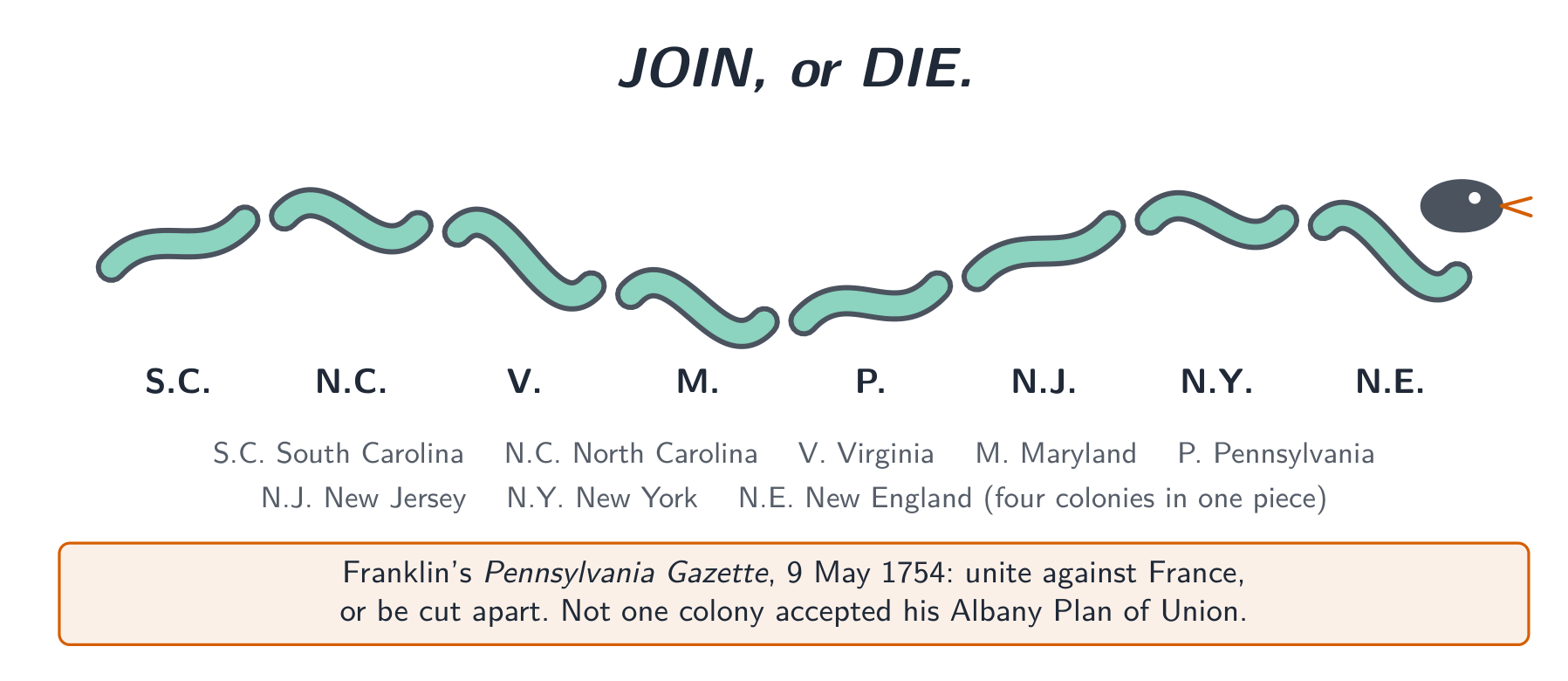
"Join, or Die", 1754
- On 9 May 1754, Benjamin Franklin's Pennsylvania Gazette printed a woodcut of a snake cut into eight pieces, each labelled with a colony's name. The caption read: "Join, or Die." Franklin wanted the colonies to unite against France and its Native allies. None of the colonies accepted his plan of union. They were tied more closely to London than to each other.
- Between 1607 and 1754, European colonies in North America grew in different ways, and their ties to Britain both bound them and created resistance.
What was the purpose of "Join, or Die"?
Difficulté 1/5 · 100 pièces + un petit bonus lors de la première réussite aujourd'hui
Franklin, 1754.
Two big ideas for the period
- Colonies were very different from each other, shaped by environment, religion and economy.
- At the same time, ties of trade and culture drew the British colonies closer to Britain — until those ties began to cause tension.
Three sources of variety
- Environment: tobacco in the Chesapeake, rice in South Carolina, wheat in the middle colonies, fishing and trade in New England.
- Religion and people: Puritans in New England, Quakers in Pennsylvania, Catholics in Maryland; and enslaved Africans in growing numbers.
A source of variety, competition, or the British relationship?
Sort each element of the colonial context.
Match each region to its main product.
Difficulté 2/5 · 140 pièces + un petit bonus lors de la première réussite aujourd'hui
Environment shaped economies.
Worked example: three-sided competition
- Europeans against each other: Britain, France and Spain fought four wars for North America between 1689 and 1763.
- Europeans against Native nations: colonists pushed onto Native land, causing wars such as King Philip's War (1675–76).
- Native nations' strategy: the Haudenosaunee played Britain and France against each other to protect their independence.
Which were part of the three-sided competition?
Difficulté 2/5 · 140 pièces + un petit bonus lors de la première réussite aujourd'hui
Europeans and Native nations.
Bonds with Britain
- Colonists bought British cloth, tea and china, and read British books and newspapers — Anglicization 英国化.
- The Great Awakening (1730s–40s), a Protestant revival, connected preachers and believers across the Atlantic.
Anglicization means colonists adopting British goods and culture.
Difficulté 1/5 · 100 pièces + un petit bonus lors de la première réussite aujourd'hui
Cloth, tea, books.
And resistance
- The Navigation Acts required colonial trade to pass through Britain; colonists often smuggled to avoid them.
- Colonial assemblies grew used to governing themselves while Britain followed salutary neglect 有益的忽视 — not enforcing many laws strictly.
What was salutary neglect?
Difficulté 1/5 · 100 pièces + un petit bonus lors de la première réussite aujourd'hui
Colonists grew used to self-government.
Do not describe "the colonies" as one society. New England, the middle colonies, the Chesapeake and the South differed greatly. Specify which region you mean.
All the British colonies had the same economy and religion.
Difficulté 1/5 · 100 pièces + un petit bonus lors de la première réussite aujourd'hui
They varied widely.
From 1607 to 1754, British colonies varied by environment, religion and labour. Britain, France, Spain and Native nations competed for the continent. Trade and culture tied the colonies to Britain, but self-government and smuggling also bred independence.
Explain how ties to Britain both united and divided the colonies and Britain before 1754.
Two-sided effect.