Random Sampling
Introduit| English | Sens |
|---|---|
| random sampling/ˈrændəm ˈsæmplɪŋ/ | tirage aléatoire |
| simple random sample/ˈsɪmpl ˈrændəm ˈsæmpl/ | échantillon aléatoire simple |
| stratified/ˈstrætɪfaɪd/ | stratifié |
| cluster/ˈklʌstə/ | en grappes |
| systematic/ˌsɪstəˈmætɪk/ | systématique |
Why randomize the choice?
- Random sampling 随机抽样 uses chance to decide who gets into the sample.
- Chance has no agenda, so it avoids the human tendencies that create bias.
- A random sample tends to look like the population in the long run.
- Randomness is what makes a fair generalization possible.
The simple random sample
- A simple random sample (SRS) 简单随机样本 gives every group of $n$ individuals an equal chance.
- Carry it out: number the population, then draw numbers (random digits or a hat).
- Every individual — and every combination — is equally likely.
- The SRS is the gold-standard idea the others build on.
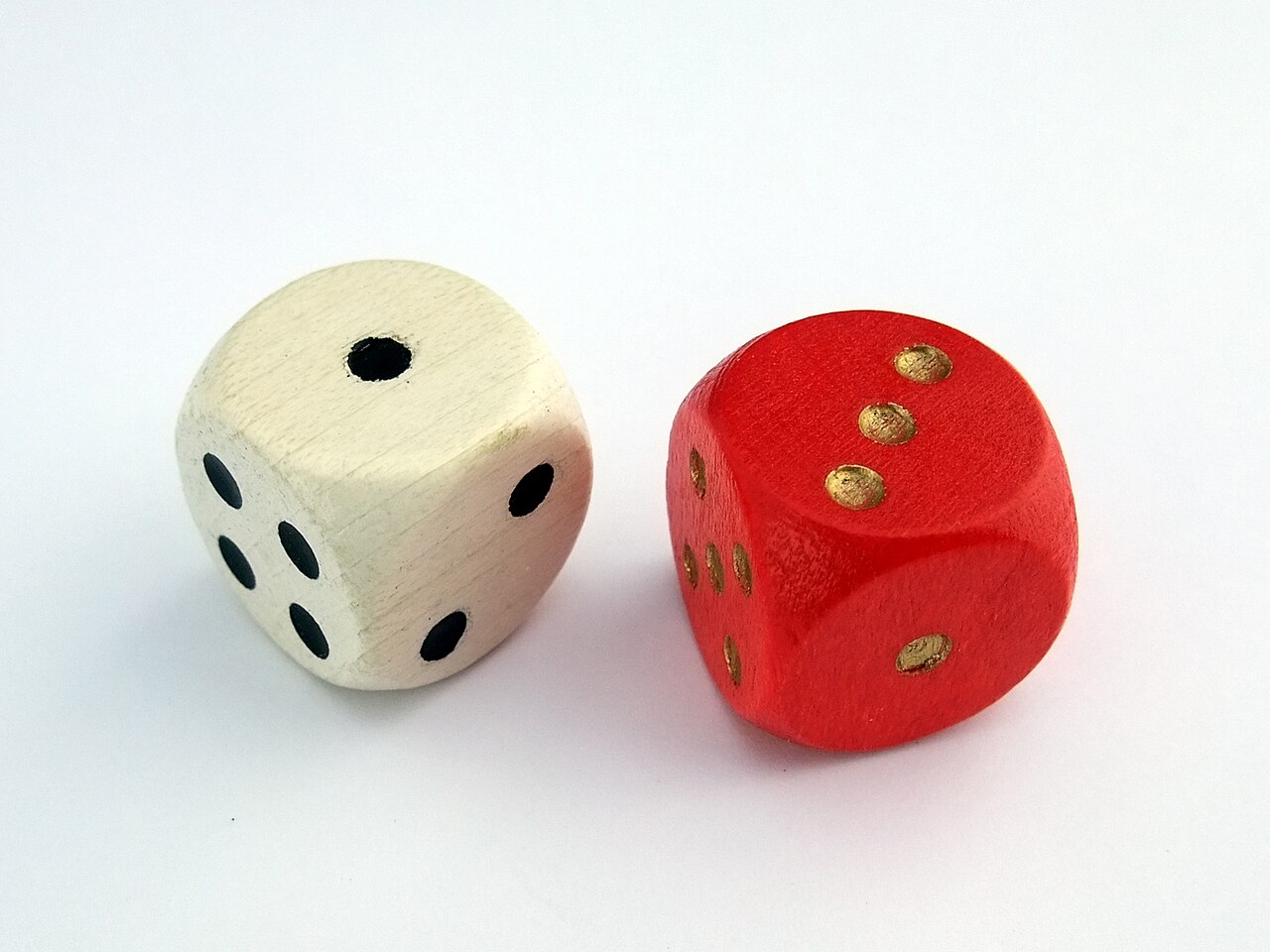
Random outcomes: dice make each face equally likely under fair conditions
Stratified, cluster, systematic
- Stratified 分层: split into similar groups (strata), then take an SRS within each.
- Cluster 整群: split into groups (clusters), randomly pick whole clusters, sample everyone in them.
- Systematic 系统: pick a random start, then take every $k$-th individual.
- Stratify to guarantee representation of each group; cluster for convenience when groups are scattered.
Randomness enables generalization
- A random sampling design supports generalization to its sampling-frame population, provided coverage, response, and measurement are adequate.
- The sample statistic becomes a trustworthy estimate of the population value.
- Random selection does not guarantee that any one sample is representative; nonresponse and measurement can still introduce bias.
- Later units' inference formulas assume the sample was random.
Don't confuse stratified and cluster sampling. Stratified: strata are internally similar, and you sample from every stratum (to guarantee each is represented). Cluster: clusters are mini-populations, and you sample only some whole clusters. Same word "groups," opposite logic — mixing them up is the classic exam slip.
Survey $100$ of a school's $1000$ students across four grades.
- SRS: number all $1000$, draw $100$ random numbers.
- Stratified: take $25$ at random from each of four grades → $4(25)=100$ students. For an overall estimate, weight each grade estimate by its share of the school; pooling equally is valid only if grade populations are equal.
- Cluster: randomly pick $4$ homeroom classes (clusters) and survey all $\approx 100$ students in them.
Random sampling limits selection bias and supports generalization, but does not eliminate coverage, nonresponse, or measurement problems. A simple random sample (SRS) gives every group of $n$ an equal chance. Stratified samples within every similar stratum; cluster samples some whole clusters; systematic takes every $k$-th after a random start.
Write from this case
- The population is split into year groups.
- A random sample is taken inside each year group.
A school population is split into year groups, then a random sample is taken within every year. Name the sampling method and explain how to combine estimates if year groups differ in size.
Strata are groups, and each group is sampled.
What is a random sample inside each year group?
Difficulté 1/5 · 100 pièces + un petit bonus lors de la première réussite aujourd'hui
Sampling within every group is stratification.
Strata within a population
Stratified sampling draws from every slice (stratum).
A simple random sample (SRS) of size n gives an equal chance to...
Difficulté 1/5 · 100 pièces + un petit bonus lors de la première réussite aujourd'hui
An SRS gives every group of n an equal chance.
Match each sampling method to its idea.
Difficulté 2/5 · 140 pièces + un petit bonus lors de la première réussite aujourd'hui
Stratify = all strata; cluster = some clusters; systematic = every k-th.
Random sampling is what justifies generalizing the sample result to the population.
Difficulté 1/5 · 100 pièces + un petit bonus lors de la première réussite aujourd'hui
A bias-free random method supports generalization.
You take an SRS of 25 students from EACH grade. This is which method?
Difficulté 1/5 · 100 pièces + un petit bonus lors de la première réussite aujourd'hui
Sampling within every group (grade) is stratified sampling.
Choosing a random start and then taking every k-th individual is ___ sampling.
Difficulté 1/5 · 100 pièces + un petit bonus lors de la première réussite aujourd'hui
That every-k-th rule is systematic sampling.