Secant, Cosecant, and Cotangent · Sécante, Cosecante et Cotangente
| English | Français |
|---|---|
| reciprocal/rɪˈsɪprəkl/ | réciproque |
| secant/ˈsiːkənt/ | sécante |
| cosecant/ˈkəʊsekənt/ | cosécante |
| cotangent/ˈkəʊtændʒənt/ | cotangente |
| vertical asymptote/ˈvɜːtɪkl ˈæsɪmptəʊt/ | asymptote verticale |
Three more from flipping
- Sine, cosine, and tangent have three partners built by flipping them over.
- Each new function is simply $1$ divided by one of the originals.
- They appear whenever a ratio is easier written "upside down".
- Their graphs inherit their asymptotes from wherever the originals hit zero.
Trois autres issues du retournement
- Le sinus, le cosinus et la tangente ont trois partenaires construits en les retournant.
- Chaque nouvelle fonction est simplement $1$ divisé par l'une des originales.
- Elles apparaissent quand un rapport est plus facile à écrire « à l'envers ».
- Leurs graphes héritent de leurs asymptotes là où les originaux s'annulent.
The three reciprocals
- Secant 正割 is the reciprocal 倒数 of cosine: $\sec x = \dfrac{1}{\cos x}$.
- Cosecant 余割 is the reciprocal of sine: $\csc x = \dfrac{1}{\sin x}$.
- Cotangent 余切 is the reciprocal of tangent: $\cot x = \dfrac{1}{\tan x} = \dfrac{\cos x}{\sin x}$.
- A handy memory hook: "co-" and the base function never match up (secant pairs with cosine).
Les trois réciproques
- La sécante 正割 est le réciproque 倒数 du cosinus : $\sec x = \dfrac{1}{\cos x}$.
- Le cosécante 余割 est le réciproque du sinus : $\csc x = \dfrac{1}{\sin x}$.
- La cotangente 余切 est le réciproque de la tangente : $\cot x = \dfrac{1}{\tan x} = \dfrac{\cos x}{\sin x}$.
- Un moyen mnémotechnique utile : « co- » et la fonction de base ne s'associent jamais (la sécante va avec le cosinus).
The cosine wave whose reciprocal is secant · L'onde cosinus dont le reciprocal est la sécante
y = cos x
Secant is 1 divided by cosine. Wherever this cosine wave crosses zero, secant blows up to an asymptote. · La sécante est 1 divisé par le cosinus. Partout où cette onde cosinus traverse zéro, la sécante explose vers une asymptote.
The · Le secant function is defined as… · La fonction sécante est définie comme…
Secant is the reciprocal · réciproque of cosine: $\sec x = \dfrac{1}{\cos x}$. · Sécante est le reciprocal · réciproque du cosinus : $\sec x = \dfrac{1}{\cos x}$.
Which pairing is correct? · Quel couple est correct ?
Cosecant is $1/\sin$ and · et cotangent is $1/\tan = \cos/\sin$ — the reciprocals of sine and tangent. · Cosécante est $1/\sin$ et cotangente est $1/\tan = \cos/\sin$ — les inverses du sinus et de la tangente.
Select all · tout correct reciprocal identities. · Sélectionnez tous les identités réciproques correctes.
Secant is $1/\cos$, not $\sin$. The other three are correct reciprocal definitions. · La sécante est $1/\cos$, pas $\sin$. Les trois autres sont des définitions réciproques correctes.
Where they blow up
- A reciprocal is undefined when the original is zero — you cannot divide by zero.
- So secant has a vertical asymptote 竖直渐近线 wherever $\cos x = 0$.
- Cosecant blows up wherever $\sin x = 0$; cotangent wherever $\sin x = 0$ too.
- Between the asymptotes, each curve swoops up toward $\pm\infty$.
Où elles explosent
- Un réciproque est indéfini quand l'original est zéro — on ne peut pas diviser par zéro.
- La sécante a donc une asymptote verticale 竖直渐近line partout où $\cos x = 0$.
- Le cosécante explose partout où $\sin x = 0$ ; la cotangente partout où $\sin x = 0$ aussi.
- Entre les asymptotes, chaque courbe plonge vers $\pm\infty$.
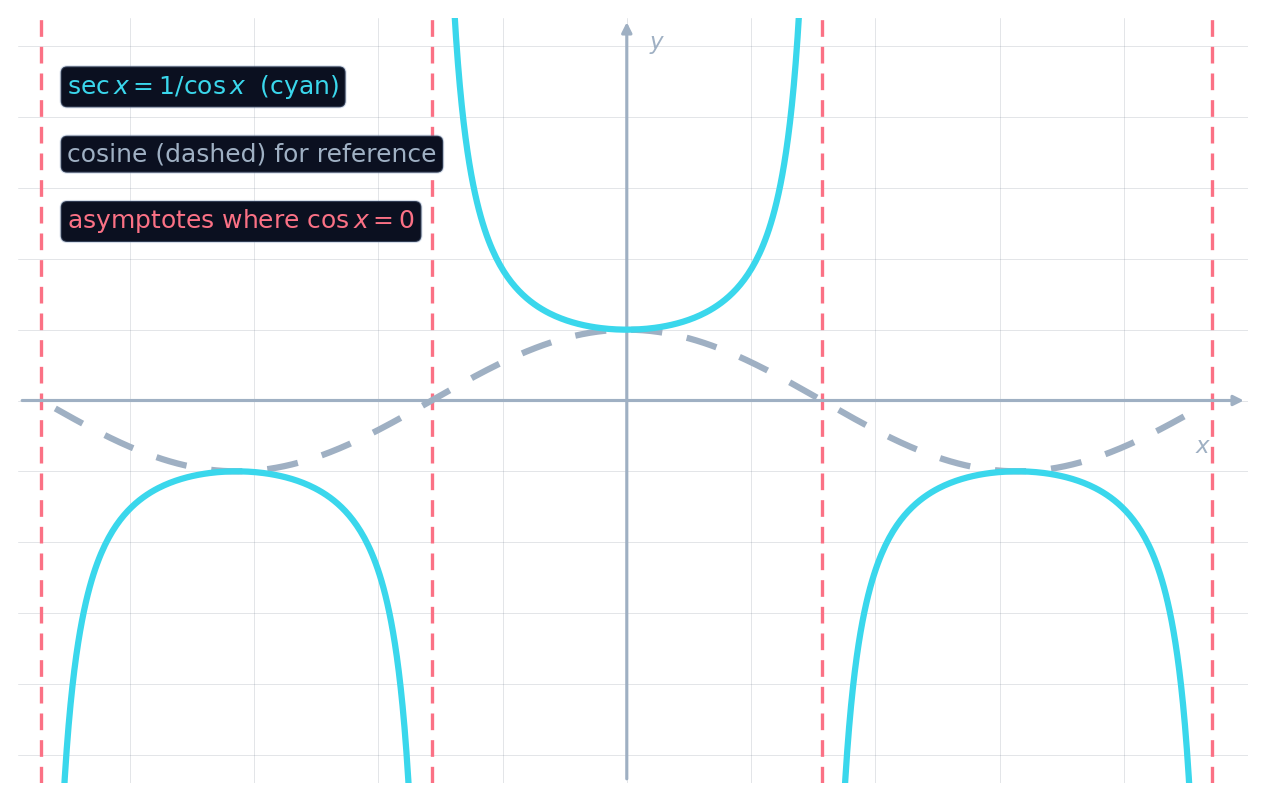
Secant has a vertical ____ wherever $\cos x = 0$, because you cannot divide by zero. · La sécante a une asymptote verticale ____ partout où $\cos x = 0$, car on ne peut pas diviser par zéro.
Since $\sec x = 1/\cos x$, a zero cosine makes secant undefined — a vertical asymptote. · Puisque $\sec x = 1/\cos x$, un cosinus nul rend la sécante indéfinie — une asymptote verticale.
Secant's output never lies strictly between $-1$ and · et $1$. · La sortie de la sécante ne se situe jamais strictement entre $-1$ et $1$.
Since $|\cos x| \le 1$, its reciprocal $|\sec x| \ge 1$ — secant is always at least $1$ in size. · Puisque $|\cos x| \le 1$, son reciprocal $|\sec x| \ge 1$ — la sécante est toujours d'au moins $1$ en magnitude.
Their shape
- Because $|\cos x| \le 1$, its reciprocal secant satisfies $|\sec x| \ge 1$.
- So secant never enters the strip between $-1$ and $1$ — it lives outside it.
- Each secant "U" sits above a cosine peak or below a cosine trough.
- Cosecant looks the same, shifted to match sine instead of cosine.
Leur forme
- Puisque $|\cos x| \le 1$, son réciproque la sécante satisfait $|\sec x| \ge 1$.
- La sécante n'entre jamais dans la bande entre $-1$ et $1$ — elle vit à l'extérieur.
- Chaque « U » de sécante surplombe un sommet du cosinus ou descend sous un creux.
- Le cosécante ressemble à cela, décalé pour correspondre au sinus au lieu du cosinus.
Why they are useful
- Some formulas are cleaner with secant or cotangent than with a fraction of sine and cosine.
- The Pythagorean identities come in secant and cosecant forms too.
- In calculus, the derivative of tangent is $\sec^2 x$ — the reciprocals show up naturally.
- Knowing all six trig functions lets you pick the simplest one for the job.
Pourquoi elles sont utiles
- Certaines formules sont plus propres avec la sécante ou la cotangente qu'avec une fraction de sinus et cosinus.
- Les identités pythagoriciennes existent aussi sous forme de sécante et cosécante.
- En calcul différentiel, la dérivée de la tangente est $\sec^2 x$ — les réciproques apparaissent naturellement.
- Connaissant les six fonctions trigonométriques, vous pouvez choisir la plus simple pour la tâche.
Do not confuse the reciprocal $\sec x = \tfrac{1}{\cos x}$ with the inverse $\cos^{-1} x = \arccos x$. Despite the similar names, one is "one over cosine" and the other is "the angle with this cosine" — completely different functions.
Ne confondez pas le réciproque $\sec x = \tfrac{1}{\cos x}$ avec l'inverse $\cos^{-1} x = \arccos x$. Malgré les noms similaires, l'un est « un sur cosinus » et l'autre est « l'angle ayant ce cosinus » — des fonctions totalement différentes.
Evaluate $\sec\tfrac{\pi}{3}$ and explain why $\csc 0$ is undefined.
- $\cos\tfrac{\pi}{3} = \tfrac12$, so $\sec\tfrac{\pi}{3} = \tfrac{1}{1/2} = 2$.
- $\csc 0 = \tfrac{1}{\sin 0} = \tfrac{1}{0}$, which is undefined.
- So $x = 0$ is a vertical asymptote of cosecant.
Évaluez $\sec\tfrac{\pi}{3}$ et expliquez pourquoi $\csc 0$ est indéfini.
- $\cos\tfrac{\pi}{3} = \tfrac12$, donc $\sec\tfrac{\pi}{3} = \tfrac{1}{1/2} = 2$.
- $\csc 0 = \tfrac{1}{\sin 0} = \tfrac{1}{0}$, qui est indéfini.
- Donc $x = 0$ est une asymptote verticale du cosécante.
Secant, cosecant, and cotangent are the reciprocals of cosine, sine, and tangent. Each has a vertical asymptote wherever its base function is zero, and secant/cosecant outputs never fall strictly between $-1$ and $1$.
Sécante, cosécante et cotangente sont les réciproques du cosinus, du sinus et de la tangente. Chacune possède une asymptote verticale 竖直渐近line là où sa fonction de base est nulle, et les sorties de sécante/cosécante ne tombent jamais strictement entre $-1$ et $1$.