Fonctions trigonométriques inverses
Introduit| English | Sens |
|---|---|
| sine/saɪn/ | sinus |
| inverse/ɪnˈvɜːs/ | fonction inverse |
| one-to-one/wʌn tuː wʌn/ | bijection |
| domain/dəˈmeɪn/ | domaine de définition |
From a ratio back to an angle
- Sine turns an angle into a ratio; sometimes we need to run that backward.
- "Which angle has a sine of $0.5$?" is a question only an inverse can answer.
- Ramps, satellite dishes, and navigation all need the angle from a measured ratio.
- The inverse trig functions do exactly this reversal.
What the inverse does
- The inverse 反函数 of sine, written $\arcsin$ or $\sin^{-1}$, takes a value and returns an angle.
- $\arcsin(0.5) = 30°$, because $\sin 30° = 0.5$.
- Likewise $\arccos$ and $\arctan$ reverse cosine and tangent.
- Each undoes its trig function, recovering the angle that produced a value.
La fonction inverse $\arcsin$ (ou $\sin^{-1}$) prend une valeur et retourne…
Difficulté 1/5 · 100 pièces + un petit bonus lors de la première réussite aujourd'hui
L'inverse du sinus l'inverse : $\arcsin(0.5)$ est l'angle dont le sinus est $0.5$, soit $30°$.
Why we must restrict
- Sine is not one-to-one 一一对应: countless angles share the same sine value.
- If we reversed all of them, the "inverse" would give many answers at once — not a function.
- So we restrict the domain to one rising piece, from $-\tfrac{\pi}{2}$ to $\tfrac{\pi}{2}$.
- On that restricted domain 定义域, each output comes from exactly one angle.
D'un rapport à un angle
Une fonction trig inverse répond à la question inverse — donnée la valeur du sinus ou du cosinus, quel angle l'a produite ?
Pourquoi le sinus doit-il être restreint avant d'avoir une fonction inverse ?
Difficulté 1/5 · 100 pièces + un petit bonus lors de la première réussite aujourd'hui
Beaucoup d'angles partagent le même sinus, donc le sinus n'est pas injectif. Restreindre son domaine fixe une seule sortie par entrée.
Quelle est la valeur de $\arcsin(1)$ (en radians) ?
Difficulté 1/5 · 100 pièces + un petit bonus lors de la première réussite aujourd'hui
$\sin\tfrac{\pi}{2} = 1$, donc $\arcsin(1) = \tfrac{\pi}{2}$ — l'angle dans la plage restreinte.
Sélectionnez tous les énoncés vrais sur les fonctions trig inverses.
Difficulté 2/5 · 140 pièces + un petit bonus lors de la première réussite aujourd'hui
Un inverse retourne juste non angle (dans la plage restreinte), pas tous. Les trois autres sont corrects.
The inverse graphs
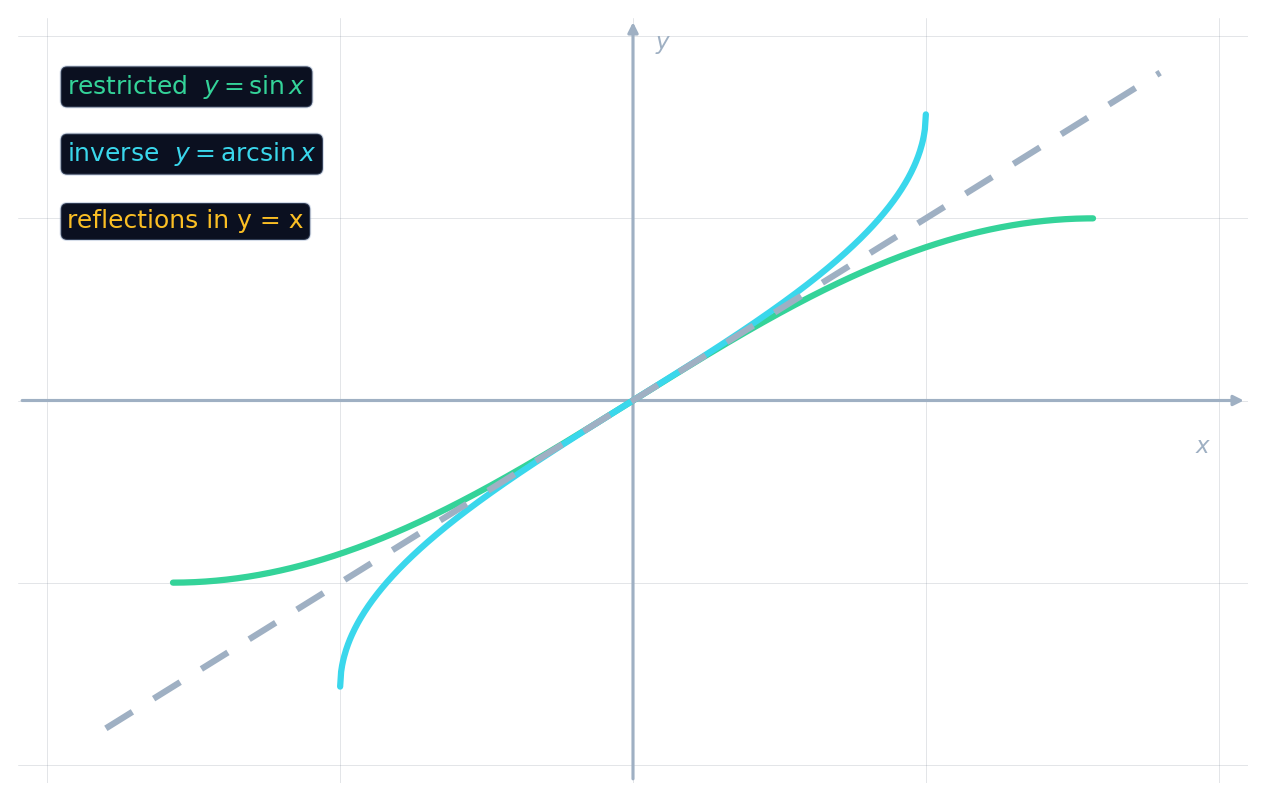
- Because they are inverses, the graphs reflect the restricted trig graphs across $y = x$.
- $\arcsin$ has domain $[-1, 1]$ (all valid sine 正弦 values) and range $[-\tfrac{\pi}{2}, \tfrac{\pi}{2}]$.
- $\arccos$ has the same domain but range $[0, \pi]$.
- Their inputs are ratios; their outputs are angles.
Le graphe d'une fonction trig inverse est le graphe trig restreint reflété à travers $y = x$.
Difficulté 1/5 · 100 pièces + un petit bonus lors de la première réussite aujourd'hui
Comme avec toute fonction inverse, inverser l'entrée et la sortie miroite le graphe à travers la ligne $y = x$.
Reading a value
- To find $\arccos(0)$, ask "which angle in $[0,\pi]$ has cosine $0$?" — the answer is $\tfrac{\pi}{2}$.
- The inverse returns the one angle inside the restricted range, called the principal value.
- Other angles may also work, but the inverse function reports just one.
- Add full turns or use symmetry if you need the rest.
The inverse gives only the principal angle, not every solution. $\arcsin(0.5) = 30°$, but $150°$ also has sine $0.5$. When solving an equation you must find all the angles yourself — the inverse hands you just one.
A ramp rises $3$ m over a slope length of $6$ m. What angle does it make?
- The sine of the angle is $\tfrac{\text{rise}}{\text{slope}} = \tfrac{3}{6} = 0.5$.
- So the angle is $\arcsin(0.5) = 30°$.
- The inverse turned the measured ratio back into the angle we wanted.
An inverse trig function returns an angle from a ratio: $\arcsin$, $\arccos$, $\arctan$. Since trig functions are not one-to-one, we restrict their domain first. The inverse graphs reflect the restricted sine/cosine/tangent across $y = x$, and report just the principal angle.
Write from the data given
- Find arctangent of 1.
- The result is an angle, not a ratio.
Quelle est la valeur de l'arc tangente de 1, dans l'intervalle standard ?
L'angle principal dont la tangente est 1 est pi sur 4.
Quel angle retourne l'arc tangente de 1 ?
Difficulté 1/5 · 100 pièces + un petit bonus lors de la première réussite aujourd'hui
L'arc tangente annule la tangente sur son domaine restreint. Les autres options — 1 (le rapport laissé comme un angle) ; pi sur 2 (l'angle droit).