Equivalent Representations of Expressions
Introduit| English | Sens |
|---|---|
| equivalent form/ɪˈkwɪvələnt fɔːm/ | forme équivalente |
| factoring/ˈfæktərɪŋ/ | factorisation |
| zeros/ˈzɪərəʊz/ | zéros |
| polynomial long division/ˌpɒlɪˈnəʊmɪəl lɒŋ dɪˈvɪʒn/ | division euclidienne de polynômes |
| binomial theorem/baɪˈnəʊmɪəl ˈθɪərəm/ | théorème du binôme |
Same function, many disguises
- The rule $y = (x+1)(x-3)$ and the rule $y = x^2 - 2x - 3$ look different.
- Yet they draw the exact same parabola — they are the same function.
- One expression can be written in several equal-looking-but-equivalent ways.
- The skill is choosing the disguise that shows the feature you want.
Factored and expanded forms
- An equivalent form 等价形式 is a rewrite that gives the same output for every input.
- Factoring 因式分解 turns $x^2 - 2x - 3$ into $(x+1)(x-3)$; expanding does the reverse.
- The factored form shows the zeros 零点 at once: set each factor to zero → $x = -1, 3$.
- The expanded form shows the leading term, and so the end behavior.
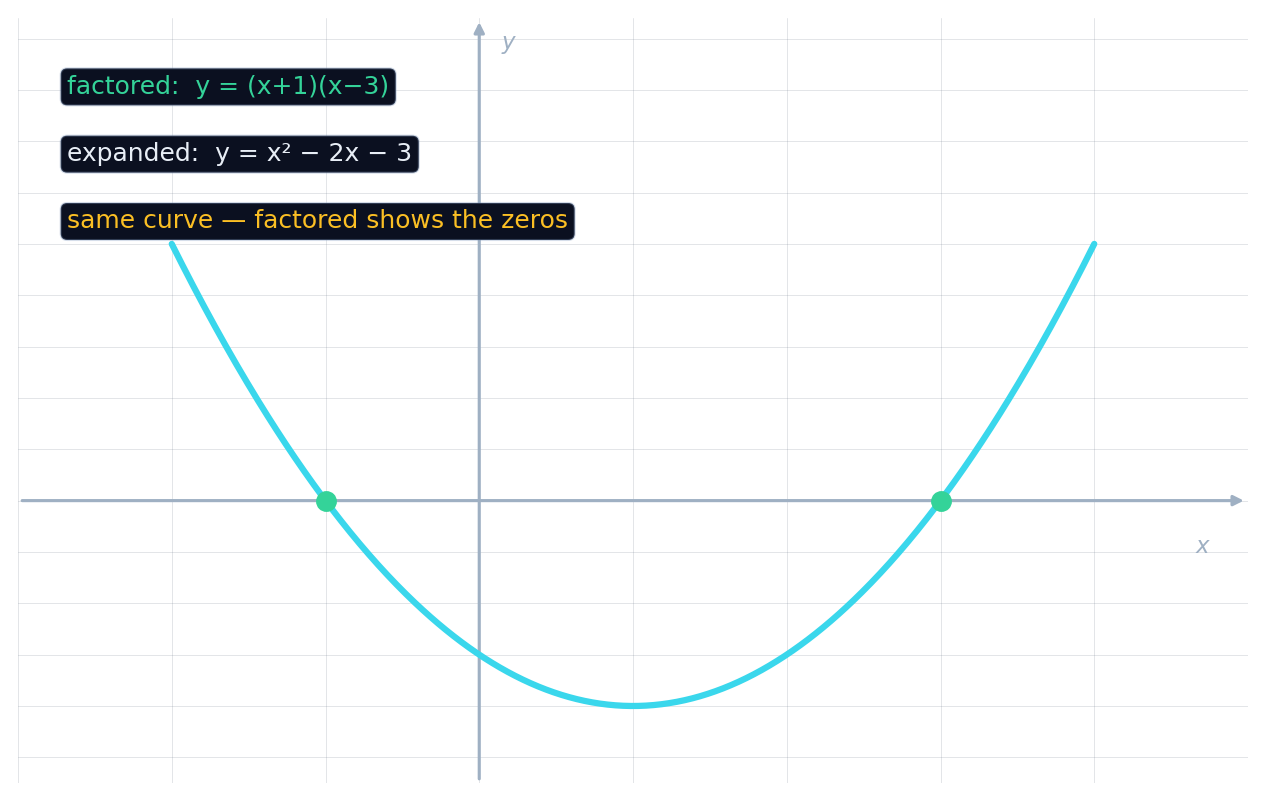
One parabola, written two ways
y = (x+1)(x−3) = x² − 2x − 3
This curve is y = (x+1)(x−3) and also y = x² − 2x − 3. The factored form shows the zeros −1 and 3; the expanded form shows the leading term.
Pick the form that reveals the feature
- Want the zeros or x-intercepts? Use the factored form.
- Want the y-intercept? Any form works — just evaluate at $x = 0$.
- Want the end behavior? Expand and read the leading term.
- Choosing wisely saves work; the answer is the same either way.
Which form of a polynomial most quickly reveals its zéros?
Difficulté 1/5 · 100 pièces + un petit bonus lors de la première réussite aujourd'hui
In factored form $(x-a)(x-b)$, the zeros $a$ et $b$ are read off instantly by setting each factor to zero.
Which form most quickly reveals the end behavior?
Difficulté 1/5 · 100 pièces + un petit bonus lors de la première réussite aujourd'hui
The expanded form shows the leading term directly, and the leading term controls end behavior.
Long division for rational expressions
- Polynomial long division 多项式长除法 rewrites $\frac{\text{top}}{\text{bottom}}$ as a quotient plus a remainder over the bottom.
- That form exposes the horizontal or slant asymptote directly — it is the quotient.
- It is the rational-function version of turning $\frac{7}{2}$ into $3 + \frac{1}{2}$.
- Divide when you need the asymptotic behavior of a fraction.
Polynomial long division rewrites a rational expression as a quotient plus a ____ over the denominator.
Difficulté 1/5 · 100 pièces + un petit bonus lors de la première réussite aujourd'hui
$\frac{\text{top}}{\text{bottom}} = \text{quotient} + \frac{\text{remainder}}{\text{bottom}}$ — the form that reveals asymptotic behavior.
Binomial theorem for powers
- Expanding $(a+b)^n$ by hand gets slow as $n$ grows.
- The binomial theorem 二项式定理 gives every term of the expansion using a fixed pattern of coefficients.
- For example $(a+b)^3 = a^3 + 3a^2b + 3ab^2 + b^3$.
- It is the quick route from a compact power to its expanded form.
Le binomial theorem helps you expand expressions of the form…
Difficulté 1/5 · 100 pièces + un petit bonus lors de la première réussite aujourd'hui
The binomial theorem gives the expanded terms of $(a+b)^n$ without multiplying it out by hand.
Select tout true statements about choosing a form.
Difficulté 2/5 · 140 pièces + un petit bonus lors de la première réussite aujourd'hui
Equivalent forms never change the output — they only make different features easy to see.
Two forms are equivalent only on their common domain. Cancelling $\frac{(x-1)(x+2)}{x-1}$ to $x+2$ changes the domain — the forms match everywhere except the hole. Equivalent means "same output where both are defined", not "identical everywhere".
Two equivalent forms give the same output for every input in their common domain.
Difficulté 1/5 · 100 pièces + un petit bonus lors de la première réussite aujourd'hui
That is what "equivalent" means — identical values everywhere both are defined. Watch for domain gaps a cancellation may hide.
Rewrite $x^2 - 5x + 6$ to find its zeros.
- Factor: $x^2 - 5x + 6 = (x-2)(x-3)$.
- Set each factor to zero: $x = 2$ and $x = 3$.
- The expanded form hid these; the factored form hands them over instantly.
An equivalent form rewrites an expression without changing its output. Factoring exposes the zeros; expanding exposes the leading term; polynomial long division exposes an asymptote; the binomial theorem expands $(a+b)^n$. Pick the form that reveals what you need.
Write from the data: find the value
- (x squared minus 9) divided by (x minus 3) equals x plus 3, except at x equals 3.
- Evaluate the equivalent form at x equals 5.
For x not equal to 3, (x squared minus 9) divided by (x minus 3) equals x plus 3. What is the value at x equals 5?
5 plus 3 is 8.
What is the value at x equals 5?
Difficulté 1/5 · 100 pièces + un petit bonus lors de la première réussite aujourd'hui
The equivalent form x plus 3 gives 8. Other options — 5 (the input); 3 (the excluded input).