Newton's Third Law
Introduit| English | Sens |
|---|---|
| Newton's third law/ˈnjuːtnz θɜːd lɔː/ | troisième loi de Newton |
| action-reaction pair/ˈækʃn rɪˈækʃn peə/ | paire action-réaction |
| cancel/ˈkænsl/ | s'annuler |
You cannot push without being pushed back
- Push hard on a wall and your hand feels the wall pushing back — just as hard.
- Fire a rifle and it kicks your shoulder; a rocket throws gas down and is thrown up.
- Forces never come alone — they come in pairs.
- This simple idea powers walking, swimming, and every rocket ever launched.
Newton's third law
- Newton's third law 牛顿第三定律: if object A pushes on object B, then B pushes on A.
- The two forces are equal in magnitude and opposite in direction.
- Together they make an action-reaction pair 作用反作用对.
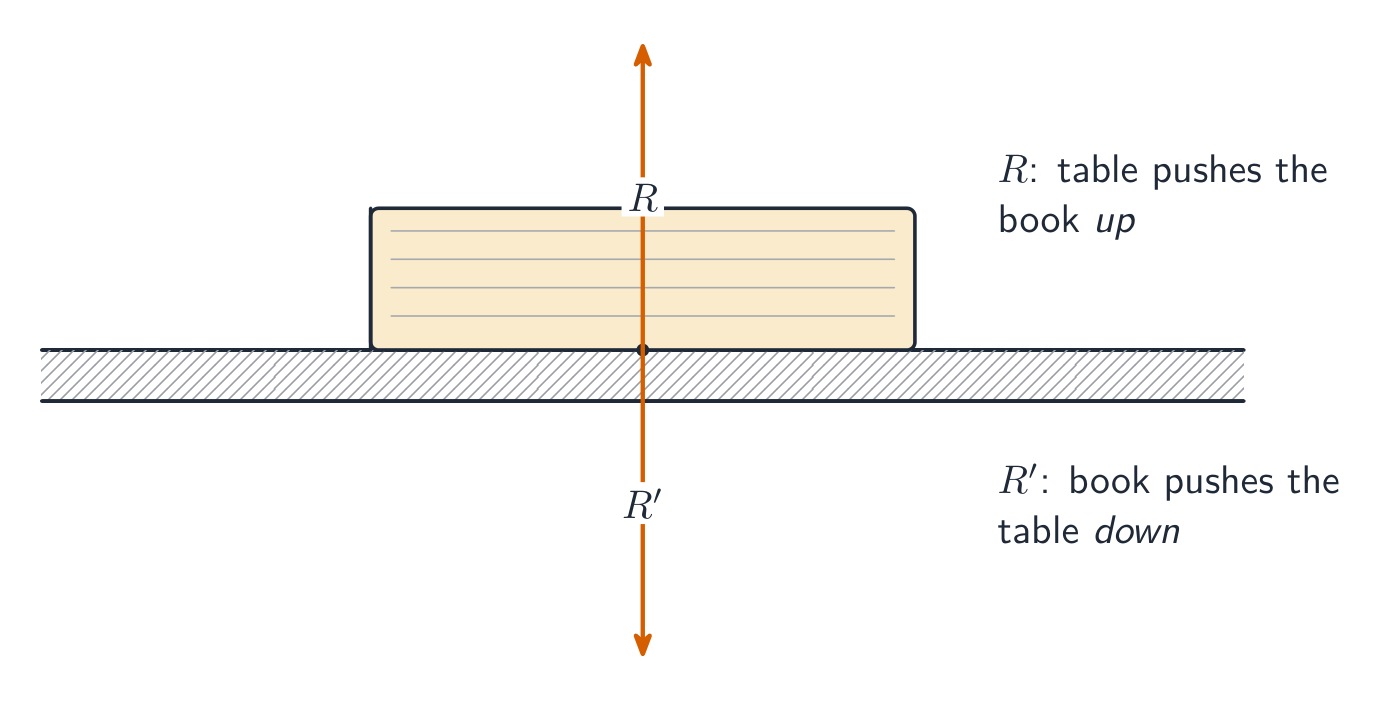
A Newton's third-law pair: equal and opposite forces on two different objects
A truck ($3000\ \text{kg}$) hits a car ($1000\ \text{kg}$). During the crash, the force the truck exerts on the car compared with the force the car exerts on the truck is...
Difficulté 1/5 · 100 pièces + un petit bonus lors de la première réussite aujourd'hui
Third-law forces are always equal and opposite, regardless of mass. (The car accelerates more because it has less mass, not more force.)
The pair acts on different objects
- The two forces of a pair act on different bodies — one on A, one on B.
- So they can never cancel 抵消 on one object; they do cancel in the net internal force of the combined system.
- Balanced forces on a single object must both act on that object.
The two forces of an action-reaction pair cancel on the free-body diagram of one object.
Difficulté 1/5 · 100 pièces + un petit bonus lors de la première réussite aujourd'hui
False: the pair acts on different objects, so only one member belongs on each free-body diagram. Both cancel when summing internal forces of the combined system.
The two forces of a third-law pair always act on ____ objects.
Difficulté 1/5 · 100 pièces + un petit bonus lors de la première réussite aujourd'hui
One force acts on A and the other on B. They do not cancel on either object, but cancel in the internal-force sum for A and B together.
It is how we move
- Walk forward: your foot pushes back on the ground, and the ground pushes you forward.
- Swim: you push water back, the water pushes you ahead.
- A rocket: engines hurl gas down, the gas hurls the rocket up.
Third-law pairs
Newton's third law pairs act on different objects. Sort each statement.
When you walk forward, what actually pushes you forward?
Difficulté 1/5 · 100 pièces + un petit bonus lors de la première réussite aujourd'hui
You push the ground backward; by the third law the ground pushes you forward -- that reaction is what moves you.
A rocket in empty space can still accelerate, with nothing to push against.
Difficulté 1/5 · 100 pièces + un petit bonus lors de la première réussite aujourd'hui
It pushes its own exhaust gas backward; by the third law the gas pushes the rocket forward -- no outside surface needed.
Not the same as balanced forces
- A book on a table has gravity down and the normal force up — these balance on one object.
- That is not a third-law pair (both act on the book).
- The book's third-law partner to gravity is the book pulling Earth up.
Select tout genuine action-reaction (third-law) pairs.
Difficulté 2/5 · 140 pièces + un petit bonus lors de la première réussite aujourd'hui
The first two are pairs on different objects. The third is two forces on the même book -- balanced forces, not a third-law pair.
You push a wall with $50\ \text{N}$.
- By the third law, the wall pushes your hand with exactly $50\ \text{N}$ the other way.
- One force acts on the wall, the other on your hand — different objects, so they do not cancel.
If a horse pulls a cart and the cart pulls back equally, why does the cart move? Because those two forces act on different objects. The cart accelerates from the forces on the cart alone (the horse's pull minus friction) — the reaction pull acts on the horse.
Newton's third law: forces come in equal-and-opposite pairs, an action-reaction pair. The two act on different objects, so they never cancel on either object alone; their internal-force sum for the combined system is zero. This is different from two balanced forces on a single object — that is why a horse-and-cart still accelerates.
Write from a 40 N pair
- A 50 kg student pushes a 200 kg cart with 40 N.
- State the force the cart exerts on the student.
A 50 kg student pushes a 200 kg cart with a force of 40 N. What force does the cart exert on the student during the push?
Action and reaction are equal. The accelerations differ because the masses differ.
A 50 kg student pushes a 200 kg cart with 40 N. What force does the cart exert on the student?
Difficulté 1/5 · 100 pièces + un petit bonus lors de la première réussite aujourd'hui
The pair is 40 N each way. Mass changes the acceleration, not the partner force.