Newton's First Law
Introduit| English | Sens |
|---|---|
| Newton's first law/ˈnjuːtnz fɜːst lɔː/ | première loi de Newton |
| net force/net fɔːs/ | force nette |
| inertia/ɪˈnɜːʃə/ | inertie |
| translational equilibrium/trænˈsleɪʃənl ˌiːkwɪˈlɪbrɪəm/ | équilibre de translation |
| inertial reference frame/ɪˈnɜːʃl ˈrefrəns freɪm/ | référentiel inertiel |
A puck that never stops
- Slide a hockey puck across smooth ice and it glides on and on, barely slowing.
- Make the ice perfectly frictionless and it would glide forever.
- Nothing keeps it going — it just refuses to stop on its own.
- That refusal is one of the deepest ideas in physics.
Newton's first law
- Newton's first law 牛顿第一定律: an object keeps constant velocity unless a net force acts on it.
- At rest? It stays at rest. Moving? It keeps the same speed and direction.
- "No net force" does not mean "no motion" — it means "no change in motion."
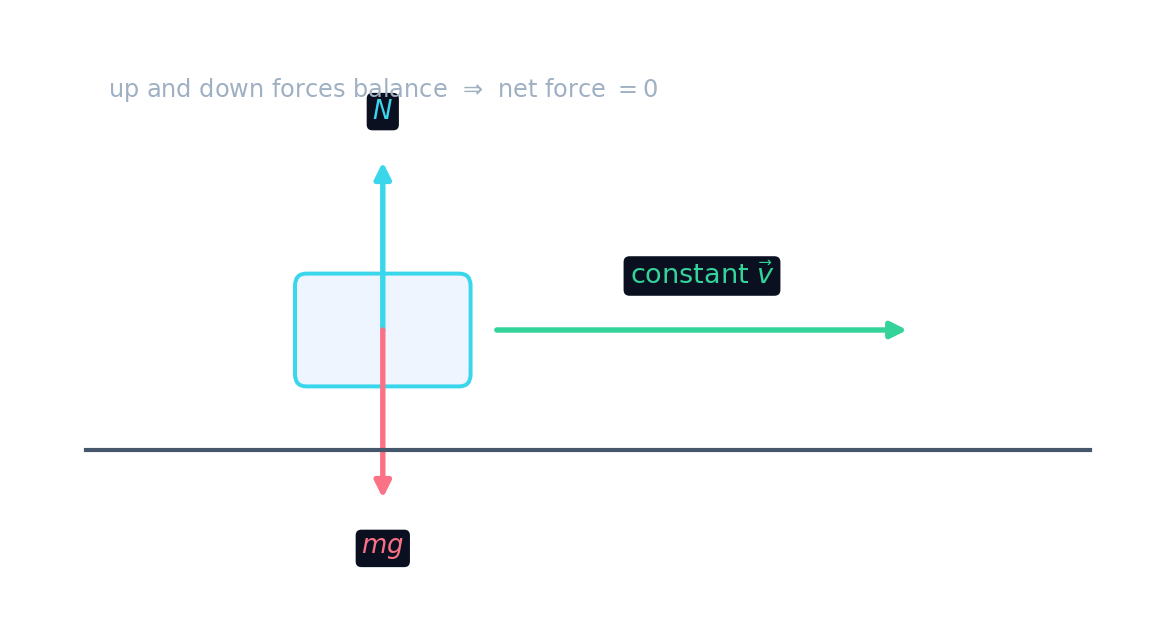
Balanced forces: zero net force, so the velocity stays constant
An object moving at constant velocity must have a nonzero net force pushing it.
Difficulté 1/5 · 100 pièces + un petit bonus lors de la première réussite aujourd'hui
Constant velocity means zero net force. A force is needed only to changement velocity, not to maintain it.
Inertia
- The property that makes objects resist changes in motion is inertia 惯性.
- More mass means more inertia — a loaded truck is far harder to start or stop than a bike.
- Inertia is why the first law holds.
Which object has the most inertia?
Difficulté 1/5 · 100 pièces + un petit bonus lors de la première réussite aujourd'hui
Inertia is measured by mass -- the $2000\ \text{kg}$ car resists changes in motion the most.
Translational equilibrium
- When the net force 合力 is zero, an object is in translational equilibrium 平动平衡.
- That covers both an object at rest and one moving at constant velocity.
- To solve these problems, set $\sum F_x = 0$ and $\sum F_y = 0$.
Balanced or unbalanced?
By Newton's first law, decide whether the forces on each object are balanced.
An object with zero net force is said to be in translational ____.
Difficulté 1/5 · 100 pièces + un petit bonus lors de la première réussite aujourd'hui
Zero net force → translational equilibrium, which covers rest et constant velocity.
Select tout situations in translational equilibrium (zero net force).
Difficulté 2/5 · 140 pièces + un petit bonus lors de la première réussite aujourd'hui
Rest and constant velocity both mean zero net force. A falling ball accelerates, so its net force is not zero.
A crate sits still while pulled right with $40\ \text{N}$ and left with $40\ \text{N}$. What is the net horizontal force (in N)?
Difficulté 2/5 · 140 pièces + un petit bonus lors de la première réussite aujourd'hui
$40 - 40 = 0\ \text{N}$ -- balanced forces, so it stays in equilibrium (at rest).
Inertial reference frames
- The first law only holds in an inertial reference frame 惯性参考系 — one that is not accelerating.
- In a braking bus you lurch forward with no force pushing you — because the bus is a non-inertial frame.
- Physics is written from the point of view of inertial frames.
When a bus brakes hard and you lurch forward, a force pushed you forward.
Difficulté 1/5 · 100 pièces + un petit bonus lors de la première réussite aujourd'hui
No forward force acts -- your body's inertia keeps it moving while the bus (a non-inertial frame) slows beneath you.
A lamp hangs still from two angled cords.
- It is in translational equilibrium, so the net force is zero.
- The cords' horizontal pulls cancel, and their vertical pulls together hold up the weight — two equations, $\sum F_x = 0$ and $\sum F_y = 0$, solve for the tensions.
Constant velocity does not require a forward force. A car cruising at a steady $100\ \text{km/h}$ has zero net force — its engine thrust exactly balances air drag and friction. Force is needed only to change velocity, not to maintain it.
Newton's first law: velocity stays constant unless a net force acts — objects resist change through their inertia. Zero net force means translational equilibrium (at rest or constant velocity), solved with $\sum F_x = 0$, $\sum F_y = 0$. It holds only in a non-accelerating inertial reference frame.
Write from the data: find the net force
- A 3 kg puck slides at a steady 6 m/s on frictionless ice.
- Find the net force.
A 3 kg puck moves at a constant 6 m/s on frictionless ice. What is the net force on it?
Zero acceleration means zero net force.
A 3 kg puck moves in a straight line at a constant 6 m/s on frictionless ice. What is the net force on it?
Difficulté 1/5 · 100 pièces + un petit bonus lors de la première réussite aujourd'hui
Constant velocity needs no net force.