Electromagnetic Induction
Introduit| English | Sens |
|---|---|
| electromagnetic induction/ɪˌlektrəʊməɡˈnetɪk ɪnˈdʌkʃn/ | induction électromagnétique |
| Faraday's law/ˈfærədeɪz lɔː/ | loi de Faraday |
| motional EMF/ˈməʊʃənl emf/ | motional EMF |
Move a magnet near a coil and convert motion into electricity
- Push a magnet into a closed conducting coil and a current appears with no battery; your mechanical work supplies the energy.
- Pull it out and the current reverses.
- A changing magnetic flux drives the current: electromagnetic induction 电磁感应.
- This single effect powers almost every generator on Earth.
Faraday's law
- The induced EMF equals how fast the flux changes: $\varepsilon = -N\dfrac{d\Phi_B}{dt}$.
- $N$ is the number of turns; the faster $\Phi_B$ changes, the bigger the EMF.
- A steady flux ($d\Phi_B/dt = 0$) induces nothing.
- This is Faraday's law 法拉第定律 — the heart of the unit.
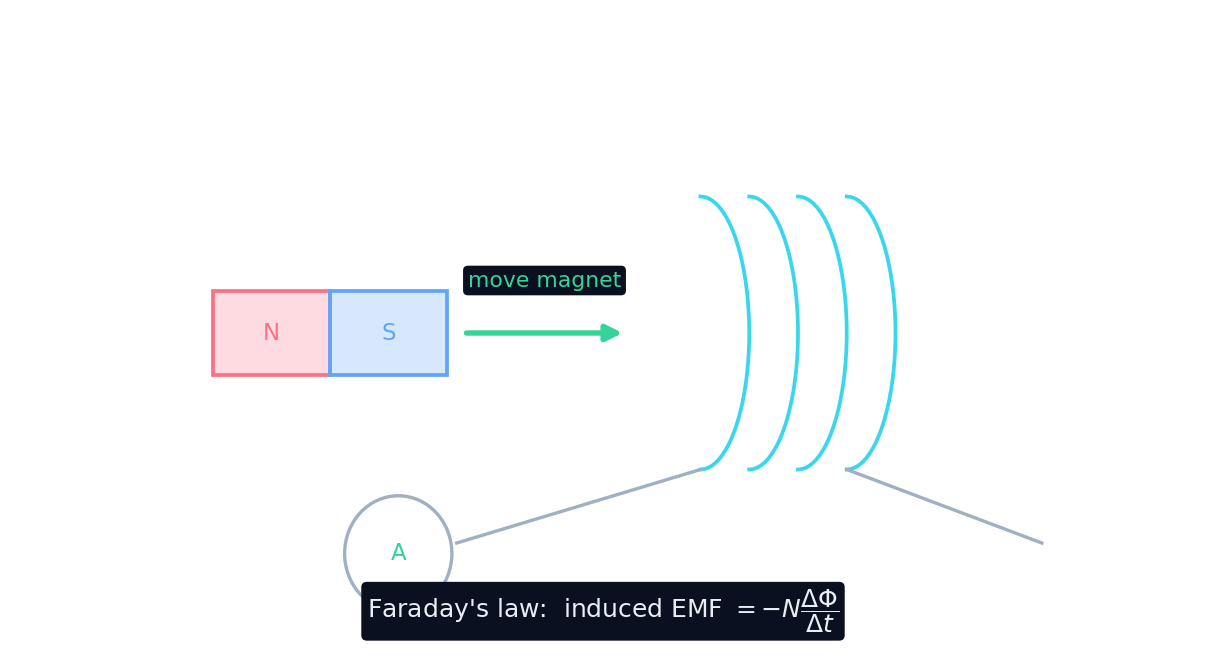
Induce a current
Move the magnet faster or slower and watch the induced current grow and reverse.
Faraday's law says the induced EMF depends on:
Difficulté 1/5 · 100 pièces + un petit bonus lors de la première réussite aujourd'hui
$\varepsilon = -N\,d\Phi_B/dt$ — the rate of change of flux.
A stationary rigid coil in a very strong but steady magnetic field has a large induced EMF.
Difficulté 1/5 · 100 pièces + un petit bonus lors de la première réussite aujourd'hui
A stationary rigid coil in a steady field has constant flux, so the induced EMF is zero regardless of field strength. Moving or rotating it can change flux even if the field stays steady.
A single loop's flux changes by $0.6\ \text{Wb}$ in $0.3\ \text{s}$. Find the magnitude of the average EMF (in V).
Difficulté 2/5 · 140 pièces + un petit bonus lors de la première réussite aujourd'hui
$\varepsilon = \Delta\Phi_B/\Delta t = 0.6/0.3 = 2\ \text{V}$.
What makes a bigger EMF
- More turns $N$ in the coil — each loop adds its own EMF.
- A stronger magnet — more flux to change.
- A faster motion — a quicker change of flux.
- Slow, weak, or few-turn setups give only a tiny EMF.
Select tout the ways to get a bigger induced EMF.
Difficulté 2/5 · 140 pièces + un petit bonus lors de la première réussite aujourd'hui
More turns, faster motion, stronger field all raise the EMF. Holding still gives zero.
Many ways to change the flux
- Move a magnet toward or away from the coil.
- Move the coil through a field.
- Rotate the coil in the field (this makes AC generators work).
- Change a nearby current, whose field threads the coil.
Which of these does non induce an EMF in a coil?
Difficulté 1/5 · 100 pièces + un petit bonus lors de la première réussite aujourd'hui
A steady field with no motion gives no flux change — no EMF.
This is how generators work
- Spin a coil in a magnetic field and its flux changes continuously.
- That induces an alternating EMF — the mains electricity in your home.
- Wind, water and steam turbines drive relative rotation between magnetic fields and coils; many generators rotate the magnet while the coils stay fixed.
- Induction turns motion into electrical energy.
A device that spins a coil in a field to make electricity is a ____.
Difficulté 1/5 · 100 pièces + un petit bonus lors de la première réussite aujourd'hui
A generator uses induction to turn motion into electricity.
A single loop's flux changes by $0.4\ \text{Wb}$ in $0.2\ \text{s}$. Find the average EMF.
- $\varepsilon = \dfrac{\Delta\Phi_B}{\Delta t} = \dfrac{0.4}{0.2}$.
- $\varepsilon = 2\ \text{V}$ (magnitude).
Worked example: a rod sliding on rails
- A rod of length $L$ moves at speed $v$ along rails in a uniform field $B$ perpendicular to the circuit. The area grows at $Lv$, so $\varepsilon=\dfrac{d\Phi_B}{dt}=BLv$ (motional EMF 动生电动势).
- The current $I=\dfrac{BLv}{R}$ feels a force $F=BIL=\dfrac{B^2L^2v}{R}$ that opposes the motion (Lenz's law): magnetic braking.
$B=0.50\ \text{T}$, $L=0.40\ \text{m}$, $R=2.0\ \Omega$, $v=3.0\ \text{m/s}$.
- $\varepsilon=BLv=0.60\ \text{V}$ and $I=\varepsilon/R=0.30\ \text{A}$.
- Braking force $F=BIL=0.060\ \text{N}$. Power to keep it moving: $Fv=0.18\ \text{W}=I^2R$ ✓ (energy is conserved).
- Falling rod (FRQ style). If the rod falls under gravity instead, it speeds up until $mg=\dfrac{B^2L^2v_t}{R}$, so the terminal speed is $v_t=\dfrac{mgR}{B^2L^2}$.
A 0.25 m rod slides at 4.0 m/s on rails in a 0.80 T field. The circuit resistance is 0.50 Ω. Find the induced current.
Difficulté 2/5 · 140 pièces + un petit bonus lors de la première réussite aujourd'hui
ε = BLv = 0.80 × 0.25 × 4.0 = 0.80 V, so I = 0.80/0.50 = 1.6 A.
A rod of mass 0.020 kg and length 0.20 m falls along vertical rails in a 0.50 T horizontal field; the circuit resistance is 1.0 Ω. Find its terminal speed. Use g = 9.8 m/s².
Difficulté 2/5 · 140 pièces + un petit bonus lors de la première réussite aujourd'hui
v_t = mgR/(B²L²) = (0.020 × 9.8 × 1.0)/(0.25 × 0.04) = 0.196/0.010 = 19.6 m/s.
It is the rate of change of flux that matters, not the flux itself. A coil sitting in a huge but steady field has a large flux and yet zero induced EMF. No change, no EMF.
Electromagnetic induction: a changing magnetic flux drives an EMF, given by Faraday's law $\varepsilon = -N\,d\Phi_B/dt$. A bigger EMF comes from more turns, a stronger field, or faster change. A steady flux induces nothing — this is how generators make electricity.
Write from the data: find the induced EMF
- A coil has 20 turns; the flux through each turn changes by 0.30 weber in 0.50 seconds.
- Find the average EMF magnitude. Say what a steady flux induces.
A 20-turn coil has a flux change of 0.30 weber through each turn in 0.50 seconds. What is the average induced EMF magnitude, and what EMF does constant flux induce?
20 times 0.30 divided by 0.50 is 12 volts. Faraday's law needs a changing flux.
A coil has 20 turns. The flux through each turn changes by 0.30 weber in 0.50 seconds. What is the magnitude of the average induced EMF?
Difficulté 1/5 · 100 pièces + un petit bonus lors de la première réussite aujourd'hui
20 times 0.30 divided by 0.50 is 12 volts. Induction needs a changing flux.