Kirchhoff's Loop Rule
Introduit| English | Sens |
|---|---|
| Kirchhoff's loop rule/ˈkɜːkhɒfs luːp ruːl/ | loi des mailles de Kirchhoff |
Walk a full loop and you return to the same energy
- Follow one charge all the way around a circuit loop.
- It gains energy at the battery and loses it at each resistor.
- Back at the start, its energy is exactly what it began with.
- That simple bookkeeping is the loop rule — a tool for any circuit.
The loop rule: voltages sum to zero
- For a lumped circuit with no unaccounted changing magnetic flux through the loop, voltage changes add to zero: $\sum V = 0$.
- Every rise (battery) is matched by the drops (resistors).
- For a single loop: $\varepsilon - IR_1 - IR_2 = 0$.
- It is really energy conservation, counted per unit charge.
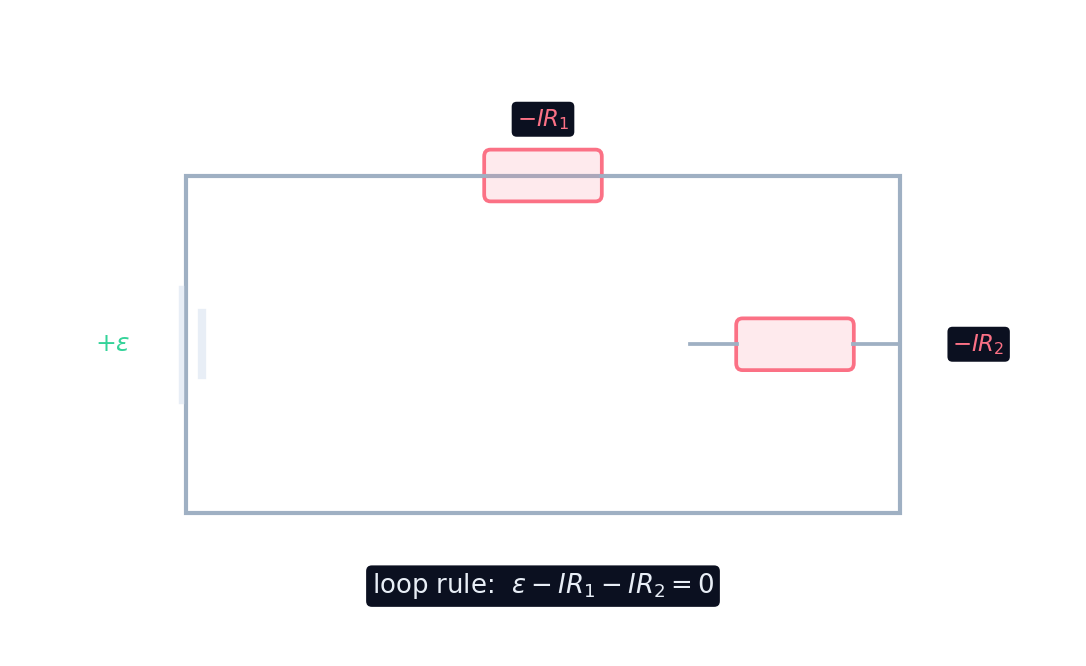
Kirchhoff's loop rule states that around any closed loop:
Difficulté 1/5 · 100 pièces + un petit bonus lors de la première réussite aujourd'hui
$\sum V = 0$ around a loop — energy conservation per charge.
A $12\ \text{V}$ battery drives current through a $2\ \Omega$ and a $2\ \Omega$ resistor in series. Find $I$ (in A).
Difficulté 2/5 · 140 pièces + un petit bonus lors de la première réussite aujourd'hui
$12 - I(2) - I(2) = 0 \Rightarrow 12 = 4I \Rightarrow I = 3\ \text{A}$.
Getting the signs right
- Going through a battery from $-$ to $+$ is a rise ($+\varepsilon$).
- Crossing a resistor with the current is a drop ($-IR$).
- Cross it against the current and it counts as a rise ($+IR$).
- Pick a direction, walk the loop, and keep the signs consistent.
Crossing a resistor in the direction of the current is a voltage drop ($-IR$).
Difficulté 1/5 · 100 pièces + un petit bonus lors de la première réussite aujourd'hui
With the current, a resistor drops the potential by $IR$.
Select tout true statements about the loop rule.
Difficulté 2/5 · 140 pièces + un petit bonus lors de la première réussite aujourd'hui
Loop rule: ΣV = 0, energy conservation, consistent signs. Currents-sum-to-zero is the junction rule.
Why it must be true
- A charge returning to its start is at the same potential.
- So the total potential change around the loop is zero.
- Energy given by the source equals energy taken by the components.
- No loop can create or destroy energy for the charge.
Kirchhoff's loop rule
Around any closed loop the voltage rises equal the voltage drops. Sort each crossing.
The loop rule is a statement of the conservation of:
Difficulté 1/5 · 100 pièces + un petit bonus lors de la première réussite aujourd'hui
A charge returns to the same potential — energy is conserved.
Using it to solve circuits
- Write one loop equation for each independent loop.
- Combine with the junction rule to get enough equations.
- Solve them together for the unknown currents.
- Complex networks fall to a handful of linear equations.
The loop rule is combined with the ____ rule to solve multi-loop circuits.
Difficulté 1/5 · 100 pièces + un petit bonus lors de la première réussite aujourd'hui
The junction rule provides the extra current equations.
A $9\ \text{V}$ battery drives one current through a $2\ \Omega$ and a $1\ \Omega$ resistor in series.
- Loop rule: $9 - I(2) - I(1) = 0$.
- So $9 = 3I$, giving $I = 3\ \text{A}$.
Worked example: two batteries, three branches
Three branches join at a top junction and a bottom junction. Left: a $12$ V battery (positive end up) with $2\ \Omega$. Middle: $6\ \Omega$. Right: a $6$ V battery (positive end up) with $3\ \Omega$.
- Guess directions: $I_1$ up the left branch, $I_2$ up the right branch, $I_3$ down the middle. Junction rule: $I_3=I_1+I_2$.
- Left loop: $12-2I_1-6I_3=0$. Right loop: $6-3I_2-6I_3=0$.
- Substituting for $I_3$ gives $8I_1+6I_2=12$ and $6I_1+9I_2=6$. Solving gives $I_1=2$ A and $I_2=-\tfrac23$ A, so $I_3=\tfrac43$ A.
- The minus sign is not an error: $I_2$ really flows down through the 6 V battery. That battery is being charged.
In the two-battery example, find the voltage across the 6 Ω middle resistor.
Difficulté 2/5 · 140 pièces + un petit bonus lors de la première réussite aujourd'hui
V = I₃R = (4/3)(6) = 8.0 V. Check with the left branch: 12 − 2(2) = 8 V ✓
You solve a circuit and get a current of −0.5 A in one branch. What should you do?
Difficulté 1/5 · 100 pièces + un petit bonus lors de la première réussite aujourd'hui
The guessed direction is only a reference. A negative answer means the real current flows the other way; the size is still right.
Keep your sign convention consistent. Decide a loop direction first, then a resistor crossed with the current is $-IR$ and against it is $+IR$. Flipping signs midway is the usual source of wrong answers.
Kirchhoff's loop rule 基尔霍夫回路定则 says the voltage changes around any closed loop sum to zero: $\sum V = 0$. It is energy conservation per charge — a battery rise balances the resistor drops. Track signs carefully and pair it with the junction rule.
Write from the data: find the loop current
- A 12 volt battery is in series with a 5 ohm resistor and a 1 ohm resistor.
- Find the current and the voltage drop on the 5 ohm resistor.
A 12 volt battery drives one series loop through a 5 ohm resistor and a 1 ohm resistor. What is the current, and what is the drop on the 5 ohm resistor?
The resistors add to 6 ohms. 12 volts divided by 6 ohms is 2 amperes, and 2 times 5 is 10 volts.
An ideal 12 volt battery drives a series loop with 5 ohm and 1 ohm resistors and ideal wires. What is the current and the voltage drop on the 5 ohm resistor?
Difficulté 1/5 · 100 pièces + un petit bonus lors de la première réussite aujourd'hui
12 divided by 6 is 2 amperes, and the 5 ohm drop is 10 volts.