Kirchhoff's Junction Rule
Introduit| English | Sens |
|---|---|
| junction/ˈdʒʌŋkʃn/ | nœud |
| Kirchhoff's junction rule/ˈkɜːkhɒfs ˈdʒʌŋkʃn ruːl/ | loi des nœuds de Kirchhoff |
At a fork in the wire, where does the current go?
- Wires often split: one path becomes two or three.
- The current can't pile up or vanish at the split.
- Whatever flows in must flow out — that is the junction rule.
- It is the partner of the loop rule for solving networks.
The junction rule: current in = current out
- At any junction 节点 (a meeting of wires), $\sum I_{\text{in}} = \sum I_{\text{out}}$.
- In the ideal junction model, no net charge accumulates: charge conservation then gives equal inflow and outflow.
- If $I_1$ enters and $I_2, I_3$ leave: $I_1 = I_2 + I_3$.
- The branches share the incoming current between them.
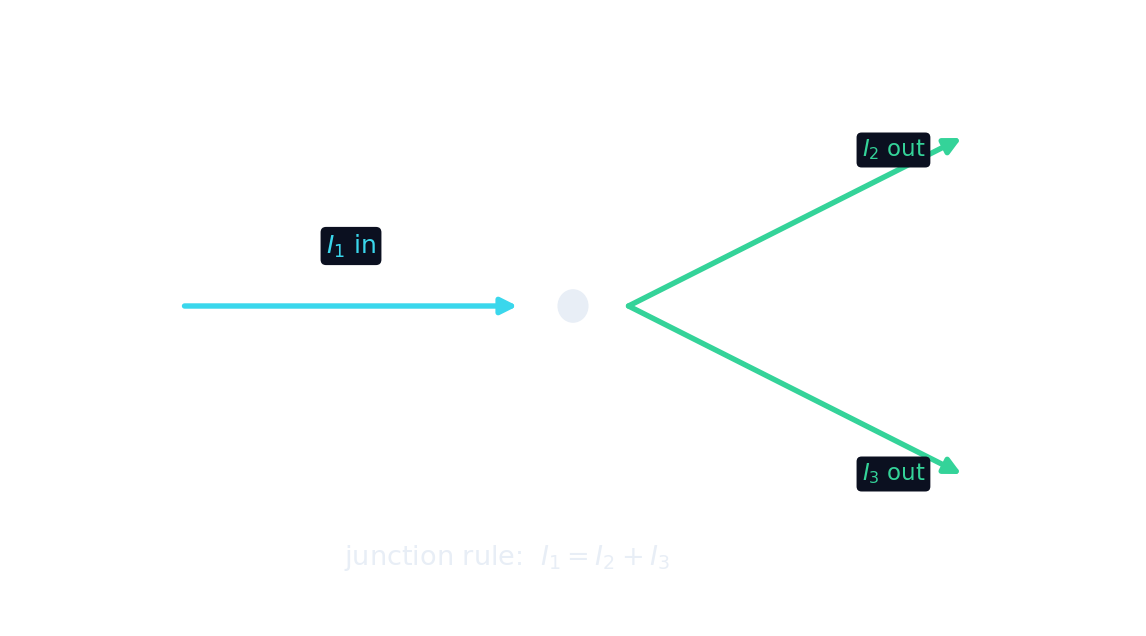
Split the current
Wire two parallel branches and see the current divide between them at the junction.
Kirchhoff's junction rule states that at a junction:
Difficulté 1/5 · 100 pièces + un petit bonus lors de la première réussite aujourd'hui
$\sum I_{\text{in}} = \sum I_{\text{out}}$ — charge is conserved.
$7\ \text{A}$ enters a junction with two outgoing branches and no net charge accumulation. One outgoing branch carries $4\ \text{A}$. Find the other outgoing current (in A).
Difficulté 2/5 · 140 pièces + un petit bonus lors de la première réussite aujourd'hui
$7 = 4 + I_2 \Rightarrow I_2 = 3\ \text{A}$.
A point where wires meet and current can split is called a ____.
Difficulté 1/5 · 100 pièces + un petit bonus lors de la première réussite aujourd'hui
That meeting point is a junction (or node).
Why: charge can't accumulate
- A real junction can carry surface charge; the ideal circuit model assumes its net charge does not change.
- In general, $\sum I_{\text{in}}-\sum I_{\text{out}}=dQ/dt$; for no net accumulation, $dQ/dt=0$.
- This is the conservation of charge applied to a point.
- During real charging transients, unequal inflow and outflow can briefly change stored charge; the more general balance still holds.
The junction rule expresses the conservation of:
Difficulté 1/5 · 100 pièces + un petit bonus lors de la première réussite aujourd'hui
Charge is conserved. With no net accumulation at the junction, total inflow equals total outflow.
Lower-resistance parallel branches carry more current
- At equal voltage, the branch with less resistance carries more current.
- Current splits in inverse proportion to the branch resistances.
- The easiest path takes the biggest share.
- Add up all the branch currents and you recover the total.
At a split, the branch with more resistance carries more current.
Difficulté 1/5 · 100 pièces + un petit bonus lors de la première réussite aujourd'hui
False. Parallel branches share the same voltage, so by $I = V/R$ the branch with less resistance carries more current.
Select tout true statements about the junction rule.
Difficulté 2/5 · 140 pièces + un petit bonus lors de la première réussite aujourd'hui
Junction rule: current in = out, charge conservation, more current in easy branches. Voltage-round-a-loop is the loop rule.
Solving with both rules
- Junction rule gives current equations; loop rule gives voltage equations.
- Together they give enough equations for every unknown current.
- Label each branch current, apply both rules, and solve.
- This pair cracks any resistor network, however tangled.
A $5\ \text{A}$ current reaches a junction and splits into two branches; one carries $2\ \text{A}$.
- Junction rule: $5 = 2 + I_2$.
- So the other branch carries $I_2 = 3\ \text{A}$.
The junction rule is about current (charge conservation), while the loop rule is about voltage (energy conservation). Don't mix them up: currents meet at junctions, voltages balance around loops.
Kirchhoff's junction rule 基尔霍夫节点定则 says the current into a junction equals the current out: $\sum I_{\text{in}} = \sum I_{\text{out}}$. It is conservation of charge at a point. Paired with the loop rule, it solves any resistor network.
Write from the data: find the third branch
- 7 amperes enter a junction. Two branches leave with 2 amperes and 1 ampere.
- Find the current in the third branch.
7 amperes enter a junction. Two outgoing branches carry 2 amperes and 1 ampere. What does the third outgoing branch carry?
7 minus 2 minus 1 is 4 amperes. The junction rule is conservation of charge.
With no net charge accumulation, 7 amperes enters a junction. Two outgoing branches carry 2 amperes and 1 ampere. What current leaves on the third branch?
Difficulté 1/5 · 100 pièces + un petit bonus lors de la première réussite aujourd'hui
7 minus 3 is 4 amperes. Other options — 3 amperes (the lesson branch when 5 amperes splits into 2 and 3); 0 amperes (because the junction uses up the remaining current).