Diélectriques
Introduit| English | Sens |
|---|---|
| dielectric/ˌdaɪɪˈlektrɪk/ | diélectrique |
| polarised/ˈpəʊləraɪzd/ | polarisé |
| dielectric constant/ˌdaɪɪˈlektrɪk ˈkɒnstənt/ | constante diélectrique |
Slide an insulator between the plates and it holds even more
- A real capacitor rarely has plain air between its plates.
- Slip an insulating slab — a dielectric 电介质 — into the gap.
- Suddenly the same capacitor stores more charge at the same voltage.
- A suitable slab boosts capacitance and can improve insulation.
The dielectric polarises
- The plates' field tugs on the slab's molecules, lining them up.
- Each molecule becomes a tiny $+/-$ pair — the slab is polarised 极化.
- These lined-up charges make their own field against the plates' field.
- At fixed free plate charge, the net field gets weaker. At fixed voltage and gap, $E=V/d$ stays unchanged as more charge flows onto the plates.
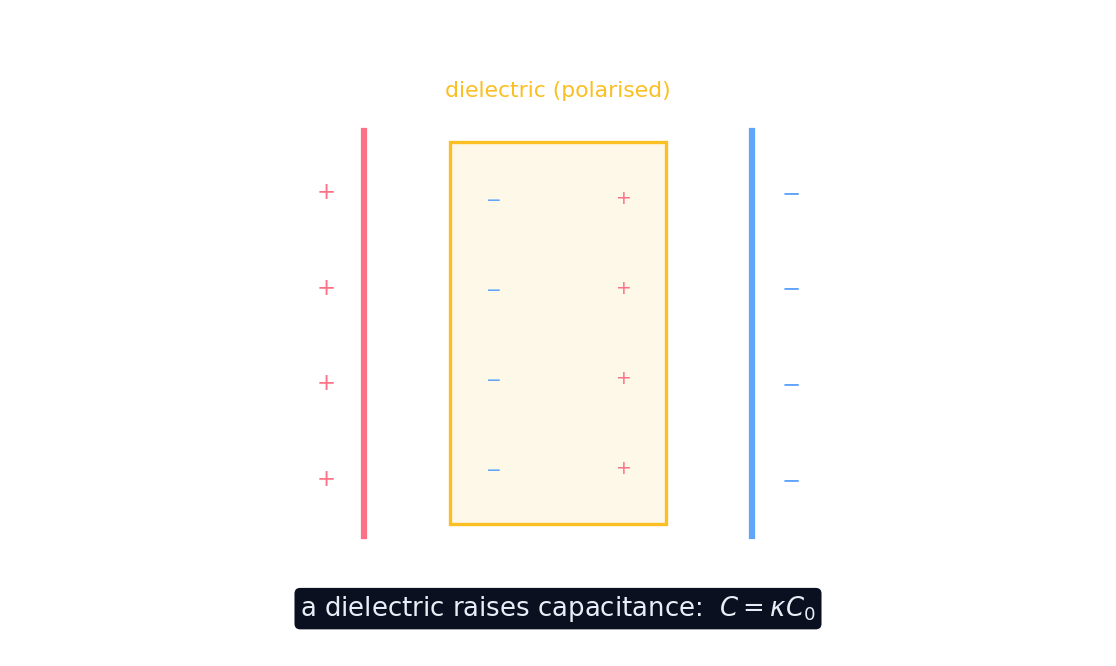
A dielectric polarises and weakens the net field in an isolated capacitor with fixed free plate charge.
Difficulté 1/5 · 100 pièces + un petit bonus lors de la première réussite aujourd'hui
At fixed free plate charge, bound charges oppose the original plate field and reduce the net field. If voltage and gap stay fixed instead, E = V/d stays the same and extra free charge arrives.
Capacitance goes up by κ
- A weaker field means a smaller voltage for the same charge — so $C$ rises.
- $C = \kappa C_0$ when a uniform linear dielectric fills the gap, where $\kappa$ is the dielectric constant 介电常数 ($\kappa > 1$).
- Air is about $1$; plastics are $2$–$5$; some ceramics reach into the hundreds.
- Insert a $\kappa = 3$ slab and the capacitance triples.
Add a dielectric
See how storing more charge at the same voltage means a larger capacitance.
Inserting a dielectric of constant $\kappa$ changes the capacitance to:
Difficulté 1/5 · 100 pièces + un petit bonus lors de la première réussite aujourd'hui
$C = \kappa C_0$, and $\kappa > 1$, so capacitance rises.
A $5\ \mu\text{F}$ capacitor gets a $\kappa = 4$ dielectric. Find the new capacitance (in μF).
Difficulté 2/5 · 140 pièces + un petit bonus lors de la première réussite aujourd'hui
$C = \kappa C_0 = 4 \times 5 = 20\ \mu\text{F}$.
For any real dielectric, the constant $\kappa$ is always greater than ____.
Difficulté 1/5 · 100 pièces + un petit bonus lors de la première réussite aujourd'hui
$\kappa > 1$ for all dielectrics, so they always raise $C$.
Three helpful effects
- Bigger $C$ — more charge stored per volt.
- Weaker field inside for the same charge — less chance of sparking.
- Possible higher breakdown voltage — a suitable material can withstand a stronger field than air; this depends on its dielectric strength, not just $\kappa$.
- The slab also physically holds the plates apart.
Select tout true effects of adding a dielectric.
Difficulté 2/5 · 140 pièces + un petit bonus lors de la première réussite aujourd'hui
A gap-filling linear dielectric raises capacitance and weakens the field at fixed free charge. A suitable material can improve breakdown voltage; kappa alone does not determine dielectric strength.
Two cases: battery on or off
- Battery connected ($V$ fixed): $C$ rises, so charge $Q = CV$ increases.
- Battery removed ($Q$ fixed): $C$ rises, so voltage $V = Q/C$ drops.
- Ask which quantity is held fixed before predicting the change.
- Same slab, opposite effects on $V$ and $Q$.
A dielectric is inserted while the battery stays connected ($V$ fixed). The stored charge:
Difficulté 1/5 · 100 pièces + un petit bonus lors de la première réussite aujourd'hui
With $V$ fixed and $C$ up, $Q = CV$ increases.
A capacitor has $C_0 = 4\ \mu\text{F}$. A dielectric of $\kappa = 3$ is inserted.
- New capacitance: $C = \kappa C_0 = 3 \times 4 = 12\ \mu\text{F}$.
- If still connected to the battery, the stored charge triples too.
Worked examples: a half-filled gap, and the energy
A parallel-plate capacitor has $C_0$ with air. A slab with $\kappa=3$ fills half of it. Which way you fill it matters.
- Half the gap (slab of thickness $d/2$, full area): two capacitors in series, $2C_0$ (air) and $2\kappa C_0$ (slab). So $\dfrac1C=\dfrac{1}{2C_0}+\dfrac{1}{6C_0}$, which gives $C=1.5\,C_0$.
- Half the area (slab of full thickness, half the plates): two capacitors in parallel, $\dfrac{C_0}{2}+\dfrac{\kappa C_0}{2}=2C_0$.
Energy with the battery removed ($Q$ fixed), $U=\dfrac{Q^2}{2C}$ falls to $\dfrac{U_0}{\kappa}$ when the slab fills the gap. The field does work pulling the slab in.
A 10 μF air capacitor has a slab with κ = 5 inserted across half of its plate area, filling the full gap. Find the new capacitance.
Difficulté 2/5 · 140 pièces + un petit bonus lors de la première réussite aujourd'hui
Parallel halves: C₀/2 + κC₀/2 = 5 + 25 = 30 μF.
A charged capacitor is disconnected from its battery, then a κ = 4 slab fills the gap. What happens to the stored energy?
Difficulté 1/5 · 100 pièces + un petit bonus lors de la première réussite aujourd'hui
Q is fixed and C becomes 4C₀, so U = Q²/2C falls to U₀/4. The difference is the work done pulling the slab in.
Before predicting $V$ or $Q$, decide whether the battery is still connected. Battery on → $V$ fixed, $Q$ rises. Battery off → $Q$ fixed, $V$ falls. Mixing these two cases is the classic dielectric mistake.
A dielectric slab polarises, weakening the field at fixed free charge, so capacitance rises: $C = \kappa C_0$ with dielectric constant $\kappa > 1$. A suitable material can also raise the breakdown voltage. With the battery connected $Q$ rises ($V$ fixed); disconnected $V$ falls ($Q$ fixed).
Write from the data: find the capacitance
- A capacitor has C0 = 6 microfarad. A dielectric with kappa = 4 fills it. It is disconnected from the battery, and the voltage was 12 volts.
- Find the new capacitance and the new voltage.
A 6 microfarad capacitor receives a dielectric of kappa 4 while disconnected, after being charged to 12 volts. What are the new capacitance and the new voltage?
4 times 6 is 24 microfarad. At fixed charge, voltage is divided by 4, so 12 volts becomes 3 volts.
An isolated 6 microfarad capacitor initially at 12 volts is fully filled with a dielectric of kappa 4. What are its new capacitance and voltage?
Difficulté 1/5 · 100 pièces + un petit bonus lors de la première réussite aujourd'hui
kappa times 6 microfarad is 24 microfarad, and 12 volts divided by 4 is 3 volts.