Reflection · Réflexion
| English | Français |
|---|---|
| law of reflection/lɔː ɒv rɪˈflekʃn/ | loi de la réflexion |
| normal/ˈnɔːml/ | normale |
Light bounces off a mirror at a precise angle
- Shine a torch at a mirror and the beam bounces off — but not just anywhere.
- It leaves at exactly the same angle it arrived, mirror-flipped.
- This is the law of reflection 反射定律, obeyed by every mirror and shiny surface.
- Get this one rule and mirror images make perfect sense.
La lumière rebondit sur un miroir à un angle précis
- Dirigez une lampe de poche vers un miroir et le faisceau rebondit — mais pas n'importe où.
- Il part avec exactement le même angle qu'il est arrivé, inversé par le miroir.
- C'est la loi de réflexion 反射定律, respectée par chaque miroir et surface brillante.
- Comprenez cette seule règle et les images dans les miroirs auront tout leur sens.
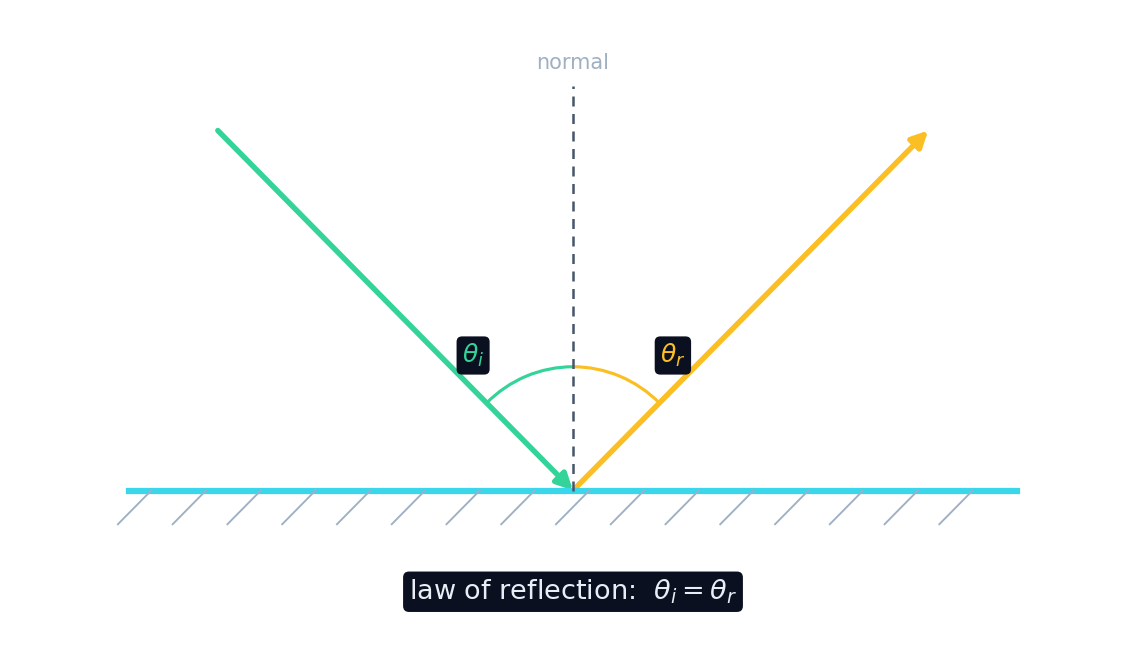
The law of reflection
- Angles are measured from the normal 法线 — the line perpendicular to the surface.
- The angle of incidence equals the angle of reflection: $\theta_i = \theta_r$.
- The incoming ray, the reflected ray and the normal all lie in one plane.
- This holds no matter what the angle — steep or shallow.
La loi de réflexion
- Les angles sont mesurés par rapport à la normale 法线 — la ligne perpendiculaire à la surface.
- L'angle d'incidence est égal à l'angle de réflexion : $\theta_i = \theta_r$.
- Le rayon incident, le rayon réfléchi et la normale se trouvent tous dans un même plan.
- Cela vaut quel que soit l'angle — raide ou faible.
A ray strikes a mirror at $30^\circ$ to the normal. At what angle to the normal does it reflect, in degrees? · Un rayon frappe un miroir à $30^\circ$ par rapport à la normale. À quel angle par rapport à la normale se reflète-t-il, en degrés ?
$\theta_r = \theta_i = 30^\circ$ by the law of reflection. · $\theta_r = \theta_i = 30^\circ$ par la loi de la réflexion.
The law of reflection states that: · La loi de la réflexion stipule que :
$\theta_i = \theta_r$, both measured from the normal. · $\theta_i = \theta_r$, tous deux mesurés par rapport à la normale.
Smooth vs rough surfaces
- A smooth surface (a mirror) reflects a beam neatly — specular reflection.
- A rough surface scatters light every which way — diffuse reflection.
- Both obey $\theta_i = \theta_r$ at each tiny point; the roughness just points the normals every way.
- Diffuse reflection is why you can see this page from any angle.
Surfaces lisses vs rugueuses
- Une surface lisse (un miroir) réfléchit un faisceau proprement — réflexion spéculaire.
- Une surface rugueuse diffuse la lumière dans toutes les directions — réflexion diffuse.
- Toutes deux obéissent à $\theta_i = \theta_r$ à chaque point microscopique ; la rugosité oriente simplement les normales dans tous les sens.
- La réflexion diffuse est pourquoi vous pouvez lire cette page sous n'importe quel angle.
Why can you read this page from many angles? · Pourquoi pouvez-vous lire cette page sous de nombreux angles ?
The rough paper scatters light diffusely, so it reaches your eyes from any angle. · Le papier rugueux disperse la lumière de manière diffuse, de sorte qu'elle atteint vos yeux sous n'importe quel angle.
Select all · tout true statements about reflection. · Sélectionnez toutes les affirmations vraies concernant la réflexion.
Reflection obeys $\theta_i = \theta_r$ from the normal, smooth = specular. Rough surfaces still obey it at each point. · La réflexion respecte $\theta_i = \theta_r$ par rapport à la normale, lisse = spéculaire. Les surfaces rugueuses la respectent encore en chaque point.
Always measure from the normal
- The single most common slip is measuring the angle from the surface instead of the normal.
- The normal is the perpendicular line; angles in optics are always taken from it.
- A ray hitting a mirror "flat" ($\theta_i \approx 90^\circ$ from the normal) grazes off almost flat.
- A ray straight down the normal ($\theta_i = 0$) reflects straight back.
Mesurez toujours depuis la normale
- L'erreur la plus fréquente consiste à mesurer l'angle par rapport à la surface plutôt qu'à la normale.
- La normale est la ligne perpendiculaire ; les angles en optique sont toujours pris par rapport à elle.
- Un rayon frappant un miroir « à plat » ($\theta_i \approx 90^\circ$ par rapport à la normale) frôle la surface presque parallèlement.
- Un rayon descendant verticalement le long de la normale ($\theta_i = 0$) se reflète directement en arrière.
The law of reflection · La loi de la réflexion
For a mirror, the angle of reflection always equals the angle of incidence - a straight line through the origin. · Pour un miroir, l'angle de réflexion est toujours égal à l'angle d'incidence — une ligne droite passant par l'origine.
In optics, angles are always measured from the ____ (the perpendicular line). · En optique, les angles sont toujours mesurés par rapport à la ____ (la ligne perpendiculaire).
The normal is perpendicular to the surface; all optics angles use it. · La normale est perpendiculaire à la surface ; tous les angles optiques l'utilisent.
A ray at $30^\circ$ to the mirror surface is at $60^\circ$ to the normal. · Un rayon à $30^\circ$ par rapport à la surface du miroir est à $60^\circ$ par rapport à la normale.
Surface and normal are perpendicular, so the two angles add to $90^\circ$. · La surface et la normale sont perpendiculaires, donc les deux angles s'additionnent pour faire $90^\circ$.
Always measure the angles from the normal (the perpendicular), not from the mirror surface. A ray at $30^\circ$ to the surface is at $60^\circ$ to the normal — and $60^\circ$ is what goes into $\theta_i = \theta_r$.
Mesurez toujours les angles depuis la normale (la perpendiculaire), et non depuis la surface du miroir. Un rayon à $30^\circ$ par rapport à la surface est à $60^\circ$ par rapport à la normale — et $60^\circ$ est ce qui entre dans $\theta_i = \theta_r$.
A ray strikes a mirror at $30^\circ$ to the normal. At what angle does it reflect?
- By the law of reflection, $\theta_r = \theta_i = 30^\circ$ to the normal.
The total angle between the incoming and outgoing rays is $60^\circ$.
Un rayon frappe un miroir à $30^\circ$ par rapport à la normale. À quel angle se reflète-t-il ?
- Selon la loi de réflexion, $\theta_r = \theta_i = 30^\circ$ par rapport à la normale.
L'angle total entre les rayons entrant et sortant est $60^\circ$.
The law of reflection: the angle of incidence equals the angle of reflection ($\theta_i = \theta_r$), both measured from the normal. Smooth surfaces give clear specular reflection; rough ones give scattered diffuse reflection. Always measure from the normal.
La loi de réflexion : l'angle d'incidence est égal à l'angle de réflexion ($\theta_i = \theta_r$), tous deux mesurés depuis la normale. Les surfaces lisses offrent une réflexion spéculaire claire ; les surfaces rugueuses offrent une réflexion diffuse dispersée. Mesurez toujours depuis la normale.