Gravitational Force
Introduit| English | Sens |
|---|---|
| gravity/ˈɡrævɪti/ | gravité |
| weight/weɪt/ | poids |
| gravitational field strength/ˌɡrævɪˈteɪʃənl fiːld streŋθ/ | champ gravitationnel |
The apple and the Moon
- An apple falls 5 m in its first second. The Moon, 60 times farther from Earth's centre, "falls" toward Earth only about 1.4 mm in each second as it curves around its orbit: $5\ \text{m}/60^2\approx1.4$ mm. Newton saw that one force explains both, getting weaker with distance.
- This lesson: the law of universal gravitation 万有引力, the gravitational field 引力场, weight 重量, apparent weight (why you feel heavier in a lift), and two kinds of mass.
Newton's law of universal gravitation
- $G=6.67\times10^{-11}\ \text{N}\cdot\text{m}^2/\text{kg}^2$. The force is attractive, acts along the line joining the centres of mass, and can be treated as acting at each object's centre of mass. $r$ is the distance between centres, not between surfaces.
- It is proportional to each mass and to $1/r^2$: double one mass → $2F$; double $r$ → $F/4$; triple $r$ → $F/9$. Both objects feel the same size force (Newton's third law).
If the distance between two masses doubles, the gravitational force between them becomes:
Difficulté 1/5 · 100 pièces + un petit bonus lors de la première réussite aujourd'hui
Gravity is inverse-square: $F \propto 1/r^2$, so doubling $r$ gives $1/2^2 = 1/4$ the force.
Gravitational force is proportional to $1/r^{\_\_}$. Fill in the power.
Difficulté 1/5 · 100 pièces + un petit bonus lors de la première réussite aujourd'hui
It is an inverse-carré law: $F \propto 1/r^2$.
Select tout changes that would make the gravitational force between two objects stronger.
Difficulté 2/5 · 140 pièces + un petit bonus lors de la première réussite aujourd'hui
$F = GMm/r^2$ grows with either mass and shrinks with distance. Moving them apart weakens it.
The gravitational field and weight
- The gravitational field strength at a point is the force per kilogram on a test mass: $g=\dfrac{F_g}{m}=\dfrac{GM}{r^2}$, in N/kg. If gravity is the only force on an object, its acceleration in m/s² equals $g$ there. Near Earth's surface, $g\approx10$ N/kg.
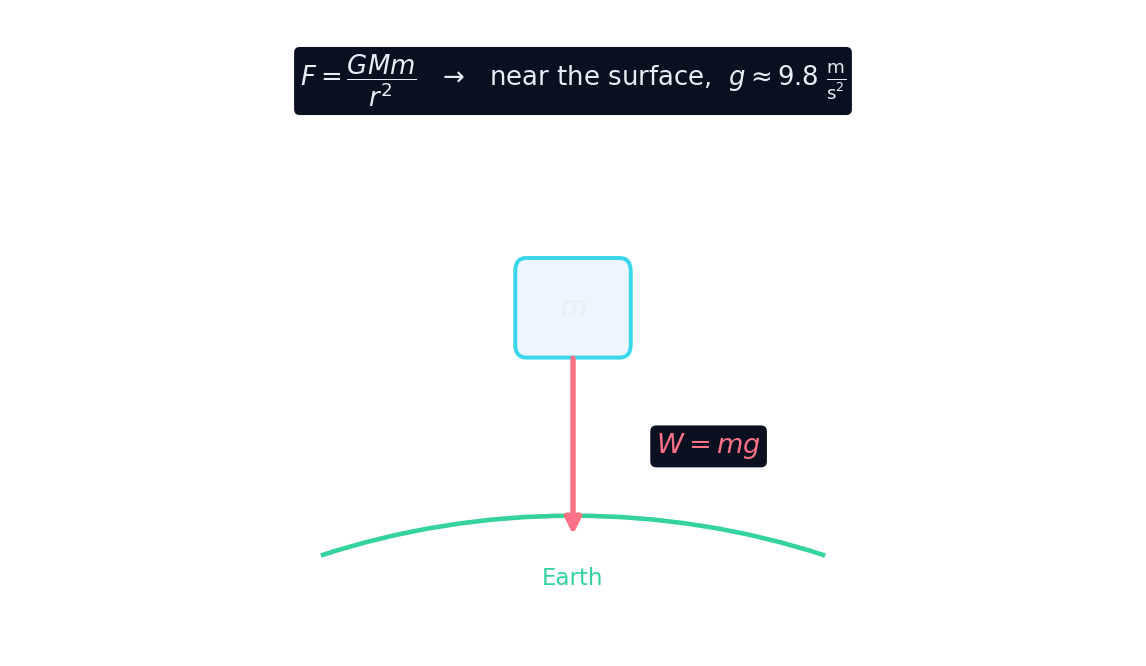
- Weight is the gravitational force from a planet on a nearby object: $W=F_g=mg$. Mass (kg) stays the same everywhere; weight (N) depends on $g$.
Gravity on different worlds
Switch the planet and watch how a weaker or stronger g bends the same launch differently.
What is the weight of a $5\ \text{kg}$ bag on Earth, where $g = 9.8\ \tfrac{\text{N}}{\text{kg}}$? Answer in $\text{N}$.
Difficulté 2/5 · 140 pièces + un petit bonus lors de la première réussite aujourd'hui
$W = mg = 5 \times 9.8 = 49\ \text{N}$.
An object has the same weight everywhere in the universe.
Difficulté 1/5 · 100 pièces + un petit bonus lors de la première réussite aujourd'hui
Poids $W = mg$ depends on the local $g$. Mass stays fixed, but weight changes from planet to planet.
On a distant planet a $10\ \text{kg}$ rock weighs $25\ \text{N}$. What is $g$ there, in $\tfrac{\text{N}}{\text{kg}}$?
Difficulté 2/5 · 140 pièces + un petit bonus lors de la première réussite aujourd'hui
$g = W/m = 25/10 = 2.5\ \tfrac{\text{N}}{\text{kg}}$.
When can we treat gravity as constant?
- If moving an object changes its distance from the planet's centre only a little, $F_g$ barely changes, so we use a constant $g$. Raising a ball 100 m changes $r$ by $100/6\,400\,000$ m: about 0.002%.
- For satellites and planets, $r$ changes a lot, so use $\dfrac{GMm}{r^2}$. At $2R_\text{E}$ from Earth's centre (one Earth radius up), $g=10/4=2.5$ N/kg.
At Earth's surface $g=10$ N/kg. What is $g$ at a height of two Earth radii above the surface, in N/kg?
Difficulté 2/5 · 140 pièces + un petit bonus lors de la première réussite aujourd'hui
Two radii above the surface is $r=3R_\text{E}$ from the centre. $g=10/3^2\approx1.11$ N/kg.
Apparent weight: what a scale reads
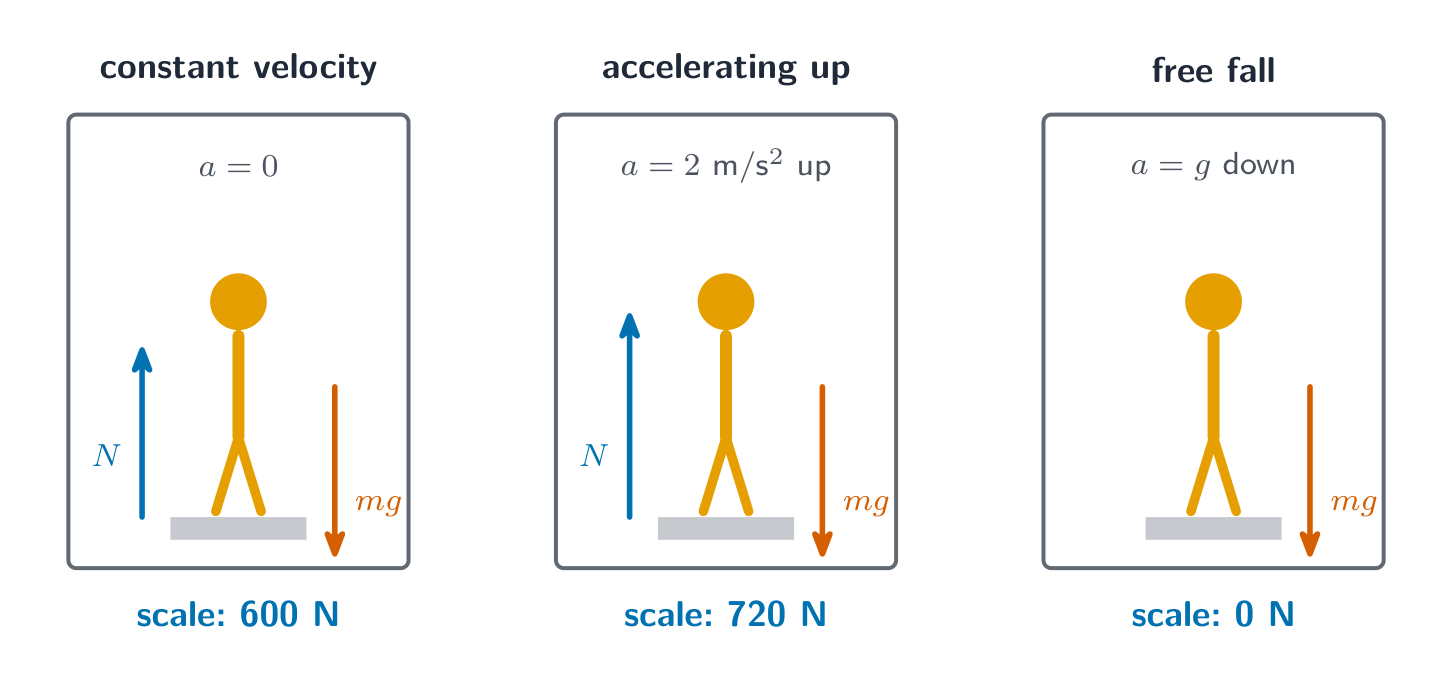
- A scale measures the normal force $N$ on you: your apparent weight. It equals $mg$ only when you are not accelerating. Newton's second law (up positive): $N-mg=ma$, so $N=m(g+a)$.
- Accelerating up (or slowing while going down): $N>mg$, you feel heavier. Accelerating down: $N<mg$. In free fall ($a=g$ down), $N=0$: you appear weightless, even though gravity still acts.
A 50 kg student stands on a scale in a lift that is moving vers le bas et speeding up at 3 m/s². Use $g=10$ N/kg. What does the scale read, in N?
Difficulté 2/5 · 140 pièces + un petit bonus lors de la première réussite aujourd'hui
Speeding up while moving down: $a$ is downward, $a=-3$ m/s². $N=m(g+a)=50(10-3)=350$ N.
In which situations does a scale in a lift read davantage than your weight $mg$? Select all.
Difficulté 2/5 · 140 pièces + un petit bonus lors de la première réussite aujourd'hui
The scale reads more when the acceleration is vers le haut. Speeding up going up, and slowing down going down, both have upward acceleration.
Inertial mass and gravitational mass
- Inertial mass measures how much an object resists changes in motion ($a=F/m$). Gravitational mass measures how strongly it is attracted by gravity ($F_g=GMm/r^2$). Experiments show the two are equal, which is why all objects fall with the same acceleration when air resistance is negligible.
- Equivalence principle: inside a closed lift, you cannot tell whether you are pressed to the floor by gravity or by the lift accelerating upward. Astronauts in orbit float because they and their station are both in free fall.
Astronauts float inside a space station orbiting 400 km above Earth, where $g$ is still about 8.7 N/kg. Why do they appear weightless?
Difficulté 1/5 · 100 pièces + un petit bonus lors de la première réussite aujourd'hui
Gravity is the only force on them. Station and astronauts fall with the same acceleration, so the floor pushes on nothing.
Worked AP-style questions
Multiple choice. A satellite orbits at a distance $3R$ from the centre of a planet of radius $R$. On the surface, the satellite's weight is $W$. What is the gravitational force on it in orbit? (A) $W/3$ (B) $W/9$ (C) $W/4$ (D) $W$
Answer: B. $r$ changes from $R$ to $3R$ (measured from the centre), so $F$ is multiplied by $1/3^2=1/9$. (C) wrongly uses the height above the surface, $2R$, as $r$; (A) forgets to square.
Free response. A 60 kg student stands on a scale in a lift. Use $g=10$ N/kg.
(A) The lift moves up at a constant 3 m/s. What does the scale read? $a=0$, so $N=mg=$ 600 N.
(B) The lift slows to a stop while moving up, at $2$ m/s². What does the scale read? Slowing while going up means $a$ is downward: $a=-2$ m/s². $N=m(g+a)=60(10-2)=$ 480 N.
(C) The cable breaks. Explain the reading. The lift and student fall together with $a=g$, so $N=m(g-g)=0$: the scale reads 0 N. Gravity still pulls on the student with 600 N.
- Why it scores: (B) finds the direction of acceleration from the motion first; (C) separates apparent weight (the normal force) from the gravitational force.
- $r$ is centre to centre. Height above the surface is not $r$: add the planet's radius.
- Weightless does not mean no gravity. In free fall, gravity is the only force; the normal force is zero.
- Direction of acceleration ≠ direction of motion. Slowing while moving up is a downward acceleration: the scale reads less.
$F_g=\dfrac{Gm_1m_2}{r^2}$: attractive, along the line of centres, $r$ measured centre to centre. Field strength $g=F_g/m=GM/r^2$ (≈10 N/kg near Earth); weight $W=mg$; treat $g$ as constant when $r$ hardly changes. A scale reads the normal force, the apparent weight, $N=m(g+a)$; in free fall it is zero. Inertial and gravitational mass are equal.