Newton's Third Law
IntroduitYou cannot push without being pushed back
- Shove a heavy wall and you feel it shove you — hard enough and you slide backward.
- Every force is one half of a pair; there is no such thing as a lone push.
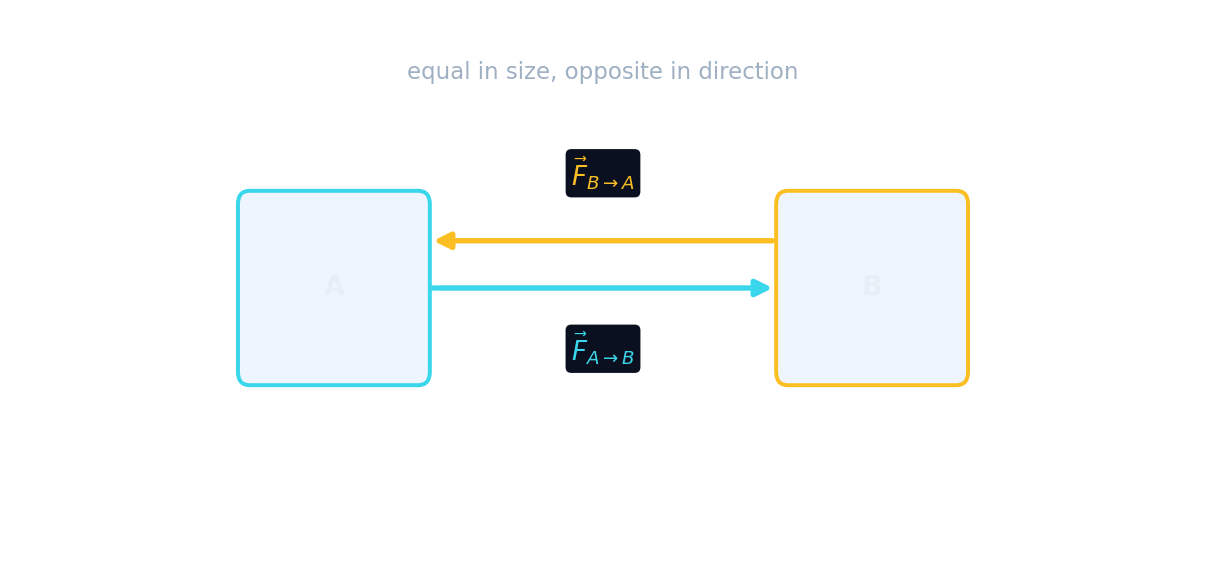
- Newton's third law: if A pushes B, then B pushes A equally and oppositely.
- This is why rockets fly, swimmers move, and you can walk at all.
The law in symbols
- For any interaction between two bodies: $\vec F_{A\to B} = -\,\vec F_{B\to A}$.
- Equal in size, opposite in direction — always, no exceptions.
- It holds whether the objects are still, moving, heavy, or light.
- The pair appears and disappears together, at the same instant.
You push a wall with a force of $50\ \text{N}$. With what force does the wall push back on you?
Difficulté 1/5 · 100 pièces + un petit bonus lors de la première réussite aujourd'hui
By the third law the reaction is equal in size: the wall pushes back with $50\ \text{N}$.
Newton's third law says forces come in equal-and-____ pairs.
Difficulté 1/5 · 100 pièces + un petit bonus lors de la première réussite aujourd'hui
Equal in magnitude, opposite in direction: $\vec F_{A\to B} = -\vec F_{B\to A}$.
The pair acts on different objects
- The two forces in the pair act on different bodies — one on A, one on B.
- That is why they do not cancel: they cancel in the total for a system containing both bodies, but not on either body alone.
- To find the motion of B, you only count the forces acting on B.
- The reaction force acts on A, so it never appears in B's free-body diagram.
The two forces of an action–reaction pair act on the same object.
Difficulté 1/5 · 100 pièces + un petit bonus lors de la première réussite aujourd'hui
They act on différentes objects — one on A, one on B. That is why they do not cancel.
Why do action and reaction not cancel on either individual object?
Difficulté 1/5 · 100 pièces + un petit bonus lors de la première réussite aujourd'hui
Forces only cancel when they act on the même body. Action and reaction act on two different bodies.
Third law all around you
- Walking: your foot pushes the ground back; the ground pushes you forward.
- Swimming: you push water back; the water pushes you forward.
- Rockets: engines push gas down; the gas pushes the rocket up.
- In each case the reaction force on you drives you forward; it is equal in size to your force on the surroundings.
Third-law pairs
Newton's third-law forces are equal, opposite, and act on different objects. Sort each statement.
A rocket pushes exhaust gas backward with $2000\ \text{N}$. With what force does the gas push the rocket forward, in $\text{N}$?
Difficulté 2/5 · 140 pièces + un petit bonus lors de la première réussite aujourd'hui
The reaction is equal and opposite: the gas pushes the rocket forward with $2000\ \text{N}$ of thrust.
Select tout examples where forward motion is driven by pushing something backward.
Difficulté 2/5 · 140 pièces + un petit bonus lors de la première réussite aujourd'hui
Swimming, walking and rockets push water, ground or exhaust backward and receive a forward force. A stationary book also has third-law pairs, but these are not producing forward motion.
Action and reaction do not cancel on either object alone, because they act on different objects. They do cancel as internal forces in the total for the two-object system. A common mistake is to say "the forces are equal and opposite, so nothing moves". They are equal and opposite — but on two separate bodies, so each body can still accelerate.
A rocket engine pushes exhaust gas backward with $2000\ \text{N}$.
- By the third law, the gas pushes the rocket forward with $2000\ \text{N}$.
- That forward force on the rocket is the thrust that launches it.
Newton's third law: $\vec F_{A\to B} = -\vec F_{B\to A}$ — forces come in equal-and-opposite pairs. The two act on different objects, so they do not cancel on either object alone. Walking, swimming and rockets all work by pushing on something that pushes back.
Write from an 80 N pair
- You push a door with 80 N.
- State the force the door exerts on you.
You push a closed door with a force of 80 N. With what force does the door push back on you, and why do the two forces not cancel?
Newton's third law gives $\vec F_{door\to you}=-\vec F_{you\to door}$. The door pushes you with 80 N opposite your push. One force acts on you and the other on the door, so they do not cancel on either single-object free-body diagram.
You push a closed door with 80 N. What is the magnitude of the force the door exerts on you?
Difficulté 1/5 · 100 pièces + un petit bonus lors de la première réussite aujourd'hui
Newton's third law gives $\vec F_{door\to you}=-\vec F_{you\to door}$. The door pushes you with 80 N opposite your push. One force acts on you and the other on the door, so they do not cancel on either single-object free-body diagram.