Government Intervention in Different Market Structures
Introduit| English | Sens |
|---|---|
| per-unit tax/pɜː ˈjuːnɪt tæks/ | Taxe unitaire |
| regulation/ˌreɡjʊˈleɪʃn/ | régulation |
| marginal-cost pricing/ˈmɑːdʒɪnl kɒst ˈpraɪsɪŋ/ | tarification au coût marginal |
| average-cost pricing/ˈævrɪdʒ kɒst ˈpraɪsɪŋ/ | tarification au coût moyen |
| price controls/praɪs kənˈtrəʊlz/ | contrôles des prix |
| antitrust policy/ˌæntɪˈtrʌst ˈpɒlɪsi/ | politique antitrust |
| government failure/ˈɡʌvənmənt ˈfeɪlɪə/ | échec de l'État |
Fixing failures — carefully
- Governments have a whole toolbox for market failures: taxes, rules, and price limits.
- But the right tool depends on the market it acts on.
- The same rule that helps a monopoly could hurt a competitive market.
- And every fix has a cost of its own.
Regulating a natural monopoly
- A per-unit tax 从量税 or subsidy shifts supply; on a negative externality, a tax can raise efficiency.
- Regulation 管制 of a natural monopoly sets the price it may charge.
- Marginal-cost pricing 边际成本定价 ($P = MC$) gives the efficient quantity but often forces a loss.
- Average-cost pricing 平均成本定价 ($P = ATC$) lets the firm break even, with a little inefficiency.
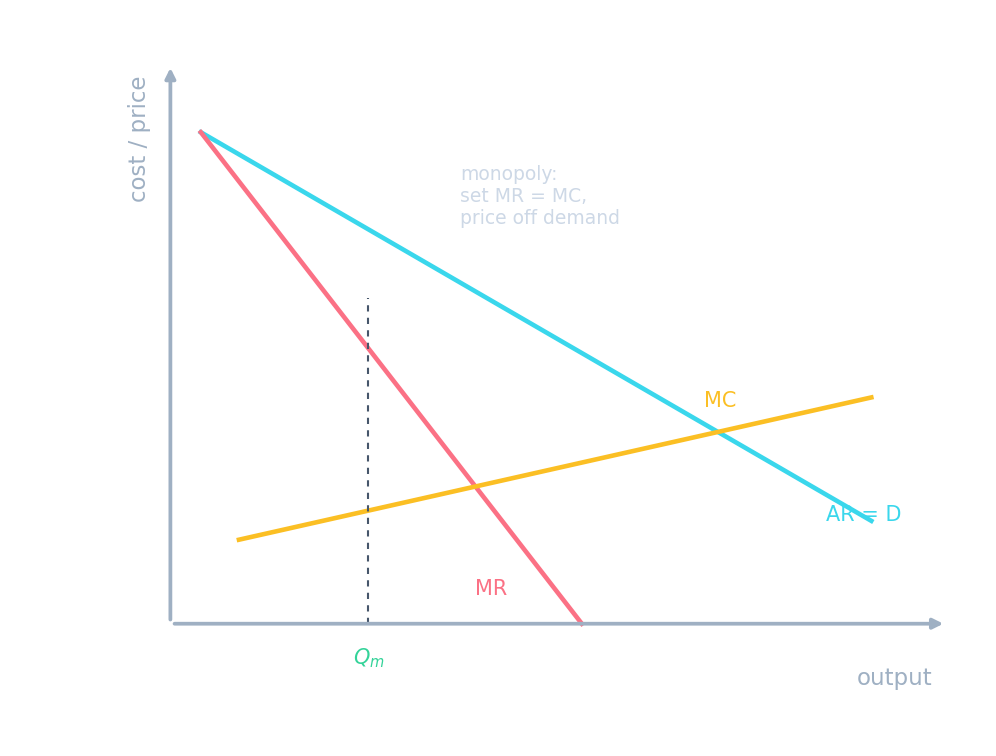
A regulated monopoly's costs
Marginal-cost pricing (P = MC) is efficient but can force a loss when average cost lies above it; average-cost pricing (P = ATC) lets the firm break even.
Marginal-cost pricing (P = MC) of a natural monopoly gives the efficient quantity but often:
Difficulté 1/5 · 100 pièces + un petit bonus lors de la première réussite aujourd'hui
A natural monopoly's average cost sits above marginal cost, so P = MC is below ATC — a loss.
Average-cost pricing (P = ATC) of a natural monopoly:
Difficulté 1/5 · 100 pièces + un petit bonus lors de la première réussite aujourd'hui
P = ATC covers all costs (break-even) but leaves output a little below the efficient level.
Antitrust and price controls
- Antitrust policy 反垄断政策 blocks mergers and practices that build market power, keeping markets competitive.
- Price controls 价格管制 (a ceiling on a monopoly's price) can raise output and welfare — unlike in a competitive market, where they cause shortages.
Policy that blocks mergers to keep markets competitive is called ______ policy.
Difficulté 1/5 · 100 pièces + un petit bonus lors de la première réussite aujourd'hui
Antitrust policy limits the build-up of market power.
A price ceiling on a monopoly can raise output and welfare, unlike in a competitive market.
Difficulté 1/5 · 100 pièces + un petit bonus lors de la première réussite aujourd'hui
A monopoly restricts output, so a well-set ceiling can push it toward the efficient amount.
Select tout tools a government uses to address market failures.
Difficulté 2/5 · 140 pièces + un petit bonus lors de la première réussite aujourd'hui
Taxes, regulation and antitrust are all real tools; ignoring it is not a fix.
Government failure
- Intervention is not free. Government failure 政府失灵 happens when the cure is worse than the disease.
- Regulation costs money, information is imperfect, and political pressure can distort choices.
- Good policy weighs the market failure against the cost of fixing it.
Government failure occurs when:
Difficulté 1/5 · 100 pièces + un petit bonus lors de la première réussite aujourd'hui
When the cure costs more than the disease, intervention makes things worse.
Worked example: regulating a water company
A natural-monopoly water company has demand $P = 100 - Q$, a constant marginal cost of 20 dollars, and a large fixed cost, so ATC is 40 dollars at $Q=60$. Compare three outcomes.
- Unregulated: $MR = 100 - 2Q = 20$ gives $Q = 40$, $P = 60$: high price, too little water.
- Marginal-cost pricing ($P=MC=20$): $Q = 80$, the efficient quantity, but the price is below ATC, so the firm makes a loss and needs a subsidy. Average-cost pricing ($P = ATC = 40$): $Q = 60$, the firm breaks even, and output is closer to efficient with a smaller deadweight loss.
Demand is P = 50 − Q and marginal cost is constant at 10. With marginal-cost pricing, what quantity is produced?
Difficulté 2/5 · 140 pièces + un petit bonus lors de la première réussite aujourd'hui
50 − Q = 10, so Q = 40.
Government intervention can make an outcome less efficient than the market alone.
Difficulté 1/5 · 100 pièces + un petit bonus lors de la première réussite aujourd'hui
This is called government failure.
Governments fix failures with taxes, regulation, antitrust, and price controls — but the effect depends on the market. Regulating a natural monopoly trades marginal-cost pricing (efficient, loss-making) against average-cost pricing (break-even). Beware government failure: the cure can cost more than the disease.
Write from a marginal-cost pricing loss of 400
- Setting price equal to marginal cost loses 400 a day.
- Setting price equal to average cost makes the loss 0.
For a natural monopoly, marginal-cost pricing loses 400 a day and average-cost pricing makes the loss 0. What does each rule do to output and to profit?
Price below average cost loses money. Price equal to average cost covers cost.
What is the daily result of marginal-cost pricing?
Difficulté 1/5 · 100 pièces + un petit bonus lors de la première réussite aujourd'hui
Marginal-cost pricing is efficient and loses 400 a day here. Other options — A loss of 0 (which is the average-cost result); A profit (because efficient output must be profitable).