Monopolistic Competition
Introduit| English | Sens |
|---|---|
| monopolistic competition/məˈnɒpəlɪstɪk ˌkɒmpəˈtɪʃn/ | concurrentielle monopolistique |
| differentiated product/ˌdɪfəˈrenʃɪeɪtɪd ˈprɒdʌkt/ | produit différencié |
| short run/ʃɔːt rʌn/ | court terme |
| free entry and exit/friː ˈentri ænd ˈeɡzɪt/ | entrée et sortie libres |
| long-run equilibrium/lɒŋ rʌn ˌiːkwɪˈlɪbrɪəm/ | équilibre de long terme |
| tangent/ˈtændʒənt/ | tangente |
| average total cost/ˈævrɪdʒ ˈtəʊtl kɒst/ | coût total moyen |
| normal profit/ˈnɔːml ˈprɒfɪt/ | bénéfice normal |
| excess capacity/ekˈses kəˈpæsɪti/ | capacité excédentaire |
| non-price competition/nɒn praɪs ˌkɒmpəˈtɪʃn/ | concurrence non-prix |
| product differentiation/ˈprɒdʌkt ˌdɪfəˌrenʃɪˈeɪʃn/ | différenciation du produit |
A street of bubble-tea shops
- A dozen tea shops share one street. Each has its own flavours, toppings and style, so a small price rise loses some customers but not all of them. Yet any shop that makes big profits soon sees a new rival open next door.
- Many sellers, products that are similar but not identical, and easy entry: this market structure is monopolistic competition 垄断竞争. Restaurants, hair salons, clothing brands and petrol stations are common examples.
Many firms, differentiated products
- Each firm sells a differentiated product 差异化产品, so it has a little market power: its demand curve slopes down, and its MR lies below demand. Demand is fairly elastic, because there are many close substitutes.
- In the short run 短期 it acts like a small monopoly: produce where $MR = MC$, read the price from demand, and compare price with ATC to find profit or loss.
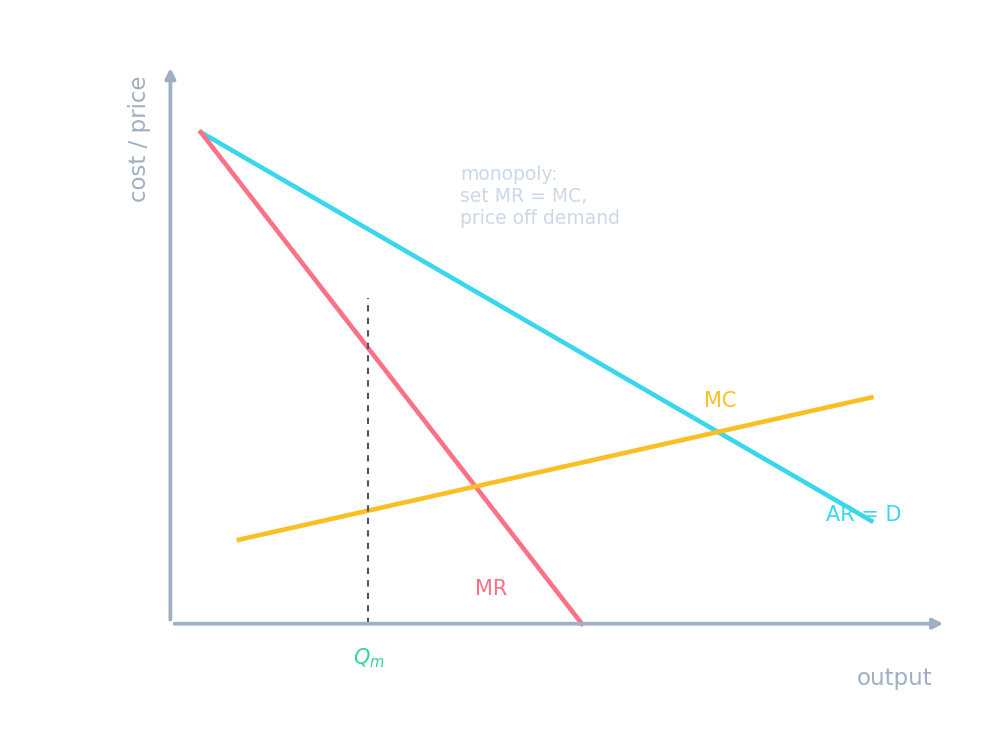
Monopolistic competition has:
Difficulté 1/5 · 100 pièces + un petit bonus lors de la première réussite aujourd'hui
Many firms compete, but each product is a little different — giving slight market power.
Long run: entry and exit bring zero profit
- There is free entry and exit 自由进出. Economic profit attracts new firms; they take customers, so each existing firm's demand (and MR) shifts left and becomes more elastic. Losses make firms leave, and the demand of those that stay shifts right.
- This stops when economic profit is zero. In this long-run equilibrium 长期均衡 the demand curve is just tangent 相切 to the average total cost 平均总成本 curve, at the quantity where $MR = MC$: $P = ATC$, so the firm earns normal profit 正常利润.
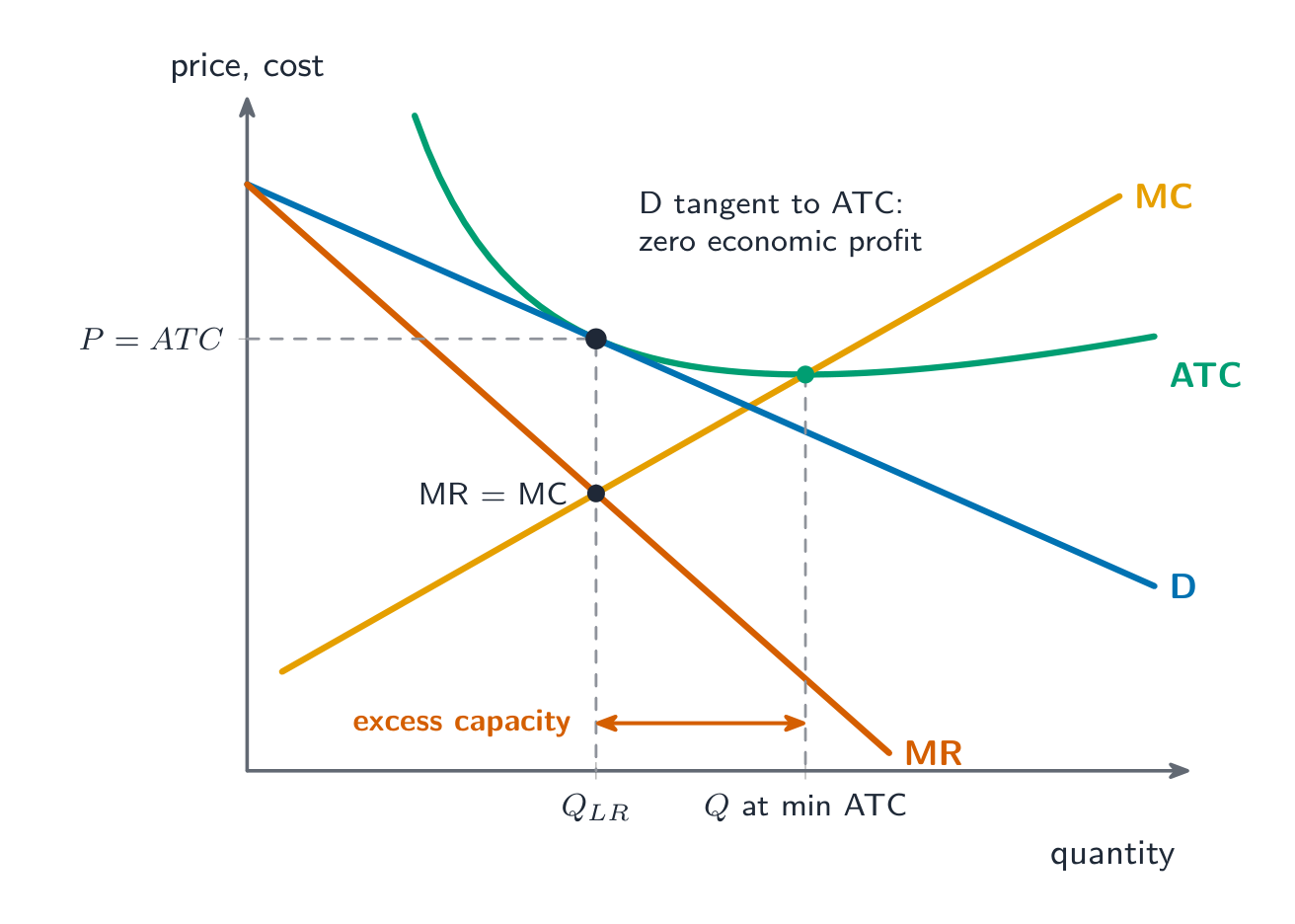
Cost curves and the firm
In the long run, free entry shifts each firm's demand until it just touches average total cost — the firm earns only normal profit, with excess capacity.
In long-run equilibrium, a monopolistically competitive firm earns:
Difficulté 1/5 · 100 pièces + un petit bonus lors de la première réussite aujourd'hui
Free entry competes profit away until demand is tangent to ATC — normal profit.
Match each term to its meaning.
Difficulté 2/5 · 140 pièces + un petit bonus lors de la première réussite aujourd'hui
Differentiation gives market power; the long run brings excess capacity and normal profit.
Firms in a monopolistically competitive market are making losses. In the long run, what happens to the demand curve of each firm that stays?
Difficulté 1/5 · 100 pièces + un petit bonus lors de la première réussite aujourd'hui
Firms leave, so the customers they served move to the remaining firms. Each remaining firm's demand shifts right until losses are gone.
Two inefficiencies remain
- At the tangency, $P > MC$, so the firm is allocatively inefficient: buyers would value more output than is produced. And it produces left of minimum ATC, so it is productively inefficient with excess capacity 过剩产能 (it could lower average cost by producing more).
- To win customers without cutting price, firms use non-price competition 非价格竞争: product differentiation 产品差异化, branding, location, service and advertising. The cost of inefficiency is partly the price of variety, which buyers value.
In long-run equilibrium, a monopolistically competitive firm produces at the lowest point of its ATC curve.
Difficulté 1/5 · 100 pièces + un petit bonus lors de la première réussite aujourd'hui
It produces to the left of minimum ATC, leaving excess capacity.
Monopolistic competition is allocatively inefficient because price is greater than ______ cost.
Difficulté 1/5 · 100 pièces + un petit bonus lors de la première réussite aujourd'hui
P > MC means the last unit is worth more than it costs, yet is not made.
Select tout examples of non-price competition.
Difficulté 2/5 · 140 pièces + un petit bonus lors de la première réussite aujourd'hui
Branding, design and service compete without price; cutting price is price competition.
Three market structures side by side
| Perfect | Monop. comp. | Monopoly | |
|---|---|---|---|
| Firms | very many | many | one |
| LR profit | zero | zero | can be > 0 |
| P = MC? | yes | no | no |
| Min ATC? | yes | no | usually no |
- Monopolistic competition shares zero long-run profit with perfect competition (because of free entry) but shares $P > MC$ with monopoly (because each firm's demand slopes down).
In long-run equilibrium, which is true of monopolistic competition but NOT of perfect competition?
Difficulté 1/5 · 100 pièces + un petit bonus lors de la première réussite aujourd'hui
Both have zero long-run profit, free entry and MR = MC. Only in monopolistic competition is demand downward-sloping, so P > MC.
Worked example: a new bubble-tea shop opens
A bubble-tea shop earns economic profit. Three new shops open on the same street. Trace the effects on the original shop until long-run equilibrium.
- Customers spread across more shops, so the original shop's demand (and MR) shifts left and becomes more elastic. It still sets output where $MR=MC$, but its price and profit fall.
- Entry continues until demand is tangent to ATC, where $P=ATC$ and economic profit is zero. Because the tangency is on the downward part of ATC, the shop has excess capacity: it produces less than the output at minimum ATC, and $P>MC$.
In long-run equilibrium, a monopolistically competitive firm has:
Difficulté 1/5 · 100 pièces + un petit bonus lors de la première réussite aujourd'hui
Free entry removes profit; P = ATC on the falling part of ATC.
Product differentiation gives a monopolistically competitive firm a downward-sloping demand curve.
Difficulté 1/5 · 100 pièces + un petit bonus lors de la première réussite aujourd'hui
Some buyers stay even if it raises its price a little.
Worked FRQ answer
Question: Bella's Bakery is in a monopolistically competitive market and is in long-run equilibrium. (a) Draw a correctly labeled graph for Bella's showing demand, MR, MC and ATC, and label the profit-maximizing quantity $Q_B$ and price $P_B$. (b) What is Bella's economic profit? Explain using your graph. (c) Is Bella's producing at the quantity that minimizes ATC? Explain. (d) Bella's starts an advertising campaign that makes customers less willing to switch bakeries. In the short run, what happens to Bella's demand curve and to its economic profit?
(a) A downward-sloping demand curve with MR below it, a U-shaped ATC, and MC crossing ATC at its minimum. $Q_B$ where MR = MC; $P_B$ on the demand curve above $Q_B$, with demand tangent to ATC at that point.
(b) Zero. At $Q_B$, price equals ATC (the tangency), so total revenue equals total cost.
(c) No. The tangency is on the downward-sloping part of ATC, so $Q_B$ is less than the quantity at minimum ATC: Bella's has excess capacity.
(d) If the advertising raises demand by more than it raises costs, demand shifts right (and becomes less elastic), and Bella's earns positive economic profit in the short run. In the long run, new entry or rivals' advertising would reduce it to zero again.
- Why it scores: (a) shows the tangency at the MR = MC quantity, not where demand crosses MC; (b) uses $P = ATC$; (c) uses the words "minimum ATC" and "excess capacity"; (d) separates the short run from the long run.
FRQ practice. Nail salons in a city are monopolistically competitive. Salon Z is earning positive economic profit. (a) On a graph, how would you show Salon Z's profit? (b) Explain what will happen to the number of salons in the long run. (c) What happens to Salon Z's demand curve as a result? (d) In long-run equilibrium, compare Salon Z's price with its marginal cost and with its average total cost.
Entry stops only when demand just touches ATC.
Common errors. Drawing demand tangent to ATC at the minimum of ATC: that is perfect competition. Drawing the tangency at a quantity other than where MR = MC. Saying the firm earns zero accounting profit: it earns normal profit, zero economic profit. Forgetting that entry shifts each existing firm's demand left.
Monopolistic competition: many firms, differentiated products, a downward-sloping and fairly elastic demand, and free entry and exit. Short run: profit or loss, set by MR = MC. Long run: entry or exit moves demand until it is tangent to ATC, so $P = ATC$ and economic profit is zero. Inefficient: $P > MC$ and excess capacity (output below minimum ATC). Firms rely on non-price competition.
Write from the data: find the excess capacity
- Minimum average total cost is at 30 units.
- The long-run firm produces 22 units and earns only normal profit.
In long-run monopolistic competition, minimum average total cost is at 30 units but the firm produces 22 and earns normal profit. What is the excess capacity?
30 minus 22 is 8.
What is the excess capacity?
Difficulté 1/5 · 100 pièces + un petit bonus lors de la première réussite aujourd'hui
30 minus 22 is 8 units of unused efficient scale. Other options — 30 units (the efficient scale itself); 22 units (the output the firm sells).