Oligopoly and Game Theory
Introduit| English | Sens |
|---|---|
| oligopoly/ˌɒlɪˈɡɒpəli/ | oligopole |
| cartel/kɑːˈtel/ | cartel |
| mutual interdependence/ˈmjuːtʃuːəl ˌɪntədɪˈpendəns/ | interdépendance mutuelle |
| collusion/kəˈluːʒn/ | entente |
| game theory/ɡeɪm ˈθɪəri/ | théorie des jeux |
| payoff matrix/ˈpeɪɒf ˈmeɪtrɪks/ | matrice des gains |
| dominant strategy/ˈdɒmɪnənt ˈstrætədʒi/ | stratégie dominante |
| Nash equilibrium/næʃ ˌiːkwɪˈlɪbrɪəm/ | équilibre de Nash |
| prisoner's dilemma/ˈprɪzənəz daɪˈlemə/ | dilemme du prisonnier |
When rivals watch each other
- Just a handful of phone networks. A few big airlines.
- Each one is large enough that its choices change the market.
- So before any firm acts, it asks: "what will my rivals do?"
- That strategic tension defines an oligopoly 寡头垄断.
Interdependence and cartels
- An oligopoly's defining feature is mutual interdependence 相互依存 — each firm's best move depends on its rivals'.
- Firms would love to act like one monopoly. Through collusion 合谋 they may form a cartel 卡特尔 to cut output and raise prices.
- But cartels are unstable: every member is tempted to cheat by secretly selling more.
The defining feature of an oligopoly is:
Difficulté 1/5 · 100 pièces + un petit bonus lors de la première réussite aujourd'hui
With only a few firms, each must consider how rivals will react.
When firms collude to restrict output and raise prices, they form a ______.
Difficulté 1/5 · 100 pièces + un petit bonus lors de la première réussite aujourd'hui
A cartel acts like a monopoly, but cheating makes it unstable.
Game theory and the payoff matrix
- Game theory 博弈论 studies these strategic choices with a payoff matrix 收益矩阵.
- A dominant strategy 优势策略 is a choice that is best no matter what the rival does.
- A Nash equilibrium 纳什均衡 is an outcome where neither firm can do better by changing its own choice alone.
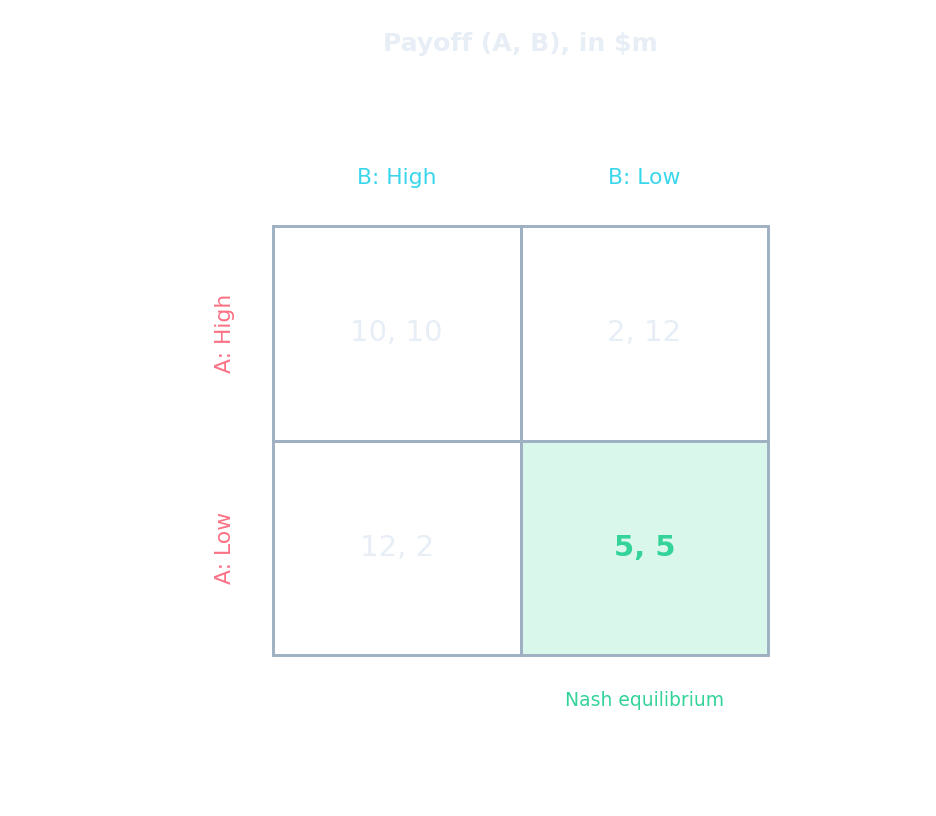
Best responses and stable outcomes
Hold the rival’s choice fixed and compare one firm’s own payoffs. A larger combined profit need not be stable against a unilateral switch.
A dominant strategy is a choice that is best:
Difficulté 1/5 · 100 pièces + un petit bonus lors de la première réussite aujourd'hui
It beats the alternatives regardless of the rival's choice.
At a Nash equilibrium, no firm can improve its payoff by changing only its own choice.
Difficulté 1/5 · 100 pièces + un petit bonus lors de la première réussite aujourd'hui
That is exactly what makes a Nash equilibrium stable.
The prisoner's dilemma
- In a prisoner's dilemma 囚徒困境, both firms have a dominant strategy to compete.
- So they reach a Nash equilibrium where both earn less than if they had cooperated.
- Rational self-interest blocks the better joint outcome — which is exactly why cartels keep collapsing.
Both firms earn 10 if both keep prices high, 5 if both go low, but a lone undercutter earns 12 (rival gets 2). The Nash equilibrium is:
Difficulté 1/5 · 100 pièces + un petit bonus lors de la première réussite aujourd'hui
"Low" is each firm's dominant strategy, so both pick it — earning 5 each, worse than the cooperative 10.
The result where both firms compete and end up worse off than cooperating is the prisoner's ______.
Difficulté 1/5 · 100 pièces + un petit bonus lors de la première réussite aujourd'hui
Rational self-interest leads to a worse joint outcome — the prisoner's dilemma.
Worked example: a two-airline pricing game
Airlines A and B each choose a High or Low fare. Profits (A, B) in millions of dollars: both High (10, 10); A High, B Low (2, 14); A Low, B High (14, 2); both Low (5, 5). Find each dominant strategy and the Nash equilibrium.
- For A: if B is High, Low gives 14 > 10; if B is Low, Low gives 5 > 2. So Low is A's dominant strategy; by symmetry, it is B's too.
- Nash equilibrium: both Low (5, 5), where neither can gain by changing alone. Both would be better off at High (10, 10), which is why they are tempted to collude, but each has an incentive to cheat: a prisoner's dilemma.
At a Nash equilibrium, no player can improve their payoff by changing strategy alone.
Difficulté 1/5 · 100 pièces + un petit bonus lors de la première réussite aujourd'hui
Each is making its best response to the other.
Why are cartels unstable?
Difficulté 1/5 · 100 pièces + un petit bonus lors de la première réussite aujourd'hui
Cheating raises one firm's profit at the others' expense.
An oligopoly has a few firms and mutual interdependence. They may collude into a cartel, but cheating makes it unstable. Game theory finds the dominant strategy and Nash equilibrium; the prisoner's dilemma shows why rivals compete even when cooperating would pay both more.
Write from a Nash payoff of 3
- Both keep prices high and each earns 8.
- Both go low and each earns 3. A lone undercutter earns 11 and the rival earns 1.
If both firms keep prices high, each earns 8. If both go low, each earns 3. A lone undercutter earns 11 and the other firm earns 1. What is the Nash payoff for each firm?
Each firm prefers to undercut whatever the other does, so both end on 3.
What does each firm earn in the Nash equilibrium?
Difficulté 1/5 · 100 pièces + un petit bonus lors de la première réussite aujourd'hui
Both play low, and the low-low cell pays 3 each. Other options — 8 (the cooperative payoff); 5 (the lesson Nash payoff).