Perfect Competition
Introduit| English | Sens |
|---|---|
| perfect competition/ˈpɜːfekt ˌkɒmpəˈtɪʃn/ | concurrence parfaite |
| free entry and exit/friː ˈentri ænd ˈeɡzɪt/ | entrée et sortie libres |
| price taker/praɪs ˈteɪkə/ | preneur de prix |
| profit/ˈprɒfɪt/ | bénéfice |
| economic profit/ˌiːkəˈnɒmɪk ˈprɒfɪt/ | Total revenue minus all economic costs, including explicit payments and the opportunity costs of owned resources. |
| loss/lɒs/ | perte |
| shut down | shut down |
| long-run equilibrium/lɒŋ rʌn ˌiːkwɪˈlɪbrɪəm/ | A market position in which firms have adjusted all inputs and entry or exit has removed incentives for further long-run adjustment. |
| allocative efficiency/ˈæləkətɪv ɪˈfɪʃənsi/ | Efficacité allocative |
| productive efficiency/prəˈdʌktɪv ɪˈfɪʃənsi/ | efficacité productive |
When no one can set the price
- Thousands of farms grow the same wheat. If one farmer asks even one cent above the market price, buyers simply go to the next farm; if she charges less, she gives money away, because she can already sell all she grows at the market price.
- This extreme case is perfect competition 完全竞争. Few real markets fit it exactly (wheat, rice and some currencies come close), but it is the benchmark against which every other market is judged.
The features, and why demand is flat
- Many small firms sell identical products, buyers and sellers have full information, and there is free entry and exit 自由进出 in the long run.
- So each firm is a price taker 价格接受者. The demand curve it faces is horizontal at the market price (perfectly elastic). Every extra unit sells for that price, so $P = AR = MR$ for the firm. The market as a whole still has a normal downward-sloping demand curve.
A perfectly competitive firm is a price taker, which means it:
Difficulté 1/5 · 100 pièces + un petit bonus lors de la première réussite aujourd'hui
It is too small to influence the price, so it takes the market price as given.
For a competitive firm, price equals average revenue and also equals ______ revenue.
Difficulté 1/5 · 100 pièces + un petit bonus lors de la première réussite aujourd'hui
Because every unit sells at the same price, P = AR = MR.
Select tout features of a perfectly competitive market.
Difficulté 2/5 · 140 pièces + un petit bonus lors de la première réussite aujourd'hui
Many firms, identical products, and free entry/exit define perfect competition; one controlling firm is a monopoly.
Short run: produce where P = MC, then compare with ATC and AVC
- Like every firm, it maximises profit where $MR = MC$; since $MR = P$, it produces where $P = MC$. Then read the costs at that quantity: profit per unit is $P - ATC$, and total economic profit 经济利润 = $(P - ATC) \times q$.
- Four cases: $P > ATC$: economic profit. $P = ATC$: break-even (normal profit). $AVC \le P < ATC$: a loss 亏损, but keep producing, because revenue still covers all variable costs and part of the fixed cost. $P < \text{min } AVC$: shut down 停产 in the short run; the loss is then only the fixed cost.
A competitive firm produces where P = MC. Price is 9, ATC is 12 and AVC is 7 at that output. In the short run the firm should
Difficulté 1/5 · 100 pièces + un petit bonus lors de la première réussite aujourd'hui
The price (9) is above AVC (7), so each unit covers its variable cost and adds 2 towards the fixed cost. Shutting down would lose the whole fixed cost.
Price is 15. The firm produces 50 units, where P = MC, and ATC there is 18. What is the firm's economic loss?
Difficulté 2/5 · 140 pièces + un petit bonus lors de la première réussite aujourd'hui
(18 − 15) × 50 = 150.
Side-by-side graphs: market and firm
- AP questions draw two graphs next to each other. The market graph (left) sets the price where market supply meets market demand. Draw that price straight across to the firm graph (right), where it becomes the firm's flat $P = MR = D = AR$ line.
- On the firm graph, find $q$ where $P = MC$, go down to ATC at that $q$, and shade the rectangle between price and ATC. In the figure the price $P_1$ is above ATC, so the shaded area is an economic profit.
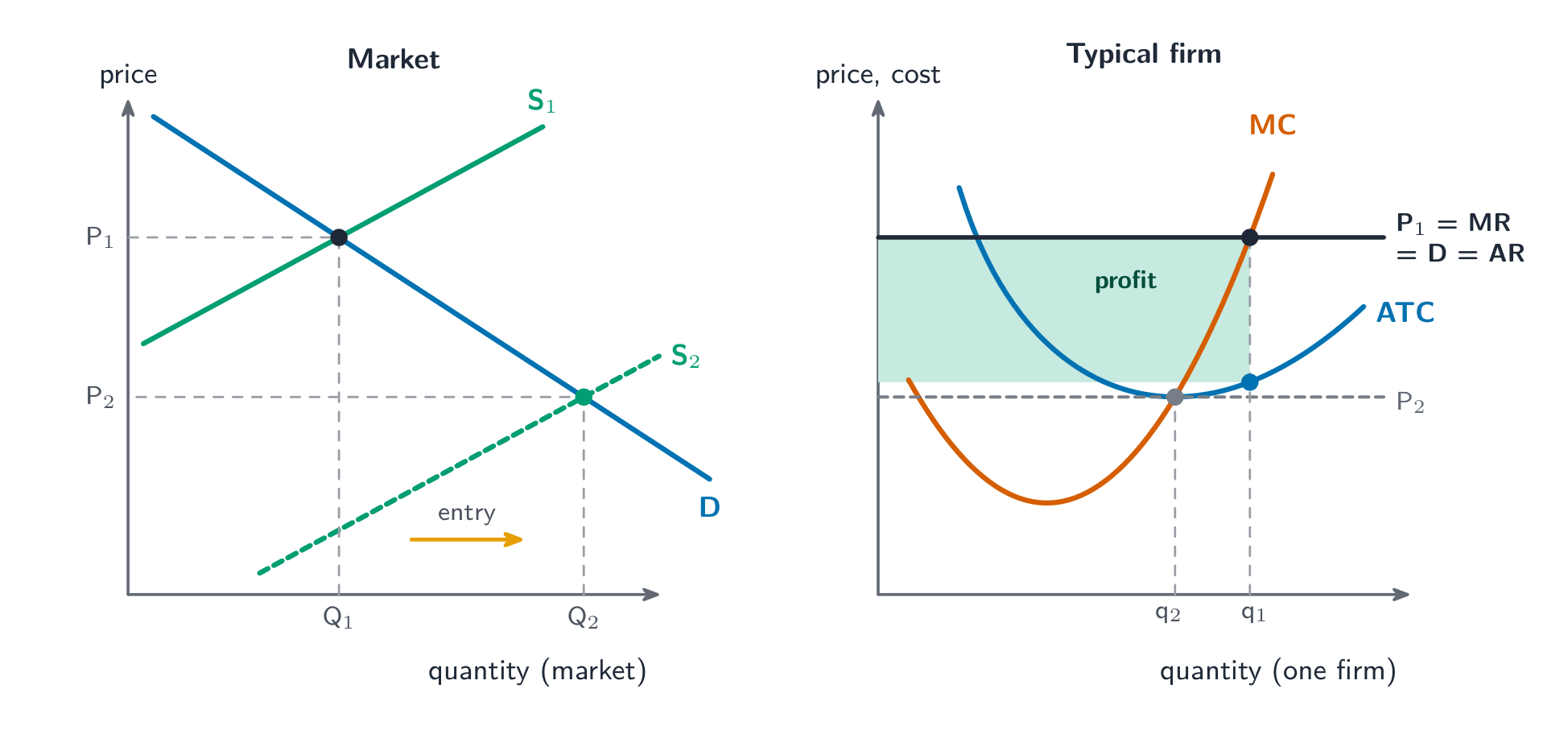
L'entreprise concurrentielle
A price-taking firm faces a horizontal demand at the market price and produces where P = MC. In the long run, entry and exit push it to P = minimum ATC.
On side-by-side graphs, market demand for a competitive good falls. What changes on the typical firm's graph in the short run?
Difficulté 1/5 · 100 pièces + un petit bonus lors de la première réussite aujourd'hui
The market sets a lower price, which the firm takes as its new MR. Its costs do not change.
Long run: entry and exit remove profit and loss
- Economic profit attracts new firms → market supply shifts right → price falls → each firm's profit shrinks, until $P = \text{min } ATC$. Losses make firms leave → market supply shifts left → price rises until losses are gone.
- In long-run equilibrium 长期均衡, $P = MR = MC = \text{min } ATC$ and economic profit is zero (firms still earn normal profit). In a constant-cost industry the long-run supply curve is horizontal at min ATC: a rise in demand brings more firms, not a higher long-run price.
In long-run equilibrium, a perfectly competitive firm produces where:
Difficulté 1/5 · 100 pièces + un petit bonus lors de la première réussite aujourd'hui
Entry and exit drive economic profit to zero at P = MC = minimum ATC.
Firms in a competitive industry are making losses. Put the long-run adjustment in order.
Difficulté 3/5 · 200 pièces + un petit bonus lors de la première réussite aujourd'hui
Exit continues until economic profit is zero again.
Why this is the efficiency benchmark
- Allocative efficiency 配置效率: $P = MC$. The price shows what buyers value the last unit at; MC shows what it costs society. They are equal, so the right amount is made (short and long run).
- Productive efficiency 生产效率: $P = \text{min } ATC$, so output is made at the lowest possible cost per unit. This holds only in the long run, after entry and exit have done their work.
Match each type of efficiency to its condition.
Difficulté 2/5 · 140 pièces + un petit bonus lors de la première réussite aujourd'hui
Perfect competition achieves both at once in the long run.
Worked examples: profit, loss, shutdown
A firm faces a market price and produces where $P = MC$. Classify each case and find the result.
- (a) $P = 30$, $q = 40$, $ATC = 25$, $AVC = 18$. $P > ATC$: profit = $(30 - 25) \times 40$ = 200. Firms will enter.
- (b) $P = 20$, $q = 30$, $ATC = 24$, $AVC = 16$. $AVC < P < ATC$: loss = $(24 - 20) \times 30$ = 120, but keep producing: revenue 600 covers variable cost 480 and pays 120 of the fixed cost.
- (c) $P = 12$, minimum $AVC = 14$, fixed cost 300. $P < \text{min } AVC$: shut down. The loss is the fixed cost, 300; producing would lose that and part of every variable cost.
A wheat farm sells at P = 5, produces Q = 1000 where MC = 5, and has ATC = 4. What is its short-run economic profit?
Difficulté 2/5 · 140 pièces + un petit bonus lors de la première réussite aujourd'hui
Profit = (P − ATC) × Q = (5 − 4) × 1000 = 1000. That profit attracts new farms to enter.
Worked FRQ answer
Question: The market for corn is perfectly competitive and in long-run equilibrium. (a) Draw correctly labeled side-by-side graphs for the corn market and a typical firm. Label the market price $P_M$ and the firm's quantity $q_F$. (b) Demand for corn rises because of new biofuel rules. On your graphs, show the short-run effect on the market price and on the firm's quantity and profit. (c) Explain what happens in the long run, assuming a constant-cost industry.
(a) Market: downward D, upward S, crossing at $P_M$. Firm: flat line at $P_M$ labeled $MR = D = P$, with MC rising through the lowest point of ATC on that line, and $q_F$ below it.
(b) Market demand shifts right, so the price rises to $P_2$. On the firm graph the MR line moves up to $P_2$; the firm raises output to where $P_2 = MC$, and since $P_2 > ATC$ it earns an economic profit (shade it).
(c) The profit attracts new firms. Market supply shifts right until the price falls back to $P_M$ (min ATC). Each firm returns to $q_F$ with zero economic profit; total market output is higher because there are more firms.
- Why it scores: the price is carried from the market graph to the firm graph; the firm's new quantity is where the new price meets MC (not ATC); (c) names entry, the supply shift and zero long-run economic profit.
FRQ practice. A perfectly competitive egg farm is in long-run equilibrium. The government then gives every egg farm a lump-sum subsidy (a fixed amount per year, not per egg). (a) What happens to the farm's marginal cost and average total cost? (b) In the short run, does the farm change its output? Explain. (c) Will the farm make an economic profit in the short run? (d) What happens in the long run?
A lump-sum change moves ATC only; a per-unit change would also move MC.
Common errors. Drawing a downward-sloping demand curve for the firm. Choosing the quantity where P = ATC instead of P = MC. Shutting down whenever there is a loss: compare price with AVC, not ATC. Shifting the firm's cost curves when market demand changes: only the price line moves.
A perfectly competitive firm is a price taker: its demand is flat, $P = AR = MR$. It produces where P = MC; profit is $(P - ATC) \times q$. Keep producing while P ≥ AVC; shut down if P < min AVC. Entry and exit drive the long run to P = MC = min ATC with zero economic profit: allocatively and productively efficient.
Write from the data: find the economic profit
- Price is 8, quantity is 200 and average total cost is 8.
- Marginal cost is also 8. Find short-run economic profit.
A competitive firm sells at price 8, produces 200 units where marginal cost is 8, and has average total cost 8. What is its economic profit?
8 minus 8 is 0, and 0 times 200 is 0.
What is the economic profit?
Difficulté 1/5 · 100 pièces + un petit bonus lors de la première réussite aujourd'hui
The price gap is 0, so profit is 0. Other options — 1000 (the lesson wheat profit); 200 (the quantity used as the profit).