Introduction to Imperfectly Competitive Markets
Introduit| English | Sens |
|---|---|
| market power/ˈmɑːkɪt ˈpaʊə/ | pouvoir de marché |
| imperfectly competitive market/ɪmˈpɜːfektlɪ kəmˈpetɪtɪv ˈmɑːkɪt/ | marché imparfaitement concurrentiel |
| price taker/praɪs ˈteɪkə/ | preneur de prix |
| downward-sloping demand curve/ˈdaʊnwəd ˈsləʊpɪŋ dɪˈmænd kɜːv/ | courbe de demande descendante |
| monopoly/məˈnɒpəli/ | monopole |
| monopolistic competition/məˈnɒpəlɪstɪk ˌkɒmpəˈtɪʃn/ | concurrentielle monopolistique |
| oligopoly/ˌɒlɪˈɡɒpəli/ | oligopole |
| monopsony/məˈnɒpsəni/ | monopsonie |
| barriers to entry/ˈbærɪəz tʊ ˈentri/ | barrières à l'entrée |
| economic profit/ˌiːkəˈnɒmɪk ˈprɒfɪt/ | bénéfice économique |
Most markets aren't "perfect"
- Perfect competition is a useful benchmark — but almost no real market matches it.
- Your phone network, favourite cafe, and local cinema all set their own prices.
- Any firm that can nudge its price has some market power 市场势力.
- The markets where this happens are called imperfectly competitive markets 不完全竞争市场.
Market power means a downward demand curve
- A price taker 价格接受者 faces a flat demand curve — it sells all it wants at the market price.
- An imperfect competitor faces a downward-sloping demand curve 向下倾斜的需求曲线 — to sell more, it must lower its price.
- That is exactly what market power is: the ability to set price above marginal cost.
A firm with market power faces a demand curve that is:
Difficulté 1/5 · 100 pièces + un petit bonus lors de la première réussite aujourd'hui
To sell more it must lower its price — a downward-sloping demand curve.
A price taker can raise its price above the market price and still sell everything.
Difficulté 1/5 · 100 pièces + un petit bonus lors de la première réussite aujourd'hui
A price taker must accept the market price; charging more loses all its buyers.
Four imperfect structures
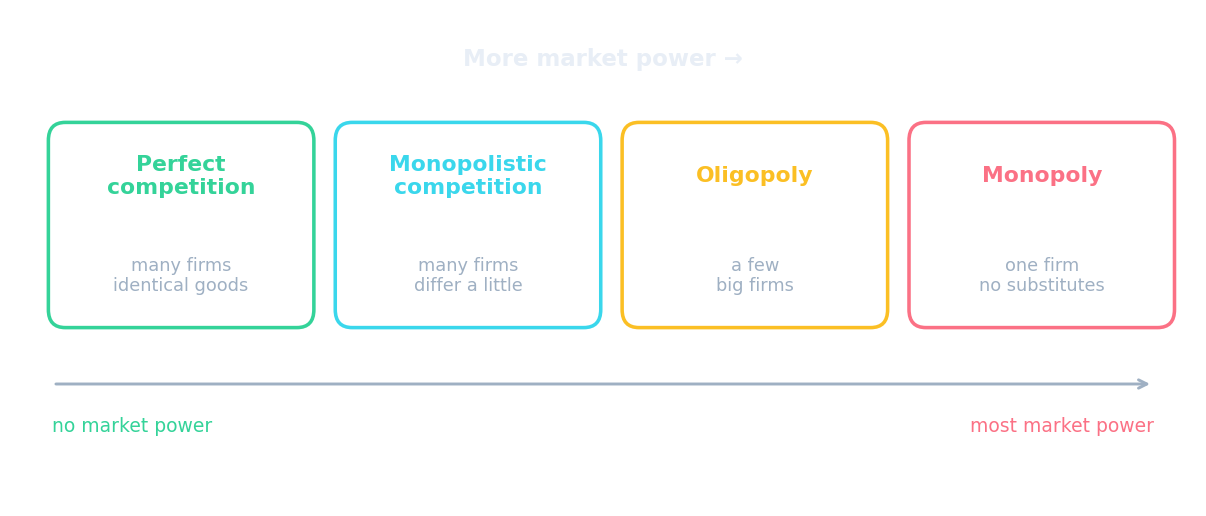
- Monopoly 垄断: one firm, no close substitutes.
- Oligopoly 寡头垄断: a few large firms that watch each other.
- Monopolistic competition 垄断竞争: many firms selling slightly different products.
- Monopsony 买方垄断: one big buyer — the mirror image of monopoly.
Which market structure?
Structures differ by how many firms there are and how similar their products are — from perfect competition to monopoly.
Match each structure to its defining feature.
Difficulté 2/5 · 140 pièces + un petit bonus lors de la première réussite aujourd'hui
They differ by number of firms, product similarity, and (for monopsony) being a buyer.
Barriers to entry
- What lets these firms keep economic profit 经济利润 even in the long run is barriers to entry 进入壁垒.
- A barrier is anything that stops new firms coming in to compete the profit away.
- Common barriers: large start-up costs, control of a key resource, patents, and government licences.
Anything that stops new firms from entering a market is a ______ to entry.
Difficulté 1/5 · 100 pièces + un petit bonus lors de la première réussite aujourd'hui
Barriers to entry protect economic profit in the long run.
Select tout that are barriers to entry.
Difficulté 2/5 · 140 pièces + un petit bonus lors de la première réussite aujourd'hui
Patents, key resources and high start-up costs block entry; many competitors is the opposite.
Worked example: why marginal revenue is below price
A firm can sell 10 units at 20 dollars each or 11 units at 19 dollars each. Find the marginal revenue of the 11th unit and explain why it is less than the price.
- TR at 10 units = $10\times20=200$ dollars; at 11 units = $11\times19=209$ dollars. MR = 209 − 200 = 9 dollars, even though the 11th unit sells for 19.
- To sell one more unit, the firm must cut the price on all units, losing 1 dollar on each of the first 10. So MR = 19 − 10 = 9. A price taker faces no such loss, so for it MR = P.
A firm sells 5 units at 12 dollars or 6 units at 11 dollars. What is the marginal revenue of the 6th unit, in dollars?
Difficulté 2/5 · 140 pièces + un petit bonus lors de la première réussite aujourd'hui
66 − 60 = 6 dollars.
For a perfectly competitive firm, marginal revenue equals the market price.
Difficulté 1/5 · 100 pièces + un petit bonus lors de la première réussite aujourd'hui
It sells every unit at the same price.
An imperfectly competitive firm has market power — a downward-sloping demand curve and price above marginal cost. The four structures are monopoly, oligopoly, monopolistic competition, and monopsony. Barriers to entry protect their long-run profit.
Write from one water seller
- One firm sells all the town's water.
- Four large rivals set prices while watching each other.
One firm sells all the town's water. Four other large firms in a different market watch each other's prices. Name each market structure.
A single seller is a monopoly. A few interdependent sellers are an oligopoly.
What structure is the single water firm?
Difficulté 1/5 · 100 pièces + un petit bonus lors de la première réussite aujourd'hui
One seller of the town's water is a monopoly. Other options — An oligopoly (because water is a big industry); Perfect competition (because households buy water).