Profit Maximization
Introduit| English | Sens |
|---|---|
| total revenue/ˈtəʊtl ˈrevənjuː/ | recette totale |
| average revenue/ˈævrɪdʒ ˈrevənjuː/ | revenu moyen |
| marginal revenue/ˈmɑːdʒɪnl ˈrevənjuː/ | revenu marginal |
| profit-maximizing rule/ˈprɒfɪt ˈmæksɪmaɪzɪŋ ruːl/ | règle de maximisation du bénéfice |
One more batch of cakes?
- A bakery sells cakes for 20 dollars each. Baking a 5th batch of cakes today costs an extra 20 dollars in flour, power and overtime; a 6th batch would cost an extra 26. Should it bake the 6th? Not if it wants the most profit: that batch adds 20 to revenue but 26 to cost.
- Every firm, in every market structure, finds its best output with the same comparison: the extra revenue from one more unit against its extra cost.
Three revenue ideas
- Total revenue 总收入 (TR) is all the money from sales: $TR = P \times Q$.
- Average revenue 平均收入 (AR) is revenue per unit: $AR = \tfrac{TR}{Q}$ — this always equals the price.
- Marginal revenue 边际收入 (MR) is the extra revenue from one more unit: $MR = \tfrac{\Delta TR}{\Delta Q}$.
Marginal revenue is:
Difficulté 1/5 · 100 pièces + un petit bonus lors de la première réussite aujourd'hui
MR = ΔTR/ΔQ — the change in total revenue from one more unit sold.
Average revenue always equals the price of the good.
Difficulté 1/5 · 100 pièces + un petit bonus lors de la première réussite aujourd'hui
AR = TR/Q = (P × Q)/Q = P.
Produce where MR = MC
- The profit-maximizing rule 利润最大化法则: make the quantity where marginal revenue equals marginal cost.
- If $MR > MC$, the next unit earns more than it costs — keep going.
- If $MR < MC$, the next unit costs more than it earns — make less.
- Only at $MR = MC$ can profit no longer improve.
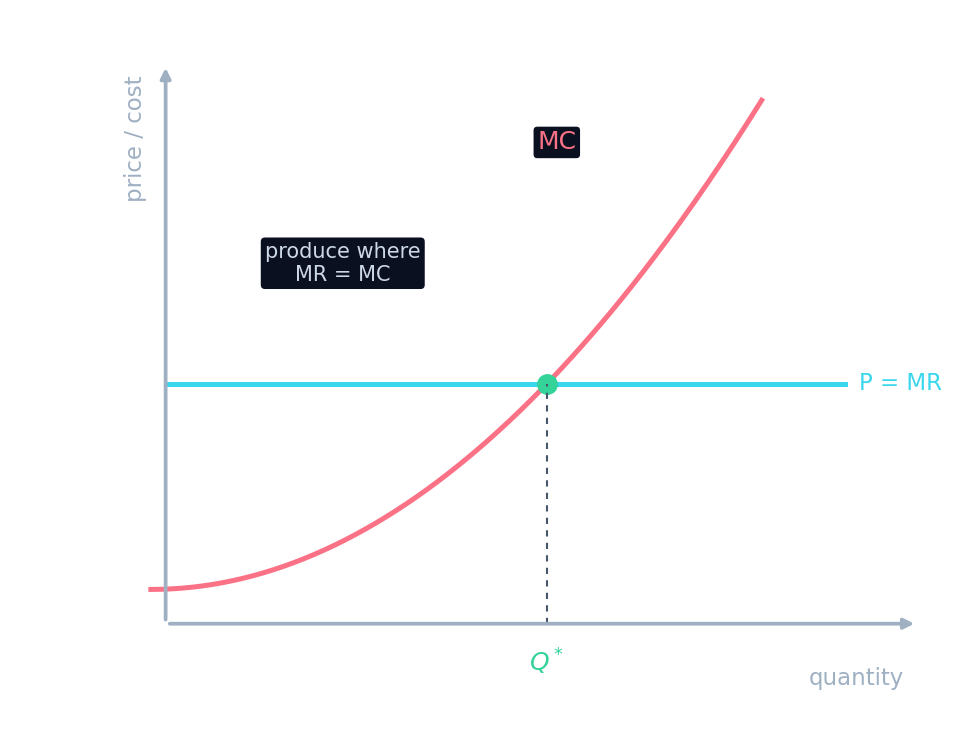
Cost curves and the best quantity
A firm maximises profit where marginal revenue meets marginal cost. Explore how the marginal-cost curve sets that best quantity.
A firm maximises profit by producing the quantity where:
Difficulté 1/5 · 100 pièces + un petit bonus lors de la première réussite aujourd'hui
At MR = MC profit can no longer improve — the profit-maximizing rule.
At the current output, MR is greater than MC. The firm should:
Difficulté 1/5 · 100 pièces + un petit bonus lors de la première réussite aujourd'hui
MR > MC means the next unit adds to profit, so keep producing until MR = MC.
Worked example: profit peaks where MR = MC
The bakery is a price taker at 20 dollars, so $MR = 20$.
| Q | TR | TC | Profit | MC |
|---|---|---|---|---|
| 2 | 40 | 36 | 4 | 10 |
| 3 | 60 | 48 | 12 | 12 |
| 4 | 80 | 64 | 16 | 16 |
| 5 | 100 | 84 | 16 | 20 |
| 6 | 120 | 110 | 10 | 26 |
- Each unit up to the 5th has $MR \ge MC$, so it adds to profit (or adds nothing). The 6th has $MC = 26 > 20$, so profit falls from 16 to 10. The best output is 5, where $MR = MC$.
- At $Q = 5$, $ATC = 84 \div 5 = 16.8$, and profit $= (20 - 16.8) \times 5 = 16$, the same as $TR - TC = 100 - 84$.
- Table rule: produce every unit for which $MR \ge MC$, and stop at the last such unit. If MR never exactly equals MC, choose the last unit where MR is still greater.
A price-taking firm sells at 15 dollars. Its marginal cost of the 1st to 6th units is 6, 8, 11, 15, 19, 24. How many units maximize profit?
Difficulté 2/5 · 140 pièces + un petit bonus lors de la première réussite aujourd'hui
Units 1 to 4 each have MR = 15 ≥ MC. The 5th costs 19 > 15, so it would lower profit.
Measure the profit on a graph
- Find $Q^*$ where MR = MC, then go up to read price (on the demand or MR = P line) and ATC at $Q^*$. Economic profit $= (P - ATC) \times Q^*$: a rectangle whose height is $P - ATC$ and whose width is $Q^*$.
- If $P > ATC$ there is profit; if $P = ATC$ the firm breaks even (normal profit); if $P < ATC$ there is a loss. MR = MC gives the best quantity in all three cases: the biggest profit, or the smallest loss.
At its best quantity a firm makes Q = 50 units, with price P = 12 and average total cost ATC = 9. What is its economic profit?
Difficulté 2/5 · 140 pièces + un petit bonus lors de la première réussite aujourd'hui
Economic profit = (P − ATC) × Q = (12 − 9) × 50 = 150.
Economic profit at the best quantity equals (P − ______) × Q.
Difficulté 1/5 · 100 pièces + un petit bonus lors de la première réussite aujourd'hui
Per-unit profit is P − ATC; multiply by Q for total economic profit.
Which quantity maximizes a firm's total profit?
Difficulté 1/5 · 100 pièces + un petit bonus lors de la première réussite aujourd'hui
Profit per unit can be largest at a smaller output, but total profit keeps rising as long as each extra unit adds more revenue than cost.
Worked FRQ answer
Question: A perfectly competitive firm sells at a market price of 12 dollars. At its profit-maximizing output of 40 units, its average total cost is 9 dollars and its average variable cost is 7 dollars. (a) State the profit-maximizing rule the firm used. (b) Calculate its economic profit. (c) The market price falls to 8 dollars, and the firm's new profit-maximizing output has ATC = 10 and AVC = 7. Is the firm earning a profit or a loss? Should it keep producing in the short run? Explain.
(a) It produces where marginal revenue equals marginal cost (MR = MC; for a price taker, P = MC).
(b) $(12 - 9) \times 40 = 120$ dollars.
(c) A loss, because $P = 8 < ATC = 10$. It should keep producing in the short run, because $P = 8 > AVC = 7$: revenue covers all variable costs and part of the fixed costs, so the loss is smaller than shutting down.
- Why it scores: (b) uses ATC for profit, not MC; (c) uses ATC to judge profit or loss and AVC to judge shutdown, and says why each comparison matters.
FRQ practice. A perfectly competitive firm faces a price of 30 dollars. At its profit-maximizing output of 100 units, ATC = 34 and AVC = 26. (a) What is the firm's marginal revenue? (b) Calculate its economic profit or loss. (c) Should it produce or shut down in the short run? Explain. (d) What would its loss be if it shut down?
Use ATC for profit, AVC for the shutdown decision.
Common errors. Choosing the output where profit per unit ($P - ATC$) is biggest, or where ATC is lowest: the rule is MR = MC. Computing profit as $(P - MC) \times Q$. Stopping production when the firm makes a loss, without checking AVC.
TR = P × Q, AR = P, and MR is the extra revenue from one more unit. The profit-maximizing rule: produce where MR = MC (in a table, the last unit with MR ≥ MC). Then measure profit as (P − ATC) × Q: positive if P > ATC, zero if equal, a loss if below. The rule also gives the smallest possible loss.
Write from the data: find the economic profit
- The best output is 20 units. Price is 15 and average total cost is 11.
- Find economic profit.
A firm produces 20 units at price 15 with average total cost 11. What is its economic profit?
4 times 20 is 80.
What is the economic profit?
Difficulté 1/5 · 100 pièces + un petit bonus lors de la première réussite aujourd'hui
The gap of 4 times the quantity 20 is 80. Other options — 150 (the lesson profit); 4 (the gap per unit left unmultiplied).