Other Elasticities
Introduit| English | Sens |
|---|---|
| cross-price elasticity of demand/krɒs praɪs ɪlæˈstɪsɪti ɒv dɪˈmænd/ | élasticité croisée de la demande |
| substitutes/ˈsʌbstɪtjuːts/ | biens substituts |
| complements/ˈkɒmplɪmənts/ | biens complémentaires |
| income elasticity of demand/ˈɪŋkʌm ɪlæˈstɪsɪti ɒv dɪˈmænd/ | élasticité-revenu de la demande |
| normal good/ˈnɔːml ɡʊd/ | bien normal |
| inferior good/ɪnˈfɪərɪə ɡʊd/ | bien inférieur |
| necessity/nəˈsesɪti/ | A normal good whose quantity demanded rises proportionately less than income when other factors are unchanged. |
| luxury/ˈlʌkʃəri/ | In economics, a good whose demand rises more than proportionally as income rises over the relevant range. |
What tea tells you about coffee
- In 2022 the price of tea leaves jumped in several countries, and coffee shops sold more coffee. When the economy grows and incomes rise, people buy more restaurant meals but fewer instant noodles. Neither change is caused by the good's own price.
- Two elasticities measure these reactions: the cross-price elasticity links one good to another good's price, and the income elasticity links a good to buyers' incomes. Their sign tells you which way the demand curve shifts.
Cross-price elasticity (XED)
- Cross-price elasticity of demand 交叉价格弹性: $\text{XED} = \dfrac{\%\,\Delta\,Q_X}{\%\,\Delta\,P_Y}$. The top is the change in the quantity of good X; the bottom is the change in the price of a different good, Y.
- Positive XED: substitutes 替代品 (tea dearer → more coffee). Negative XED: complements 互补品, used together (printers dearer → fewer printers sold → less ink). Close to zero: unrelated goods (the price of socks and the demand for coffee). The bigger the absolute value, the closer the link.
Two goods have a positif cross-price elasticity. They are:
Difficulté 1/5 · 100 pièces + un petit bonus lors de la première réussite aujourd'hui
Positive XED: a dearer Y sends buyers to X — the goods substitute for each other.
Printers and ink are complements, so their cross-price elasticity is negative.
Difficulté 1/5 · 100 pièces + un petit bonus lors de la première réussite aujourd'hui
A dearer printer lowers ink demand — a negative XED marks complements.
Income elasticity (YED)
- Income elasticity of demand 收入弹性: $\text{YED} = \dfrac{\%\,\Delta\,Q}{\%\,\Delta\,\text{income}}$. A normal good 正常商品 has YED > 0; an inferior good 低档商品 has YED < 0, because people switch to better options as they get richer.
- Normal goods split by size: between 0 and 1 is a necessity 必需品 (income-inelastic: bread, electricity); above 1 is a luxury 奢侈品 (income-elastic: foreign holidays, restaurant meals).
| Value | Meaning |
|---|---|
| XED > 0 | substitutes |
| XED < 0 | complements |
| XED ≈ 0 | unrelated goods |
| YED > 1 | normal good, luxury |
| 0 < YED < 1 | normal good, necessity |
| YED < 0 | inferior good |
Read the sign
The sign of cross-price elasticity tells you substitutes (+) from complements (−); the sign of income elasticity tells you normal (+) from inferior (−) goods.
A good with a positif income elasticity of demand is a:
Difficulté 1/5 · 100 pièces + un petit bonus lors de la première réussite aujourd'hui
Positive YED: buyers want more as income rises — a normal good.
A good you buy moins of as your income rises is called an ______ good.
Difficulté 1/5 · 100 pièces + un petit bonus lors de la première réussite aujourd'hui
An inferior good has a negative income elasticity of demand.
Worked example: the midpoint method
The price of tea rises from 4 to 6 dollars. Coffee sales rise from 90 to 110 cups a day. Find the XED with the midpoint method.
- %Δ in the price of tea = (6 − 4) ÷ average of 4 and 6 = 2 ÷ 5 = 40%. %Δ in coffee quantity = (110 − 90) ÷ average of 90 and 110 = 20 ÷ 100 = 20%.
- XED = 20% ÷ 40% = +0.5. Positive, so tea and coffee are substitutes; 0.5 is a fairly weak link. The midpoint method gives the same answer whether the price goes up or down, which is why AP questions often use it.
Income rises 10% and quantity of bus tickets demanded falls 5%. What is the income elasticity of demand (keep the sign)?
Difficulté 2/5 · 140 pièces + un petit bonus lors de la première réussite aujourd'hui
$\text{YED} = -5\% \div 10\% = -0.5$; the negative sign means bus travel is an inferior good here.
Average income rises from 40,000 to 60,000 dollars. Restaurant meals bought rise from 80 to 120 a year per family. Using the midpoint method, what is the income elasticity of demand?
Difficulté 2/5 · 140 pièces + un petit bonus lors de la première réussite aujourd'hui
%Δ income = 20,000 ÷ 50,000 = 40%. %ΔQ = 40 ÷ 100 = 40%. YED = 40% ÷ 40% = 1.0, the border between a necessity and a luxury.
From the sign to the graph
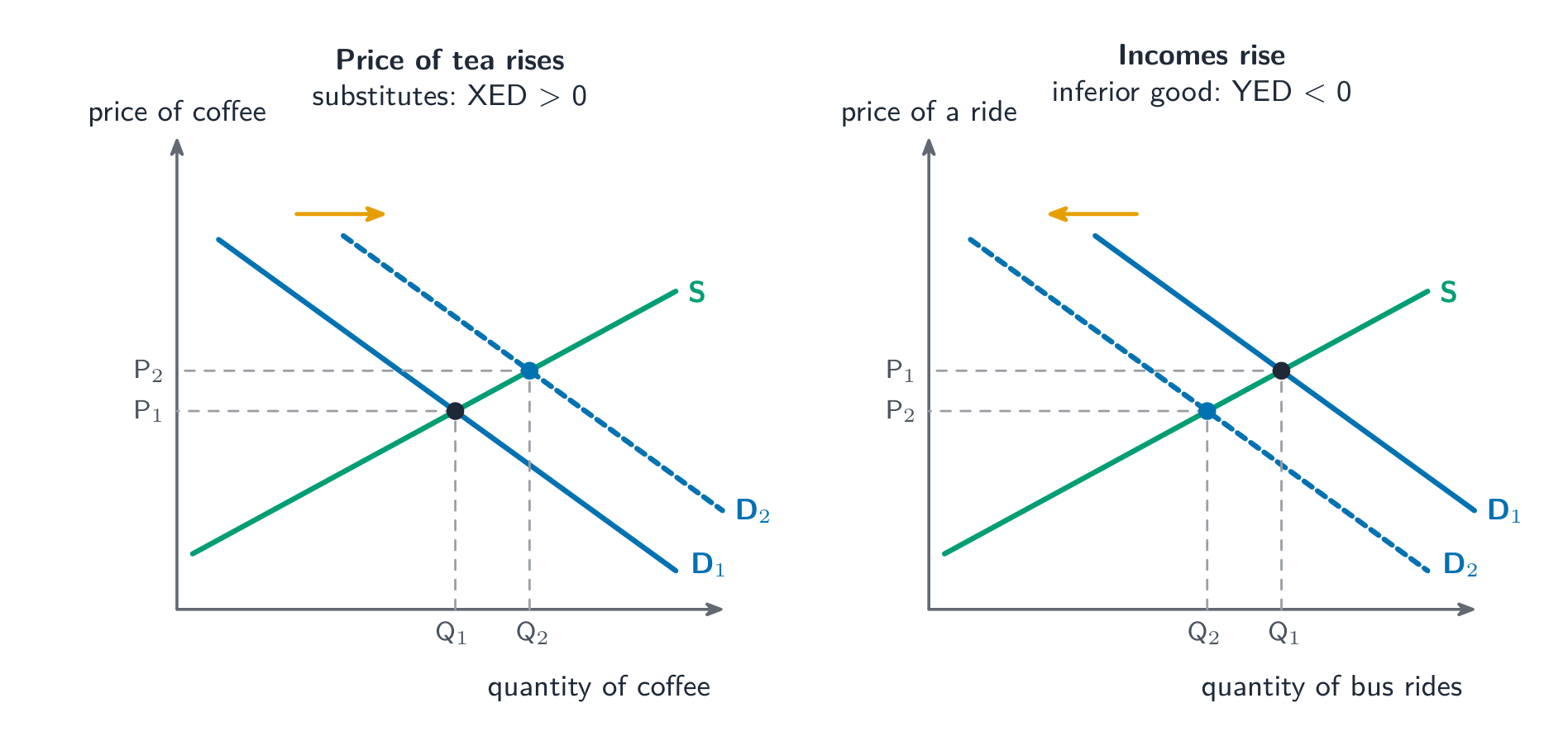
- The sign tells you how the demand curve of the other good shifts. Substitutes: a higher price of Y shifts demand for X right, so the price and quantity of X both rise. Complements: a higher price of Y shifts demand for X left.
- For income: a rise in income shifts demand for a normal good right and for an inferior good left. Either way, the change is a shift, not a movement along the curve, because the good's own price did not cause it.
The XED between e-books and e-readers is −1.2. The price of e-readers falls. What happens in the market for e-books?
Difficulté 1/5 · 100 pièces + un petit bonus lors de la première réussite aujourd'hui
Negative XED means complements. Cheaper e-readers mean more e-readers, so more e-books are wanted at every price.
In a recession, incomes fall. The YED of second-hand clothes is −0.8. What happens to demand for second-hand clothes?
Difficulté 1/5 · 100 pièces + un petit bonus lors de la première réussite aujourd'hui
For an inferior good, a fall in income raises demand. Negative YED times a negative change in income gives a positive change in quantity.
Worked example: classifying goods by elasticity
(a) The price of printers rises 10% and ink sales fall 15%. (b) Incomes rise 5% and bus rides fall 2%. (c) Incomes rise 5% and restaurant meals rise 12%. (d) Incomes rise 10% and bread sales rise 2%. Calculate and interpret each elasticity.
- (a) XED = −15% ÷ 10% = −1.5: negative, so printers and ink are complements, closely linked. (b) YED = −2% ÷ 5% = −0.4: negative, so bus rides are an inferior good.
- (c) YED = 12% ÷ 5% = 2.4: above 1, a luxury (normal good); spending on it grows faster than income. (d) YED = 2% ÷ 10% = 0.2: between 0 and 1, a necessity (normal good).
Match each elasticity sign to what it tells you.
Difficulté 2/5 · 140 pièces + un petit bonus lors de la première réussite aujourd'hui
The sign does the classifying: substitutes/complements for XED, normal/inferior for YED.
The price of tea rises 20% and the quantity of coffee demanded rises 8%. What is the cross-price elasticity?
Difficulté 2/5 · 140 pièces + un petit bonus lors de la première réussite aujourd'hui
8 ÷ 20 = 0.4, positive, so they are substitutes.
A good has an income elasticity of 0.3. It is:
Difficulté 1/5 · 100 pièces + un petit bonus lors de la première réussite aujourd'hui
YED between 0 and 1 means normal but income-inelastic.
Worked FRQ answer
Question: The cross-price elasticity of demand between hot dogs and hot dog buns is −2.0. (a) Are the goods substitutes or complements? Explain using the value. (b) The price of hot dogs rises. Using a correctly labeled graph of the market for buns, show the effect on the equilibrium price and quantity of buns. (c) If the price of hot dogs rises by 10%, by what percentage does the quantity of buns demanded change?
(a) Complements, because the cross-price elasticity is negative: a rise in the price of hot dogs lowers the quantity of buns demanded.
(b) Axes "Price of buns" and "Quantity of buns", a supply curve S and demand D₁. Demand shifts left to D₂. The equilibrium price falls from P₁ to P₂ and the quantity falls from Q₁ to Q₂.
(c) %ΔQ = XED × %ΔP = −2.0 × 10% = −20%: a 20% fall.
- Why it scores: (a) gives the label and uses the sign as the reason; (b) shifts demand (not supply) because the cause is another good's price, and labels both new values; (c) rearranges the formula and keeps the minus sign.
FRQ practice. The income elasticity of demand for cinema tickets is 1.6. (a) Is a cinema ticket a normal or an inferior good? Is it a necessity or a luxury? Explain. (b) Incomes fall by 5%. Calculate the percentage change in the quantity of tickets demanded. (c) Show the effect of the fall in income on the market for cinema tickets on a correctly labeled graph, and state what happens to the equilibrium price.
Multiply YED by the income change to find the quantity change, then let the sign decide the direction of the shift.
Common errors. Putting the good's own price on the bottom of XED (that is price elasticity of demand). Dropping the minus sign: for these elasticities the sign is the answer. Calling every normal good a luxury: a normal good with YED between 0 and 1 is a necessity.
XED = %ΔQ of X ÷ %ΔP of Y: positive → substitutes, negative → complements, near 0 → unrelated. YED = %ΔQ ÷ %Δincome: above 1 → luxury, 0 to 1 → necessity, negative → inferior. Read the sign first; it tells you which way demand shifts. Use the midpoint method for percentage changes.
Write from the data: find the cross-price elasticity
- The price of tea rises 20 percent.
- Coffee quantity demanded rises 8 percent.
The price of tea rises by 20 percent and the quantity of coffee demanded rises by 8 percent. What is the cross-price elasticity, and are tea and coffee substitutes or complements?
8 divided by 20 is 0.4, and a positive cross-price elasticity means substitutes.
What is the cross-price elasticity of coffee with respect to tea?
Difficulté 1/5 · 100 pièces + un petit bonus lors de la première réussite aujourd'hui
8 divided by 20 is 0.4, and the positive sign means substitutes.