Cost-Benefit Analysis
Introduit| English | Sens |
|---|---|
| cost-benefit analysis/kɒst ˈbenɪfɪt əˈnæləsɪs/ | analyse coûts-avantages |
| opportunity cost/ɒpəˈtjuːnɪti kɒst/ | coût d'opportunité |
| sunk cost/sʌŋk kɒst/ | coût sunk |
| sunk-cost fallacy/sʌŋk kɒst ˈfæləsi/ | erreur du coût sunk |
| implicit cost | The value of what you give up without paying, such as wages you do not earn. |
| explicit cost | explicit cost |
The $\$50$ ticket you should ignore
- You already paid $\$50$ for a concert ticket.
- On the night you feel ill and would honestly rather stay home.
- Should you drag yourself out just to "get your money's worth"?
- Economics gives a sharp answer — and the $\$50$ has nothing to do with it.
Weigh benefit against cost
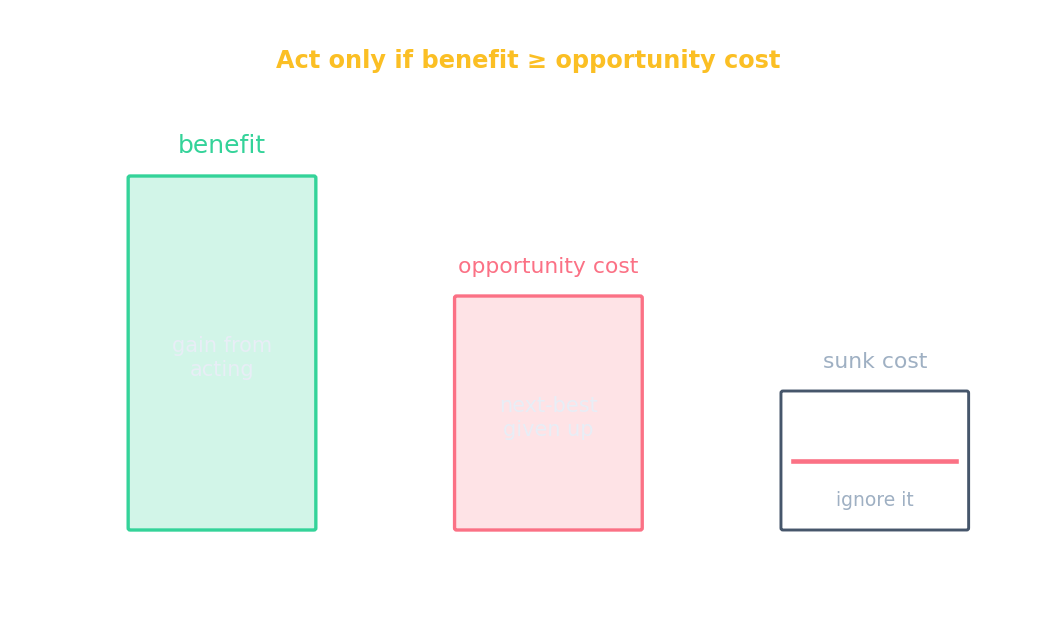
- Cost-benefit analysis 成本收益分析: take an action only when its benefit is at least as large as its cost.
- Weigh what you gain against what you give up, then decide.
- If benefit ≥ cost, do it; if not, don't.
Cost-benefit analysis says to take an action when:
Difficulté 1/5 · 100 pièces + un petit bonus lors de la première réussite aujourd'hui
Act only when benefit ≥ cost — comparing what you gain with what you give up.
The real cost is opportunity cost
- The cost that matters is the opportunity cost 机会成本 — the best alternative given up — not just the money spent.
- A dollar figure often misses the real cost.
- The true cost of a year at university is not only tuition, but also the wages you could have earned instead.
Which costs count?
A good decision weighs futures benefits and costs. Money already spent — a sunk cost — is gone and should be ignored.
The true cost of a year at university is best measured as:
Difficulté 1/5 · 100 pièces + un petit bonus lors de la première réussite aujourd'hui
Opportunity cost includes the wages given up, not just the money paid.
Match each idea to its meaning.
Difficulté 2/5 · 140 pièces + un petit bonus lors de la première réussite aujourd'hui
Decisions use opportunity cost and cost-benefit analysis; sunk costs are ignored.
Ignore sunk costs
- A sunk cost 沉没成本 is money already spent that you cannot get back.
- Only future costs and benefits should affect a decision — the past is gone either way.
- Back to the ticket: the $\$50$ is spent whether you go or not, so ignore it and just choose what you now prefer.
- Going only "to get your money's worth" is the sunk-cost fallacy 沉没成本谬误.
You should factor in money already spent (a sunk cost) when deciding what to do next.
Difficulté 1/5 · 100 pièces + un petit bonus lors de la première réussite aujourd'hui
Sunk costs are gone either way — only future costs and benefits should affect the choice.
Money already spent that cannot be recovered is a ______ cost.
Difficulté 1/5 · 100 pièces + un petit bonus lors de la première réussite aujourd'hui
A sunk cost should never influence a forward-looking decision.
You paid $50 for a ticket but now feel ill and would prefer to stay home. What should you do?
Difficulté 1/5 · 100 pièces + un petit bonus lors de la première réussite aujourd'hui
Going just to "use" the sunk $50 is the sunk-cost fallacy. Choose by future benefit vs cost.
Explicit plus implicit costs
- An explicit cost 显性成本 is money you actually pay out, such as a fee. An implicit cost 隐性成本 is the value of what you give up without paying, such as wages you do not earn.
- The full opportunity cost is explicit + implicit. Ravi pays $\$40$ for a ticket and misses a 3-hour shift at $\$12$ an hour, so the concert really costs him $\$40+\$36=\$76$.
A course costs $\$50$ in fees and takes 4 hours that you could have spent working at $\$15$ an hour. What is its full opportunity cost, in dollars?
Difficulté 2/5 · 140 pièces + un petit bonus lors de la première réussite aujourd'hui
Explicit $\$50$ plus implicit $4\times\$15=\$60$, so $\$110$ in total.
Mia can join a weekend coding course. The fee is $\$120$, but she has already paid a $\$30$ deposit that she cannot get back. The course also takes two Saturday café shifts worth $\$60$ each. She values what she will learn at $\$220$.
- Sunk: the $\$30$ deposit is gone either way, so leave it out.
- Cost from now on: explicit $\$120-\$30=\$90$, implicit $2\times\$60=\$120$, total $\$210$.
- Benefit $\$220\ge$ cost $\$210$, so she should take the course. Counting the deposit again ($\$240$) would wrongly say no.
Mia's course is the same, but she now values it at only $\$200$. What should she do?
Difficulté 1/5 · 100 pièces + un petit bonus lors de la première réussite aujourd'hui
Compare the $\$200$ benefit with the forward-looking cost of $\$90+\$120=\$210$. The deposit is sunk, and the café wages are a real cost. The last option reaches the right choice for the wrong reason.
Cost-benefit analysis: act only when benefit ≥ cost. The right cost is the opportunity cost (the best alternative given up), not just money. Ignore sunk costs — money already spent — because only future costs and benefits should change your choice.
Write from a sunk cost of 30
- A 30 dollar gym fee is already paid.
- The next hour would be better spent studying.
You already paid 30 dollars for a gym day, but you now feel tired and would learn more by studying. Should the 30 dollars decide the next hour?
A cost already paid does not change with the next choice.
What should decide the next hour?
Difficulté 1/5 · 100 pièces + un petit bonus lors de la première réussite aujourd'hui
The 30 dollars is already spent, so only the next hour's benefit matters.