Malthusian Theory
Introduit| English | Sens |
|---|---|
| Neo-Malthusians/ˈniːəʊ mælˈθjuːzɪənz/ | néo-malthusiens |
| exponentially/ˌekspəˈnenʃəli/ | exponentiellement |
| linearly/ˈlɪnɪəli/ | linéairement |
A warning from 1798
- In 1798, when the world had about 1 billion people, the English clergyman Thomas Malthus warned that population would soon outrun food. Today the world has over 8 billion people, and on average each person has more food than in 1798.
- Was Malthus wrong, or just early? The exam expects you to explain his theory, its critics, and the Neo-Malthusians 新马尔萨斯主义者 who revived it.
The theory in numbers
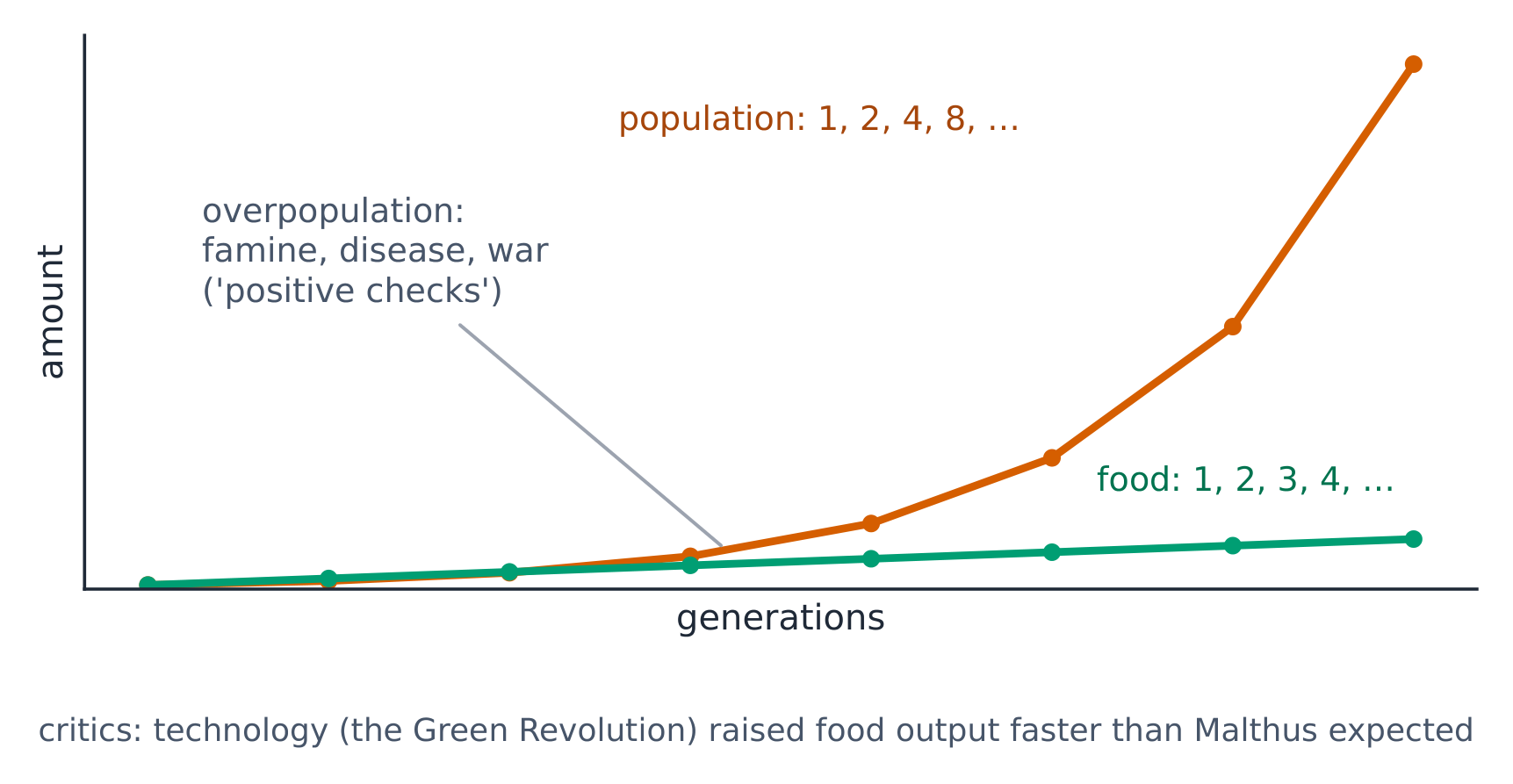
| Generation | 1 | 2 | 3 | 4 | 5 |
|---|---|---|---|---|---|
| Population (grows exponentially 指数式: ×2) | 1 | 2 | 4 | 8 | 16 |
| Food (grows linearly 线性: +1) | 1 | 2 | 3 | 4 | 5 |
| Food per person | 1 | 1 | 0.75 | 0.5 | 0.31 |
- Malthus argued that population doubles each generation while food rises only by a fixed amount, so food per person must fall. When it falls too far, a crisis follows.
Malthusian idea or criticism?
Sort each statement as a Malthusian claim or a criticism of Malthus.
Population doubles each generation from 1, and food grows by 1 each generation from 1. What is food per person in generation 6?
Difficulté 2/5 · 140 pièces + un petit bonus lors de la première réussite aujourd'hui
Population is 32 and food is 6, so food per person is 6 ÷ 32 ≈ 0.19.
Checks on population
- Positive checks raise the death rate: famine, disease and war. Malthus thought these were nature's way of bringing population back in line with food.
- Preventive checks lower the birth rate: marrying later and having fewer children. He hoped for these but did not expect them to be enough.
Match each example to its type of check.
Difficulté 2/5 · 140 pièces + un petit bonus lors de la première réussite aujourd'hui
Positive checks raise deaths; preventive checks lower births.
Why the crisis did not come (yet)
- Technology: the Agricultural Revolutions and the Green Revolution (1960s onward: new seeds, fertiliser and irrigation) multiplied food output. India's wheat harvest more than tripled between 1965 and 1990.
- Trade moves food from surplus to deficit regions; and falling birth rates (DTM Stages 3–5) slowed population growth, which Malthus did not predict.
Which help explain why a global Malthusian crisis has not happened?
Difficulté 2/5 · 140 pièces + un petit bonus lors de la première réussite aujourd'hui
World population grew from about 1 to over 8 billion after 1800.
Critics and Neo-Malthusians
| View | Main argument |
|---|---|
| Critics (e.g. Ester Boserup) | population pressure drives invention: more people lead farmers to use land more intensively |
| Marxist critics | hunger is caused by unequal distribution of food and wealth, not by too little food |
| Neo-Malthusians (e.g. Paul Ehrlich, The Population Bomb, 1968) | limits now include water, soil, energy and climate, not only food; growth in poorer countries could still exceed resources |
Match each view to its argument.
Difficulté 2/5 · 140 pièces + un petit bonus lors de la première réussite aujourd'hui
Each answers Malthus in a different way.
Worked FRQ answer
(A) Describe Malthus's prediction about population and food supply. Population would grow exponentially while food grew linearly, so population would outrun food and be reduced by famine, disease and war.
(B) Explain ONE reason his prediction has not come true on a global scale. Agricultural technology such as high-yield seeds, fertiliser and irrigation in the Green Revolution increased food production faster than population grew.
(C) Explain ONE way Neo-Malthusians extend his theory. They argue that population growth will exhaust other resources, such as fresh water and fertile soil, and that climate change will reduce food production, so limits may still be reached.
- Why it scores: (A) contrasts the two growth rates and names the result; (B) and (C) each give a mechanism, not just a label.
Do not write that Malthus was simply "wrong". Famines have still happened (Ethiopia, 1984), usually from war, poverty and poor distribution. Say why the global crisis has not come, and where his ideas still apply.
Malthus (1798): population grows exponentially, food linearly, so positive checks (famine, disease, war) or preventive checks (fewer births) must follow. Technology, trade and falling birth rates have so far prevented a global crisis. Critics stress invention and unequal distribution; Neo-Malthusians add water, energy and climate limits.
FRQ practice. Explain whether Malthus's theory helps explain food shortages in a country today with high population growth and frequent civil war. Give one way it helps and one way it does not.
A balanced judgement scores better than "right" or "wrong".