Motives and Means
Introduit| English | Sens |
|---|---|
| telegraph/ˈtelɪɡræf/ | A system for sending messages along wires by electric signals, spreading from the 1840s. |
| quinine | A drug from cinchona bark that protects against malaria, which let Europeans survive in tropical Africa. |
| New Imperialism | The rapid conquest of Africa and parts of Asia by European powers from about 1870 to 1914. |
Omdurman, 2 September 1898
- On the morning of 2 September 1898, a Sudanese army of about 50 000 attacked a British and Egyptian force at Omdurman. The British had Maxim machine guns and artillery. About 11 000 Sudanese were killed in a few hours; the British lost fewer than 50 men. "Whatever happens, we have got / The Maxim gun, and they have not," a poet had written.
- From about 1870, Europeans conquered much of Africa and Asia. Their motives were old, but their means were new.
About how many Sudanese were killed at Omdurman?
Difficulté 2/5 · 140 pièces + un petit bonus lors de la première réussite aujourd'hui
The British lost fewer than 50.
Three kinds of motive
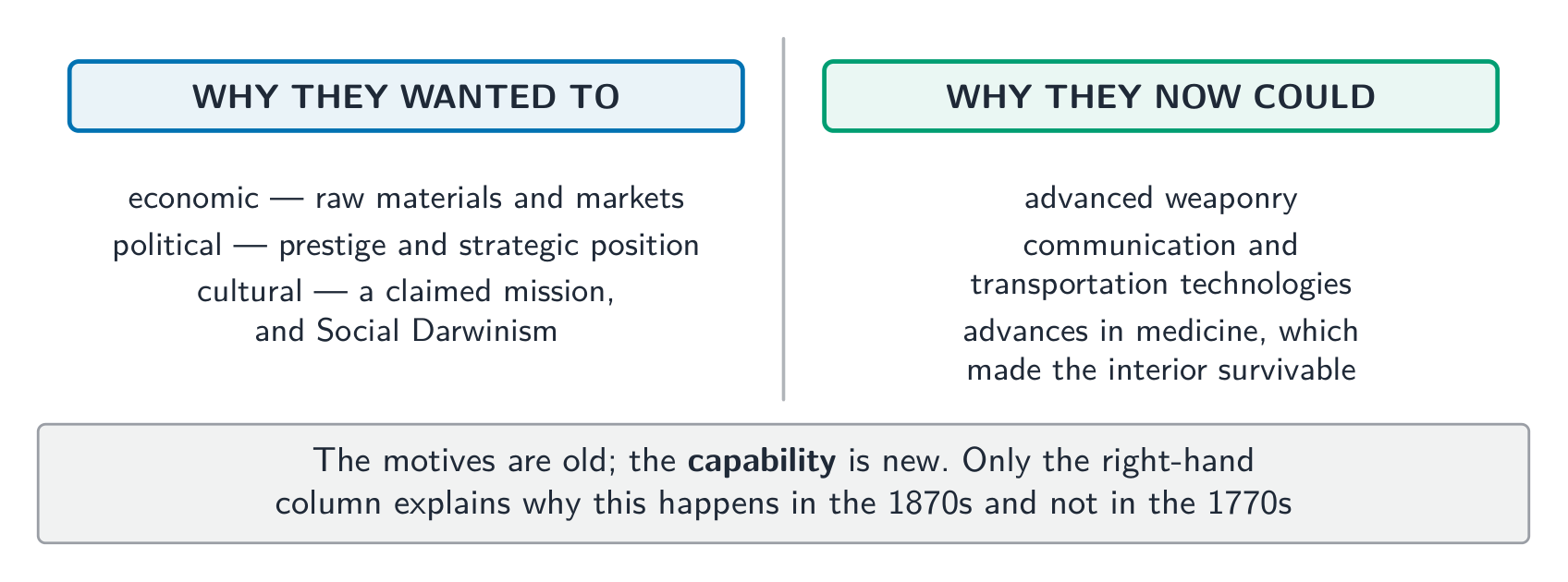
- Economic: raw materials such as rubber, cotton and copper, and new markets for factory goods.
- Political: national prestige and rivalry, ports and naval bases. Cultural and religious: missionaries and a claimed "civilizing mission" — what Kipling called "the white man's burden" (1899).
Match each motive to its type.
Difficulté 2/5 · 140 pièces + un petit bonus lors de la première réussite aujourd'hui
Three motives.
Weapons made conquest cheap
- The Maxim gun (1884) fired about 600 bullets a minute. Breech-loading rifles let soldiers fire lying down, quickly and from far away.
- Small European forces could defeat much larger armies.
A motive, or which enabler?
Sort each element of the new imperialism.
Worked example: means of empire
- Transport: steamships could travel up African rivers; the Suez Canal (1869) cut the sea route from London to India by about 7000 km.
- Communication: the telegraph 电报 linked London and India by 1870, so orders arrived in hours, not months.
- Medicine: quinine 奎宁 protected Europeans against malaria, which had killed many earlier visitors to tropical Africa.
Which were means that made conquest possible?
Difficulté 2/5 · 140 pièces + un petit bonus lors de la première réussite aujourd'hui
The civilizing mission was a motive.
Why was quinine important?
Difficulté 1/5 · 100 pièces + un petit bonus lors de la première réussite aujourd'hui
Medicine made presence possible.
Motives versus means
- Europeans had wanted wealth and power overseas for centuries. What changed after 1870 was their ability to conquer and govern interior Africa.
- That is why the New Imperialism 新帝国主义 happened when it did.
New technology best explains why the New Imperialism happened after 1870.
Difficulté 1/5 · 100 pièces + un petit bonus lors de la première réussite aujourd'hui
Motives were old.
Resistance
- Africans and Asians resisted: Ethiopia defeated Italy at Adwa (1896), and the Herero rose against German rule in Southwest Africa (1904).
- Technology gave Europeans an advantage, not complete control.
Africans never defeated a European army.
Difficulté 1/5 · 100 pièces + un petit bonus lors de la première réussite aujourd'hui
Adwa, 1896.
Do not confuse motives with means. Motives explain why Europeans wanted empire; new technologies explain why they could conquer so much so quickly after 1870.
Economic, political and cultural motives drove the New Imperialism. New weapons such as the Maxim gun, steamships, the telegraph, the Suez Canal and quinine made rapid conquest possible after 1870 — though Africans and Asians resisted, sometimes successfully.
Explain how technology made the New Imperialism possible.
Means and timing.