Introduction to Biodiversity
Introduit| English | Sens |
|---|---|
| biodiversity/ˌbaɪəʊdaɪˈvɜːsɪti/ | biodiversité |
| genetic diversity/dʒɪˈnetɪk daɪˈvɜːsɪti/ | diversité génétique |
| species richness/ˈspiːsiːz ˈrɪtʃnəs/ | richesse spécifique |
| resilient/rɪˈsɪlɪənt/ | résilient |
One fungus, one variety, one famine
- In the 1840s, most potatoes grown in Ireland were a single variety, so the plants were almost genetically identical. When a fungus-like disease arrived, it could infect all of them. The crop failed for years, and about one million people died.
- A population with more genetic variety would probably have had some resistant plants. This is why biodiversity 生物多样性, the variety of life, matters for whole ecosystems.
Biodiversité is…
Difficulté 1/5 · 100 pièces + un petit bonus lors de la première réussite aujourd'hui
Biodiversité is the variety of life — genes, species, and ecosystems.
Three levels of biodiversity
| Level | What varies | Example |
|---|---|---|
| genetic 遗传多样性 | alleles within one population or species | many potato varieties |
| species 物种多样性 | the kinds of species in an area | trees, birds, insects in a forest |
| habitat (ecosystem) 生境多样性 | the kinds of habitats in a region | forest, wetland, grassland, river |
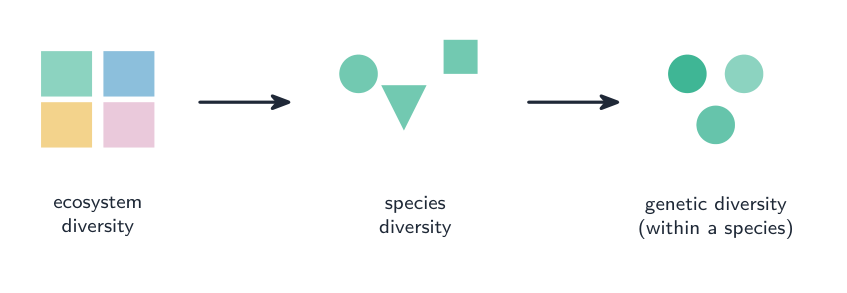
À quel niveau de la biodiversité ?
Sort each example by the level of biodiversity it describes - genes, species, or whole ecosystems.
The variety of genes within a single species is called ____ diversity.
Difficulté 1/5 · 100 pièces + un petit bonus lors de la première réussite aujourd'hui
Genetic diversity is the variety of alleles within a species — the raw material for adapting.
Measuring species diversity
- Species richness 物种丰富度 is the number of different species in an ecosystem. Evenness 均匀度 describes how equally the individuals are spread among those species.
- Two places can have the same richness but different diversity: an ecosystem dominated by one species is less diverse than one where all species are common.
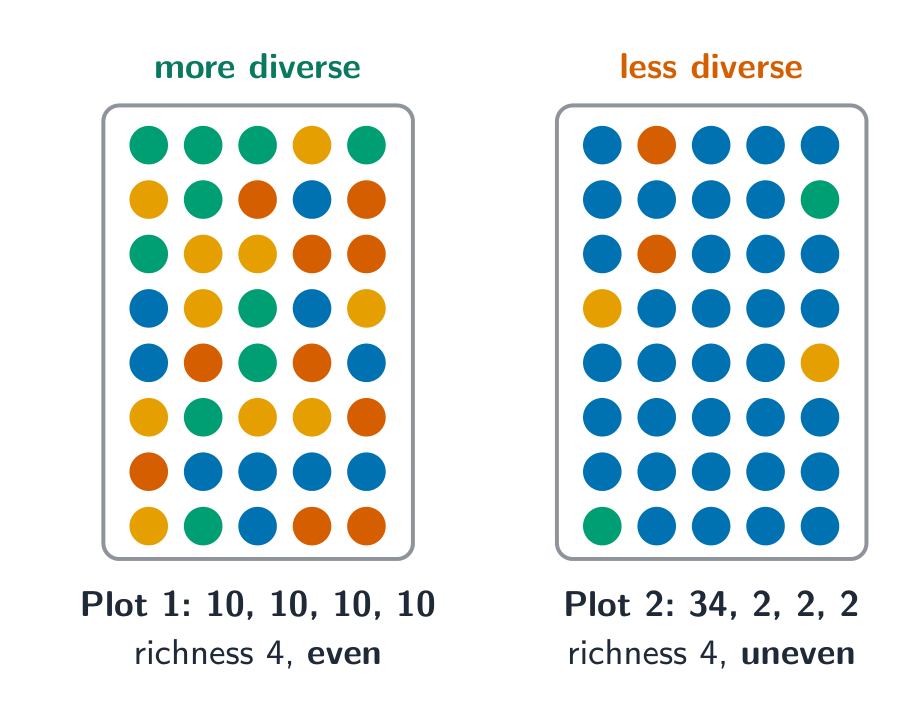
Richesse des espèces means…
Difficulté 1/5 · 100 pièces + un petit bonus lors de la première réussite aujourd'hui
Richesse des espèces simply counts how many different species live in an area.
Pond A has 25 frogs of each of 4 species. Pond B has 97 frogs of one species and 1 of each of 3 others. Which statement is correct?
Difficulté 1/5 · 100 pièces + un petit bonus lors de la première réussite aujourd'hui
Both have 4 species (same richness). Pond A is more even, so it is more diverse.
Why diversity matters
- Genetic diversity: the more genetically diverse a population, the better it can respond to environmental stressors (disease, drought, climate change), because some individuals are likely to survive. A population bottleneck (a sharp drop in population size) reduces genetic diversity, as in cheetahs.
- Species diversity: ecosystems with more species are more likely to recover from disruptions such as fire or drought, because other species can take over the roles of those that are lost.
Lower biodiversity generally makes an ecosystem more stable and resilient.
Difficulté 1/5 · 100 pièces + un petit bonus lors de la première réussite aujourd'hui
False. Higher biodiversity generally gives more stability: with more species and genetic variety, an ecosystem can better withstand disease, disturbance and change.
Select tout true statements about biodiversity.
Difficulté 2/5 · 140 pièces + un petit bonus lors de la première réussite aujourd'hui
Biodiversity is variety, so it is never just one species. The other three are correct.
Once a population recovers its size after a bottleneck, its genetic diversity is also restored.
Difficulté 1/5 · 100 pièces + un petit bonus lors de la première réussite aujourd'hui
The alleles lost in the bottleneck do not come back when numbers recover; new variation builds up only slowly by mutation.
Habitat loss: who disappears first
- When habitat is lost, specialist species 特化种 (narrow diet or habitat, like pandas that eat bamboo) disappear first, followed by generalist species 泛化种 (broad diet and habitat, like raccoons).
- Species with large territories, such as tigers and wolves, also decline because the remaining patches are too small to support them.
A wetland is drained, leaving small patches. Which species is most likely to disappear first?
Difficulté 1/5 · 100 pièces + un petit bonus lors de la première réussite aujourd'hui
Specialists with narrow needs are lost first when habitat is lost; the others are generalists.
Worked FRQ answer
A forest is cut into small, separate patches for farming.
(A) Identify whether specialist or generalist species are more likely to disappear first, and explain why. Specialists. They depend on a narrow range of food or habitat, so when their particular habitat is lost they cannot switch to another.
(B) A population of a forest bird falls from 5 000 to 40 individuals, then recovers to 3 000. Explain why the recovered population may still be at risk. The bottleneck lost many alleles. The recovered population has low genetic diversity, so it is less able to survive a new disease or a change in climate.
(C) Explain why a forest with high species diversity recovers from a drought more easily than a forest with few species. With many species, some are likely to tolerate the drought and keep doing jobs such as producing food or holding soil, so the ecosystem keeps working and recovers faster.
- Why it scores: each answer gives the reason, not just the choice: specialists have narrow needs; a bottleneck leaves fewer alleles; more species means backup for lost roles.
- Richness counts species; it is not the same as diversity. Evenness matters too.
- A recovered population size does not mean recovered genetic diversity. Lost alleles do not come back quickly.
- Specialists are lost first, not generalists.
Biodiversity has three levels: genetic, species and habitat. Species richness is the number of species; evenness is how equally individuals are spread. Genetic diversity helps a population survive stressors, and a bottleneck reduces it. More species help an ecosystem recover from disruption. Habitat loss removes specialists first, then generalists, and species needing large territories.