Lines That Do Not Stop
Introduit| English | Sens |
|---|---|
| enjambment | A sentence running on from one line of poetry to the next without a pause. |
| caesura | A strong pause inside a line. |
| end-stopped line | a line of verse that ends with punctuation, so the sense pauses at the line end |
"Bent double, like old beggars under sacks", 1917
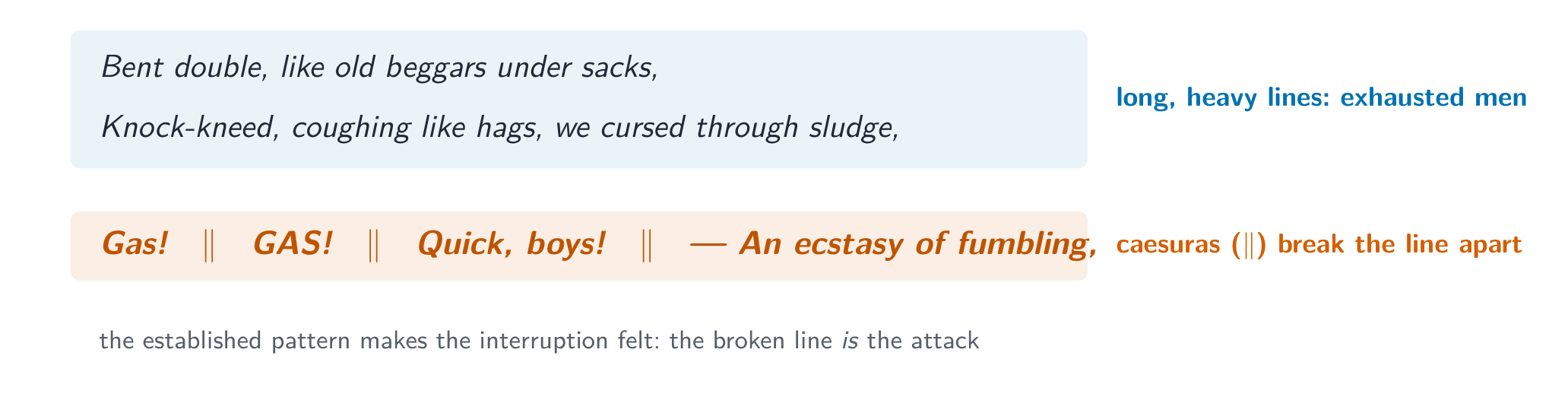
- Wilfred Owen's "Dulce et Decorum Est" (written 1917) opens with exhausted soldiers: "Bent double, like old beggars under sacks, / Knock-kneed, coughing like hags, we cursed through sludge". The lines are heavy and slow.
- Then: "Gas! GAS! Quick, boys! — An ecstasy of fumbling". The broken rhythm is the attack. Poets control rhythm through the line, enjambment 跨行 and caesura 行中停顿.
How does Owen's rhythm change at "Gas! GAS! Quick, boys!"?
Difficulté 1/5 · 100 pièces + un petit bonus lors de la première réussite aujourd'hui
The broken rhythm is the attack.
Enjambment
- Enjambment lets a sentence run past the end of a line without punctuation. The line ends; the sense does not.
- It can create momentum, surprise at the next line, or a sense of overflow.
What is enjambment?
Difficulté 1/5 · 100 pièces + un petit bonus lors de la première réussite aujourd'hui
The line ends; the sense does not.
Punctuation is where the sentence ends
- An end-stopped line 行末停顿 ends with punctuation; a caesura is a strong pause inside a line.
- Read to the punctuation, not to the line end, to hear the poem's real sentences.
Rhythm, sense, or an interruption?
Sort each observation by what it belongs to.
A caesura is a strong pause inside a line.
Difficulté 1/5 · 100 pièces + un petit bonus lors de la première réussite aujourd'hui
End-stopped lines end with punctuation.
You should read a poem to the punctuation, not just to each line end.
Difficulté 1/5 · 100 pièces + un petit bonus lors de la première réussite aujourd'hui
That reveals its real sentences.
An interruption is emphasis
- Any interruption in an established pattern creates a point of emphasis: a short line after long ones, a caesura in a smooth passage, one enjambment among end-stopped lines.
Which create a point of emphasis?
Difficulté 2/5 · 140 pièces + un petit bonus lors de la première réussite aujourd'hui
Interruption creates emphasis.
Worked example: Owen's broken rhythm
- Pattern: the first stanza moves in slow, heavy lines full of commas: "Bent double, like old beggars under sacks".
- Interruption: "Gas! GAS! Quick, boys!" — exclamations and dashes break the line into fragments, like panic breaking the march.
- Enjambment: later, "If in some smothering dreams you too could pace / Behind the wagon that we flung him in" runs on, pulling the reader into the nightmare. Interpretation: the form enacts the experience: exhaustion, sudden terror, and memory that will not stop.
What does the enjambment in "you too could pace / Behind the wagon" do?
Difficulté 1/5 · 100 pièces + un petit bonus lors de la première réussite aujourd'hui
Memory runs on and will not stop.
Line and sentence pulling apart
- When the line says one thing and the sentence another, both meanings count: a line ending on "death" may lead to "death of fear" in the next.
- Comment on what the line break isolates.
Naming "enjambment" earns nothing by itself. Say what the run-on does at that moment — momentum, suspense, or isolating a word — and why it matters there.
Naming "enjambment" is enough for credit.
Difficulté 1/5 · 100 pièces + un petit bonus lors de la première réussite aujourd'hui
Say what it does at that moment.
Enjambment runs the sentence past the line; caesura pauses inside it; end-stopped lines close with punctuation. Read to the punctuation, notice where the pattern breaks, and explain what each break emphasises.
Analyse one line break, caesura or enjambment in a poem you know.
Device, effect, meaning.