Shifts and Juxtapositions
Introduit| English | Sens |
|---|---|
| shift/ʃɪft/ | Glossaire {"sens": "changement", "sujet": "littérature américaine AP", "terme": "shift"} |
| juxtaposition/ˌdʒʌkstəpəˈzɪʃn/ | Glossaire {"sens": "juxtaposition", "sujet": "littérature américaine AP", "terme": "juxtaposition"} |
| volta | the turn in thought or tone in a sonnet, often at line 9 or the final couplet |
From disgrace to the lark, 1609
- Shakespeare's Sonnet 29 opens in misery: "When, in disgrace with fortune and men's eyes, / I all alone beweep my outcast state". For eight lines the speaker envies other men's looks, friends and talents. Then: "Haply I think on thee, and then my state, / Like to the lark at break of day arising / From sullen earth, sings hymns at heaven's gate".
- The poem turns on one thought. That turn is a shift 转折; placing two contrasting states side by side is juxtaposition 并置.
Which words begin the shift in Sonnet 29?
Difficulté 1/5 · 100 pièces + un petit bonus lors de la première réussite aujourd'hui
One thought changes the speaker's state.
Where shifts happen
- A shift is a change in tone, speaker's attitude, time, place or subject. In sonnets it often comes at the volta 十四行诗转折处 — the turn, usually at line 9 or the final couplet.
- Signal words: but, yet, then, haply, now. Also look for a change in imagery or sound.
In sonnets the turn, or volta, often comes at line 9 or the final couplet.
Difficulté 1/5 · 100 pièces + un petit bonus lors de la première réussite aujourd'hui
Signal words help locate it.
Which words often signal a shift?
Difficulté 2/5 · 140 pièces + un petit bonus lors de la première réussite aujourd'hui
Look for changes in imagery and sound too.
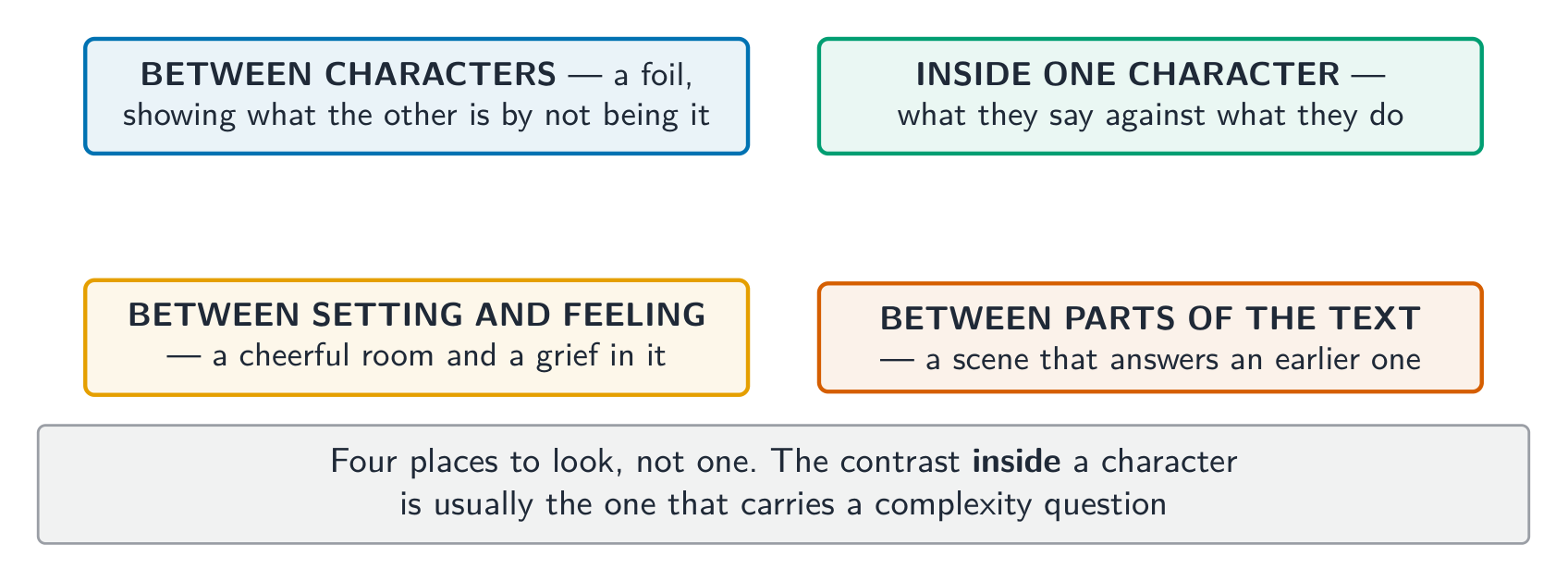
Four places to look for contrast
- Between stanzas or sections; between the beginning and end; between two images placed next to each other; between what is said and how it is said.
- The contrast is evidence of the poem's movement.
Shift or juxtaposition, and how would you find it?
Sort each contrast by how it is produced.
Where can you look for contrast in a poem?
Difficulté 2/5 · 140 pièces + un petit bonus lors de la première réussite aujourd'hui
Contrast lives in several places.
Worked example: Sonnet 29's turn
- Before the shift (lines 1–8): "disgrace", "outcast", "curse my fate", envy of "this man's art and that man's scope". The images are low and heavy — weeping, the "deaf heaven" that ignores him.
- The shift (line 9): "Haply I think on thee" — a chance thought, not a plan, changes everything.
- After (lines 10–14): the lark rises "from sullen earth" to "heaven's gate"; the heaven that was "deaf" now hears hymns. Interpretation: the juxtaposition of earth and sky, silence and song, shows love changing not the speaker's situation but his whole view of it: "I scorn to change my state with kings."
How does heaven change across Sonnet 29?
Difficulté 1/5 · 100 pièces + un petit bonus lors de la première réussite aujourd'hui
The juxtaposition shows his changed view.
Juxtaposition beyond poetry
- Novels juxtapose scenes: a wedding next to a funeral, a feast next to a famine. The placement makes a comment without a narrator stating it.
- Ask why these two things are placed side by side.
Placing a wedding scene next to a funeral scene can comment without a narrator stating it.
Difficulté 1/5 · 100 pièces + un petit bonus lors de la première réussite aujourd'hui
Ask why the two are placed together.
Writing about shifts
- Locate the shift precisely (line, word), describe the before and after with quotations, and explain what causes the change and what it means.
- Analyse how the contrast is built: imagery, sound, sentence length.
"The tone changes" is only the start. Say from what to what, where exactly, what triggers it, and what the change reveals about the speaker or theme.
"The tone changes" is a full analysis of a shift.
Difficulté 1/5 · 100 pièces + un petit bonus lors de la première réussite aujourd'hui
Say from what to what, where, why and what it reveals.
A shift is a change in tone, attitude, time, place or subject, often at a sonnet's volta; juxtaposition places contrasting things side by side. Locate the shift precisely, quote before and after, explain the trigger and what the contrast reveals.
Analyse a shift in a poem you know — where it happens, before and after, and what it reveals.
Where, before, after, meaning.