Using Modifiers and Parentheticals
Introduit"What, to the American slave, is your 4th of July?"
- In 1852, Frederick Douglass asked his Independence Day audience a question with an interruption in the middle: "What, to the American slave, is your 4th of July?" The phrase "to the American slave" is a parenthetical: it breaks into the sentence and forces the listener to see the holiday from a different place.
- Small choices about where a phrase goes, and how it is marked, change what a sentence means and stresses. This lesson covers modifiers (words that describe or limit) and parentheticals (interruptions).
Put the modifier next to what it modifies
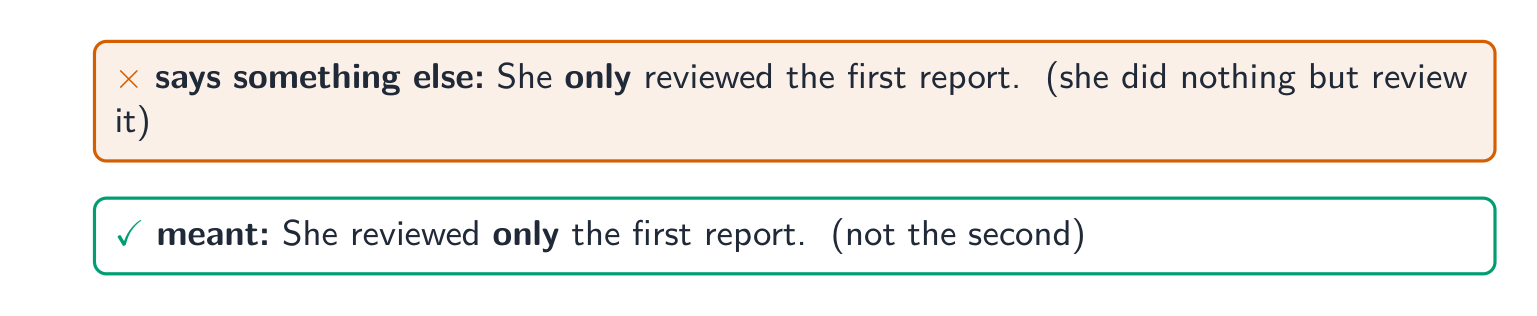
- A modifier attaches to whatever is nearest. "She only reviewed the first report" (she did nothing else with it) differs from "She reviewed only the first report" (she ignored the others).
- A dangling modifier attaches to the wrong noun: "Walking into the hall, the noise was deafening" says the noise was walking. Repair: "Walking into the hall, we heard deafening noise."
Which bracketing suits this material?
Match each parenthetical to the volume it needs.
You mean that the student read one chapter and skipped the rest. Which sentence says that?
Difficulté 1/5 · 100 pièces + un petit bonus lors de la première réussite aujourd'hui
"Only" sits next to what it limits.
Which sentence fixes the dangling modifier in "Running for the bus, my bag fell open"?
Difficulté 1/5 · 100 pièces + un petit bonus lors de la première réussite aujourd'hui
The modifier must attach to the person running.
Which marks to use for a parenthetical
| Marks | Volume | Example |
|---|---|---|
| Dashes | loud: stop and notice | "The plan — already twice over budget — is called cheap by its supporters." |
| Commas | quiet: part of the flow | "What, to the American slave, is your 4th of July?" |
| Parentheses | demoted: extra information | "The council (which meets monthly) approved it." |
- Douglass's commas keep the question flowing, so the interruption feels natural, yet it changes the whole meaning of the holiday.
Match each mark to the effect of a parenthetical.
Difficulté 2/5 · 140 pièces + un petit bonus lors de la première réussite aujourd'hui
Choose the volume you want.
Choose descriptive modifiers honestly
- Descriptive words carry an attitude: "a reckless plan", "a bold plan". Keep a loaded modifier only if you intend its attitude and can support it with evidence; otherwise use a word that only specifies ("a three-year plan").
- Use one strong parenthetical per paragraph. One interruption marks something important; three in a row mark nothing.
Calling a plan "reckless" is a neutral description.
Difficulté 1/5 · 100 pièces + un petit bonus lors de la première réussite aujourd'hui
Loaded modifiers carry an attitude you must support.
Worked exam skill: analysing a parenthetical
Claim: Douglass's interruption forces his audience to see their own celebration from the outside.
Commentary: the question "What is your 4th of July?" would be easy for a free audience to answer. By placing "to the American slave" in the middle of it, Douglass makes listeners pause and take another point of view before they can finish the question. The word "your" then separates the holiday from the enslaved, so the celebration of freedom becomes evidence of the nation's hypocrisy.
- Why it scores: it explains what the placement of the phrase does to the audience's reading, not just that a parenthetical is present.
Read every "only", "just" and "even" in your draft. Check that each sits next to the word it limits.
Place modifiers next to what they modify, and fix dangling modifiers. Mark parentheticals by the volume you want: dashes loud, commas quiet, parentheses demoted. Use loaded modifiers only on purpose, and save interruptions for the one place they matter.
Practice. Add ONE parenthetical with dashes to make the key fact loud: "The new sports centre will open next year. It was promised five years ago."
One interruption, placed where it matters.