Identifying Claims and Evidence
Introduit| English | Sens |
|---|---|
| claims/kleɪmz/ | affirmations |
| evidence and/or reasoning/ˈevɪdəns ænd ɔː ˈriːzənɪŋ/ | preuves et/ou raisonnement |
| syntactically embedding/sɪnˈtæktɪkli emˈbedɪŋ/ | intégration syntaxique |
"This Fourth of July is yours, not mine", 1852
- On 5 July 1852, Frederick Douglass, who had escaped slavery 14 years earlier, was invited to speak at an Independence Day event in Rochester, New York. He told his mostly white audience: "This Fourth of July is yours, not mine. You may rejoice, I must mourn."
- That sentence is a claim 主张: many listeners that day would have disagreed with it, so Douglass had to defend it. The rest of the speech is his evidence and reasoning 证据与推理.
Claim or fact?
| Fact | Claim | |
|---|---|---|
| Test | can be checked; nobody reasonable would dispute it | a reasonable person could disagree |
| Needs a defence? | no | yes |
| Example | "The Declaration of Independence was signed in 1776." | "The Fourth of July is a day of injustice for enslaved people." |
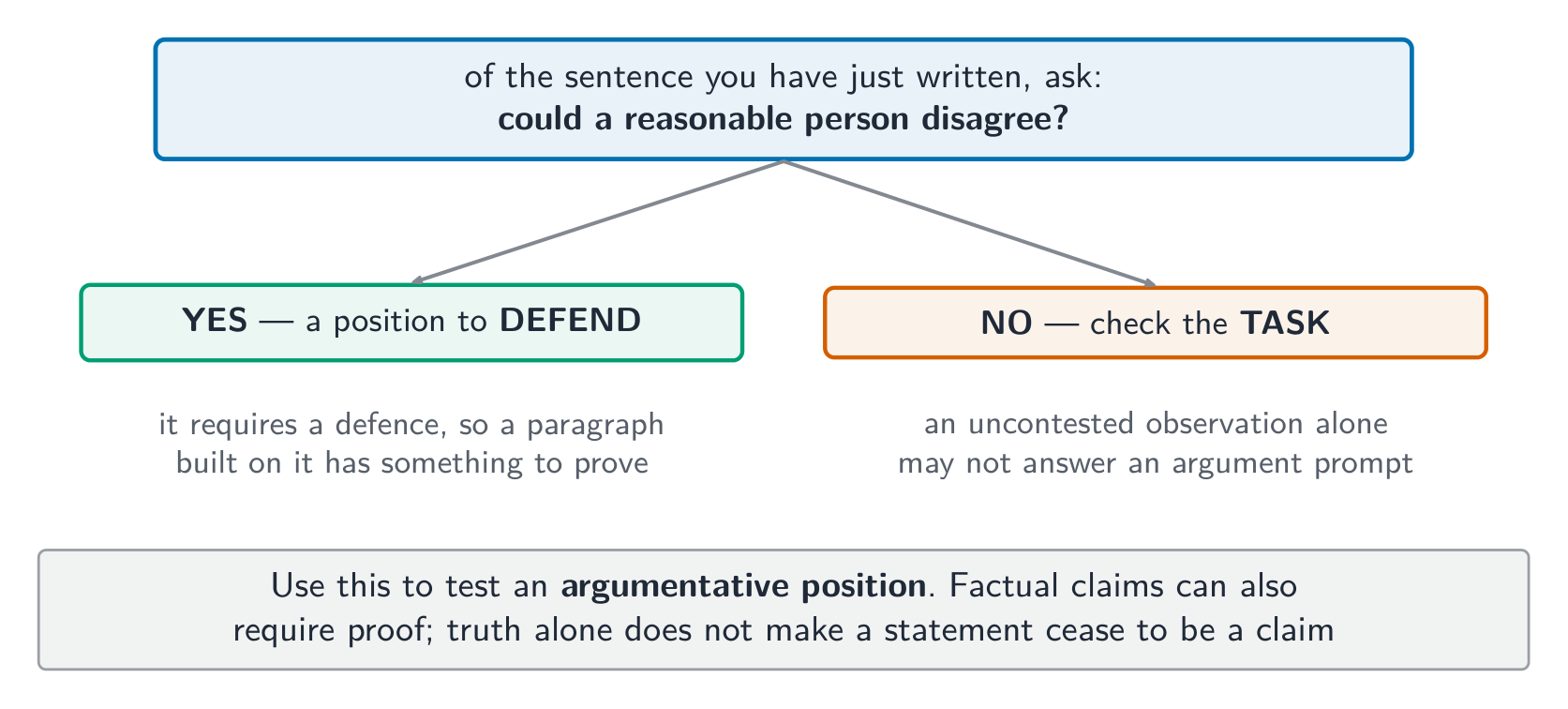
- An effective claim is interesting and arguable. A sentence nobody would dispute is not a claim, however true it is.
Claim, evidence, or neither?
Sort each sentence by the job it does in an argument.
Match each sentence to claim or fact.
Difficulté 2/5 · 140 pièces + un petit bonus lors de la première réussite aujourd'hui
Could a reasonable person disagree?
What counts as evidence
| Type | Example from Douglass |
|---|---|
| Facts and details | slave markets operating in the nation's cities; laws that forced free states to return people who escaped |
| Examples and anecdotes | scenes of enslaved people driven in chains to market |
| Appeal to shared values | the principles of liberty in the Declaration that his audience celebrated |
| Analogy and comparison | the nation's celebration set against the condition of the enslaved |
- Statistics, expert opinion and personal experience also count. Recognising an anecdote or analogy as evidence is an exam skill.
Match each piece of support to its type of evidence.
Difficulté 2/5 · 140 pièces + un petit bonus lors de la première réussite aujourd'hui
Evidence comes in many forms.
Embedding evidence
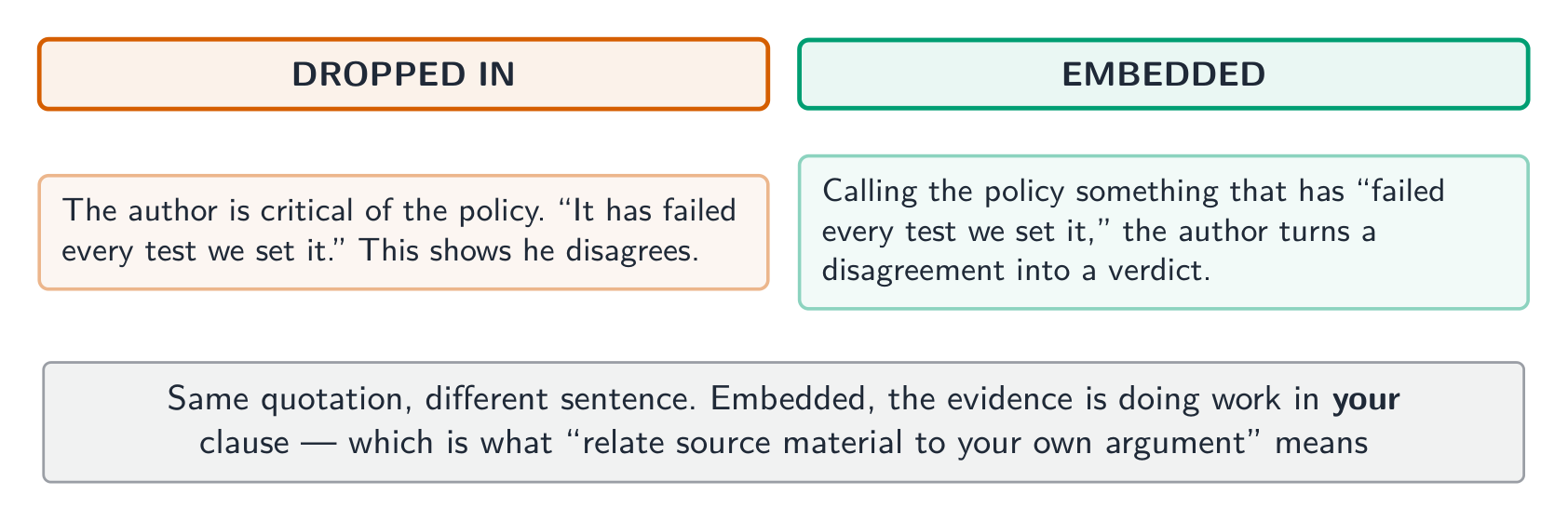
- Writers relate sources to their argument by syntactically embedding 句法嵌入 them: building the quotation into their own sentence.
- Dropped in: Douglass speaks about the holiday. "This Fourth of July is yours, not mine." Embedded: Douglass turns the audience's celebration against them when he tells them the holiday "is yours, not mine", splitting "you" from "I" at the very moment they expected unity.
Which sentence embeds the quotation?
Difficulté 1/5 · 100 pièces + un petit bonus lors de la première réussite aujourd'hui
The quotation is part of the writer's own sentence and argument.
Worked exam skill: claim, evidence, commentary
Claim: Douglass makes his audience's own celebration evidence against them.
Evidence: he asks, "What, to the American slave, is your 4th of July?" and answers that it is "a day that reveals to him, more than all other days in the year, the gross injustice and cruelty to which he is the constant victim."
Commentary: the possessive "your" places the listeners on one side and the enslaved on the other, and "more than all other days" argues that the holiday's talk of liberty makes slavery's injustice more visible, not less, so the audience cannot celebrate freedom without facing its absence.
- Why it scores: an arguable claim, short embedded evidence, and commentary that explains how specific words support the claim; commentary carries most of the 4 evidence-and-commentary points.
A true statement is not automatically a claim. If no reasonable person could disagree, there is nothing to defend, and a paragraph built on it has no argument.
Any true sentence can serve as the claim of a paragraph.
Difficulté 1/5 · 100 pièces + un petit bonus lors de la première réussite aujourd'hui
A claim must be arguable; an undisputed fact has nothing to defend.
A claim is arguable and needs a defence: ask whether a reasonable person could disagree. Evidence includes facts, details, examples, anecdotes, analogies, statistics, expert opinion and shared values. Syntactically embed evidence in your own sentence, then add commentary explaining how it supports the claim.
Practice. Write a claim about whether your school should start later in the morning. Then add one piece of embedded evidence and one sentence of commentary.
Claim, embedded evidence, commentary.