When the First Step Is Fast
Introduit| English | Sens |
|---|---|
| pre-equilibrium/priː ˌiːkwɪˈlɪbrɪəm/ | Pré-équilibre |
When the slow one comes second
- Sometimes the bottleneck sits in the middle, not the start.
- The slow step then needs an intermediate made earlier.
- But an intermediate cannot appear in the final rate law.
- A clever swap fixes this.
A fast equilibrium first
- The first step is a fast, reversible equilibrium.
- The second, slow step is the rate-determining one.
- Its rate law contains an intermediate from step one.
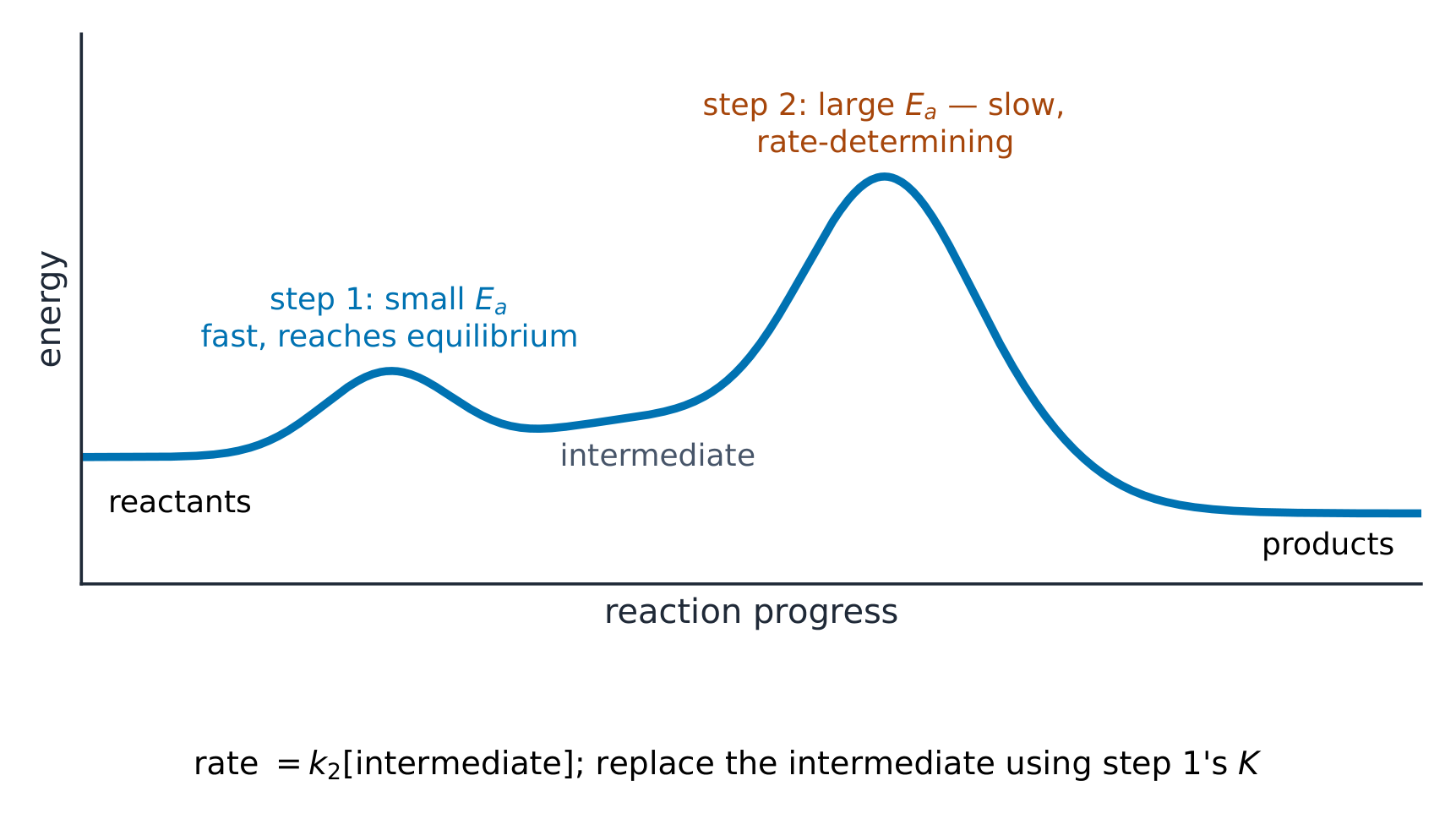
A fast reversible first step followed by a slow rate-determining step
The pre-equilibrium method is used when the slow step...
Difficulté 1/5 · 100 pièces + un petit bonus lors de la première réussite aujourd'hui
A fast equilibrium precedes the slow rate-determining step.
In this case the ____ step is not the first one, but the second.
Difficulté 1/5 · 100 pièces + un petit bonus lors de la première réussite aujourd'hui
The rate-determining (slow) step is second here.
Replace the intermediate
- Intermediates cannot appear in the final rate law.
- Use the fast equilibrium to express it in terms of reactants.
- Substitute, and the intermediate disappears.
An intermediate is allowed to remain in the final rate law.
Difficulté 1/5 · 100 pièces + un petit bonus lors de la première réussite aujourd'hui
Eliminate it using a justified relation; here the fast pre-equilibrium supplies that relation.
In fast $A \rightleftharpoons B$, slow $B + C \to D$, the intermediate $B$ is replaced using...
Difficulté 1/5 · 100 pièces + un petit bonus lors de la première réussite aujourd'hui
The equilibrium gives $[B]$ in terms of $[A]$, removing the intermediate.
The pre-equilibrium idea
- This is the pre-equilibrium 预平衡 approximation.
- The fast first step stays balanced while the slow step sips away the intermediate.
- The result is a rate law in measurable species, without the intermediate.
When the first step is fast
A fast equilibrium feeds a slow step - so the intermediate must be rewritten using the reactants.
Using a fast first equilibrium to replace an intermediate is the ____ approximation.
Difficulté 1/5 · 100 pièces + un petit bonus lors de la première réussite aujourd'hui
This is the pre-equilibrium approximation.
For the example shown, substitution gives a rate law proportional to $[A][C]$.
Difficulté 1/5 · 100 pièces + un petit bonus lors de la première réussite aujourd'hui
Substituting $[B]=(k_1/k_{-1})[A]$ dans $k_2[B][C]$ gives $k_2(k_1/k_{-1})[A][C]$.
Fast: $A \rightleftharpoons B$. Slow: $B + C \to D$.
- The slow-step rate is $k[B][C]$, but $B$ is an intermediate.
- At pre-equilibrium, $k_1[A]=k_{-1}[B]$, so $[B]=(k_1/k_{-1})[A]$. Substitution gives $\text{rate}=k_2(k_1/k_{-1})[A][C]=k'[A][C]$.
An intermediate must not appear in the final rate law — eliminate it using a justified approximation. This pre-equilibrium method applies when the first step is a fast, reversible step before the slow one. Other mechanisms may require a different approximation; rate laws can also depend on products or catalysts.
When a fast equilibrium precedes the slow step, its rate law holds an intermediate. The pre-equilibrium approximation uses the fast step to rewrite that intermediate in terms of real reactants, then substitutes it out — leaving a rate law with no intermediates. This assumes reverse equilibration is much faster than consumption in the slow step.