Oxidation-Reduction (Redox) Reactions
Introduit| English | Sens |
|---|---|
| oxidation/ˌɒksɪˈdeɪʃn/ | oxydation |
| reduction/rɪˈdʌkʃn/ | réduction |
| reducing agent/rɪˈdjuːsɪŋ ˈeɪdʒənt/ | agent réducteur |
| oxidizing agent/ˈɒksɪdaɪzɪŋ ˈeɪdʒənt/ | agent oxydant |
The electron trade
- A shiny nail rusts; a battery powers a phone.
- Both run on electrons moving from one atom to another.
- One side loses electrons; the other side gains them.
- Follow the electrons and you understand the change.
Losing and gaining electrons
- Oxidation 氧化 is the loss of electrons.
- Reduction 还原 is the gain of electrons.
- Remember "OIL RIG": Oxidation Is Loss, Reduction Is Gain.
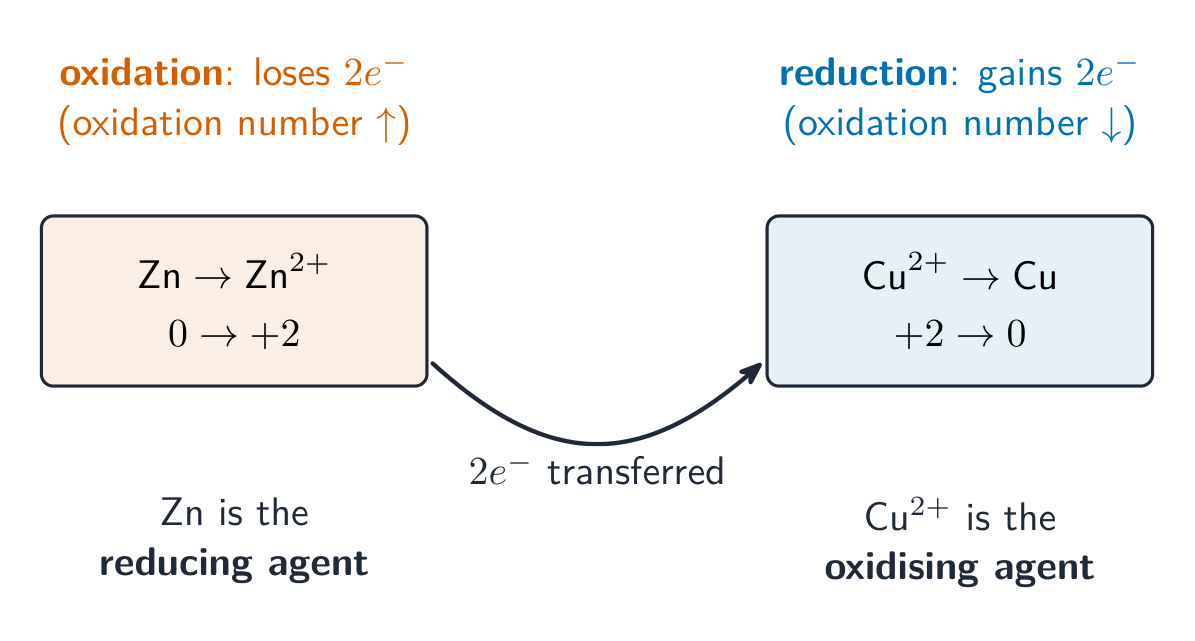
Redox is electron transfer: the reducing agent 还原剂 is oxidised, the oxidising agent reduced
Oxidation is defined as the...
Difficulté 1/5 · 100 pièces + un petit bonus lors de la première réussite aujourd'hui
OIL means Oxidation Is Loss of electrons.
Reduction is the ____ of electrons.
Difficulté 1/5 · 100 pièces + un petit bonus lors de la première réussite aujourd'hui
RIG means Reduction Is Gain of electrons.
Always paired
- The electrons lost by one atom are gained by another.
- So oxidation and reduction always happen together.
- The electrons transferred must balance.
Oxidation and reduction always happen together in a redox reaction.
Difficulté 1/5 · 100 pièces + un petit bonus lors de la première réussite aujourd'hui
Electrons lost by one species are gained by another.
In a redox reaction, more electrons can be lost than are gained.
Difficulté 1/5 · 100 pièces + un petit bonus lors de la première réussite aujourd'hui
False. Electrons are transferred from one species to another, so the number lost must equal the number gained.
Oxidizing and reducing agents
- The oxidizing agent 氧化剂 takes electrons and is itself reduced.
- The reducing agent gives electrons and is itself oxidized.
- Track oxidation states to see who did what.
Oxidised or reduced?
Track the electrons: sort each half-change as oxidation or reduction.
The oxidizing agent is itself...
Difficulté 1/5 · 100 pièces + un petit bonus lors de la première réussite aujourd'hui
The oxidizing agent takes electrons, so it is reduced.
In $\text{Zn} + \text{Cu}^{2+} \to \text{Zn}^{2+} + \text{Cu}$, which is oxidized?
- Zn goes from 0 to $+2$, losing two electrons: $\text{Zn}\to\text{Zn}^{2+}+2e^-$.
- $\text{Cu}^{2+}+2e^-\to\text{Cu}$ gains the same two electrons. Adding the half-equations cancels $2e^-$ and gives the stated overall equation.
In $\text{Zn} + \text{Cu}^{2+} \to \text{Zn}^{2+} + \text{Cu}$, zinc is...
Difficulté 1/5 · 100 pièces + un petit bonus lors de la première réussite aujourd'hui
Zn changes from oxidation state 0 to +2: $\text{Zn}\to\text{Zn}^{2+}+2e^-$. It loses two electrons, so it is oxidized and acts as the reducing agent; Cu$^{2+}$ accepts those two electrons.
Oxidation and reduction always occur together — you cannot have one without the other. "OIL RIG" keeps the direction straight (loss is oxidation). And the oxidizing agent is the one that gets reduced (it took the electrons), which trips many people up.
In a redox reaction, oxidation is loss of electrons and reduction is gain ("OIL RIG"), and they always happen together. The oxidizing agent takes electrons (and is reduced); the reducing agent gives electrons (and is oxidized). Oxidation states track the transfer.