Volumes with Cross Sections: Squares and Rectangles
Introduit| English | Sens |
|---|---|
| cross sections/krɒs ˈsekʃnz/ | sections transversales |
Stacking up thin slabs into a solid
- Slice a loaf of bread: each slice is a thin slab, and the loaf is all the slabs together. Integration finds a volume the same way.
- Each slice perpendicular to the axis has a cross section 横截面 of area $A(x)$ and thickness $dx$. Adding them: $V=\displaystyle\int_a^b A(x)\,dx$.
The volume of a solid with cross-sectional area $A(x)$ is...
Difficulté 1/5 · 100 pièces + un petit bonus lors de la première réussite aujourd'hui
Add up slabs $A(x)\,dx$.
Squares and rectangles on a base region
- The solid sits on a flat base region. The side of each slice, $s(x)$, is the width of the region at $x$: top curve − bottom curve.
- Square: $A(x)=s(x)^2$. Rectangle with height $h(x)$: $A(x)=s(x)\,h(x)$, where the problem tells you $h$.
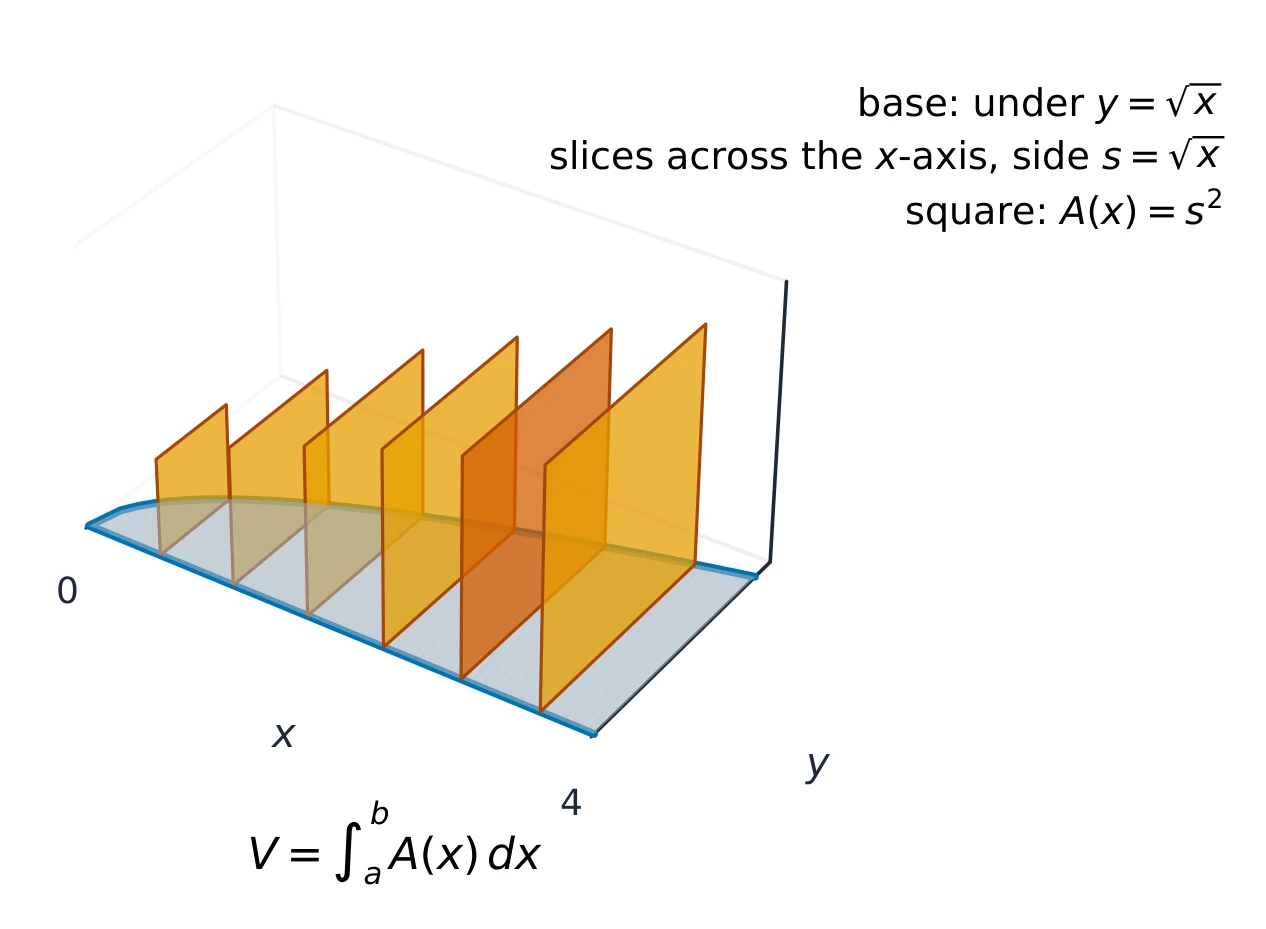
The base region under √x
y = a·√x
Each square slice sits on the base; its side is the height $\sqrt{x}$, so its area is $(\sqrt{x})^2=x$.
For square cross sections with base $s(x)$, the area is...
Difficulté 1/5 · 100 pièces + un petit bonus lors de la première réussite aujourd'hui
A square of side $s$ has area $s^2$.
The base length of a cross section is often the distance between the boundary curves, $f(x)-g(x)$.
Difficulté 1/5 · 100 pièces + un petit bonus lors de la première réussite aujourd'hui
The base spans the region between the curves.
The base is the region under $y=\sqrt x$ from $x=0$ to $4$. Cross sections perpendicular to the $x$-axis are squares.
- $s(x)=\sqrt x-0=\sqrt x$, so $A(x)=x$.
- $V=\displaystyle\int_0^4 x\,dx=\Big[\tfrac{x^2}{2}\Big]_0^4=8$.
Base under $y=\sqrt x$ on $[0,4]$, square cross sections: $A(x)=x$. Find $V=\int_0^4 x\,dx$.
Difficulté 2/5 · 140 pièces + un petit bonus lors de la première réussite aujourd'hui
$\big[\tfrac{x^2}{2}\big]_0^4=8$.
Between two curves. The base is the region between $y=x$ and $y=x^2$. Cross sections perpendicular to the $x$-axis are squares.
- The curves meet at $x=0,1$, and $x\ge x^2$ there, so $s(x)=x-x^2$.
- $V=\displaystyle\int_0^1(x-x^2)^2\,dx=\int_0^1(x^2-2x^3+x^4)\,dx$
- $=\tfrac13-\tfrac12+\tfrac15=\dfrac{1}{30}$
The base is the region between $y=2x$ et $y=x^2$. Cross sections perpendicular to the $x$-axis are squares. Find the volume to 3 decimal places.
Difficulté 2/5 · 140 pièces + un petit bonus lors de la première réussite aujourd'hui
The curves meet at $x=0,2$, with $2x$ on top. $V=\int_0^2(2x-x^2)^2\,dx=\int_0^2(4x^2-4x^3+x^4)\,dx=\tfrac{32}{3}-16+\tfrac{32}{5}=\tfrac{16}{15}\approx1.067$.
Rectangles. Same base as the first example ($y=\sqrt x$, $0\le x\le4$), but the cross sections are rectangles whose height is 3 times the base.
- $A(x)=s\cdot3s=3s^2=3x$.
- $V=\displaystyle\int_0^4 3x\,dx=3\cdot8=24$.
For rectangular cross sections, area = base ____ height.
Difficulté 1/5 · 100 pièces + un petit bonus lors de la première réussite aujourd'hui
$A=s\cdot h$ for a rectangle.
Slices perpendicular to the $y$-axis
- Then the slices are horizontal: write the width as right − left in terms of $y$ and integrate with $dy$ and $y$-limits.
- Example: base between $x=y^2$ and $x=4$, squares perpendicular to the $y$-axis: $s(y)=4-y^2$, $V=\displaystyle\int_{-2}^{2}(4-y^2)^2\,dy=\tfrac{512}{15}$.
To use $V=\int_a^b A(x)\,dx$, the cross-section slices must be...
Difficulté 1/5 · 100 pièces + un petit bonus lors de la première réussite aujourd'hui
Slices are perpendicular to the axis you integrate along.
The base is the triangle under $y=x$ from $x=0$ à $x=2$. Cross sections perpendicular to the $x$-axis are squares. Find the volume.
The antiderivative x cubed over 3 at 2 is 8/3.
Square slices of side $s(x)=x$, from $x=0$ à $x=2$. What is the volume?
Difficulté 1/5 · 100 pièces + un petit bonus lors de la première réussite aujourd'hui
The integral of x squared from 0 to 2 is 8/3.
- Square the whole width: $(x-x^2)^2$, not $x^2-x^4$.
- There is no $\pi$ here. $\pi$ only appears for circular slices (discs, washers, semicircles).
- The base is flat on the $xy$-plane; the squares stand up from it. $s(x)$ is measured in the base, across the region.
Base under $y=e^x$ on $[0,1]$; square cross sections perpendicular to the $x$-axis. Which integral gives the volume?
Difficulté 1/5 · 100 pièces + un petit bonus lors de la première réussite aujourd'hui
$s=e^x$, so $A=(e^x)^2=e^{2x}$. Squares have no $\pi$, and $(e^x)^2$ est $e^{2x}$, not $e^{x^2}$.
$V=\int_a^b A(x)\,dx$, the integral of the cross-sectional area. The side $s$ is the width of the base region (top − bottom, or right − left for $dy$). Squares: $A=s^2$. Rectangles: $A=s\cdot h$. No $\pi$.