Finding Antiderivatives and Indefinite Integrals: Basic Rules and Notation
Introduit| English | Sens |
|---|---|
| indefinite integral/ɪnˈdefɪnət ˈɪntɪɡrəl/ | intégrale indéfinie |
| constant of integration/ˈkɒnstənt ɒv ˌɪntɪˈɡreɪʃn/ | constante d'intégration |
| initial condition/ɪˈnɪʃl kənˈdɪʃn/ | A specified starting value used to determine a particular solution of an equation or model. |
Running differentiation backward
- FTC Part 2 needs an antiderivative, so now we learn to find one. An antiderivative of $f$ is any function whose derivative is $f$; the whole family is the indefinite integral 不定积分, written $\displaystyle\int f(x)\,dx$ (no limits).
- Every derivative rule, read backward, becomes an integration rule.
The power rule for integration
- Reverse the Power Rule: add one to the exponent, then divide by the new exponent. Check by differentiating: $\frac{d}{dx}\left[\frac{x^{n+1}}{n+1}\right]=x^n$.
- The case $n=-1$ is special, because dividing by $0$ is impossible: $\displaystyle\int x^{-1}\,dx=\ln|x|+C$.
What is $\displaystyle\int x^3\,dx$?
Difficulté 1/5 · 100 pièces + un petit bonus lors de la première réussite aujourd'hui
Add one to the exponent, divide by it: $\tfrac{x^4}{4}+C$.
The power rule fails for $n=-1$. What is $\displaystyle\int x^{-1}\,dx$?
Difficulté 1/5 · 100 pièces + un petit bonus lors de la première réussite aujourd'hui
$\int\tfrac1x\,dx=\ln|x|+C$.
Never forget $+C$
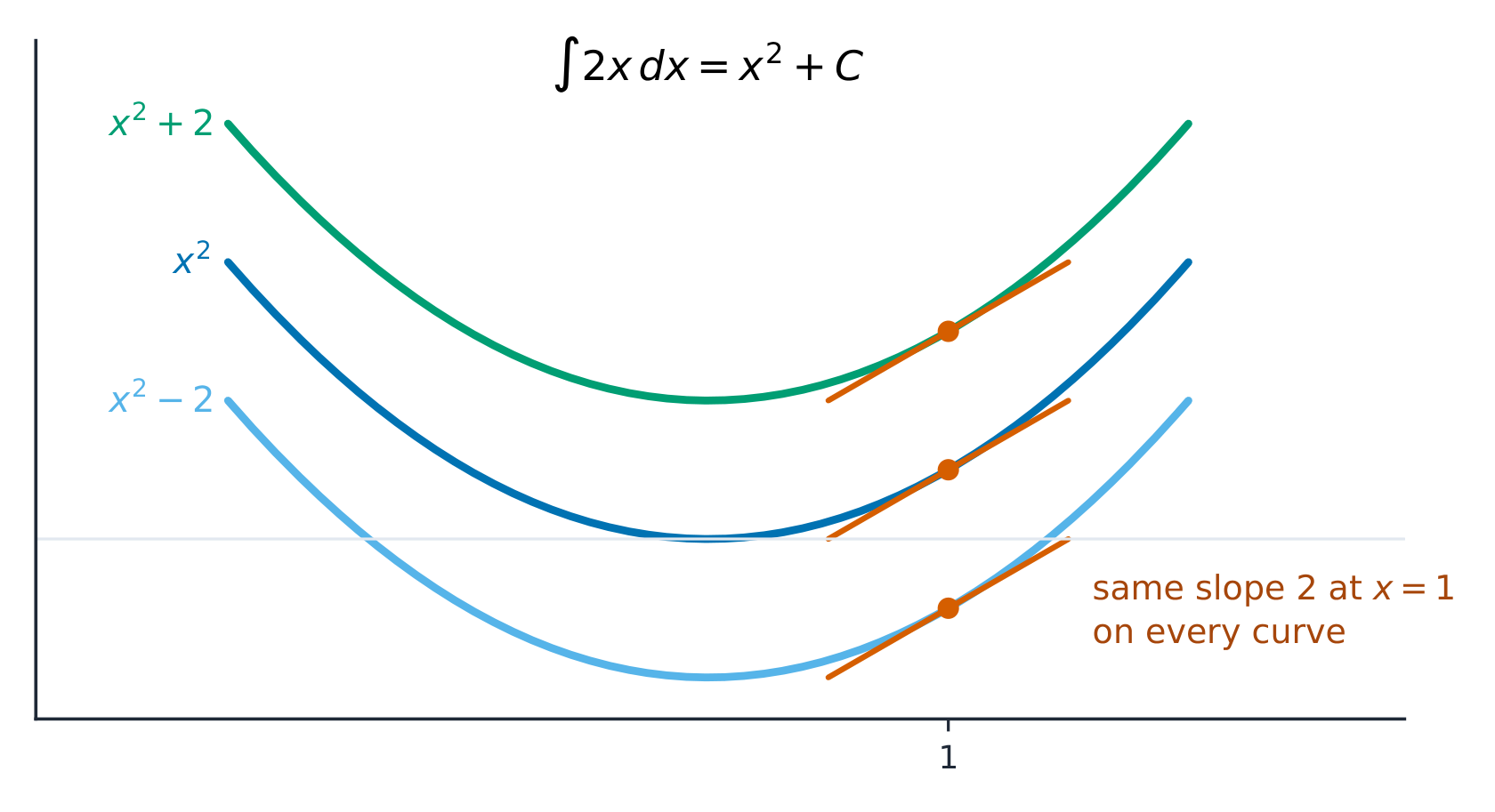
- The derivative of a constant is $0$, so any constant can be added: the antiderivatives form a family of vertical shifts. Always write the constant of integration 积分常数 $+C$.
- One known point on the curve (an initial condition 初始条件) fixes the value of $C$. In a definite integral, $C$ cancels.
A family shifted by +C
y = ax³ + d
All antiderivatives of $f$ differ only by a vertical shift $+C$ — same slope everywhere.
An indefinite integral should include the constant of integration $+C$.
Difficulté 1/5 · 100 pièces + un petit bonus lors de la première réussite aujourd'hui
The antiderivative is a family; $+C$ is part of the answer.
The standard antiderivatives
- $\displaystyle\int\cos x\,dx=\sin x+C$, $\displaystyle\int\sin x\,dx=-\cos x+C$, $\displaystyle\int\sec^2x\,dx=\tan x+C$.
- $\displaystyle\int e^x\,dx=e^x+C$, $\displaystyle\int\frac1x\,dx=\ln|x|+C$, $\displaystyle\int\frac{1}{1+x^2}\,dx=\arctan x+C$. Constants come out front, and sums are integrated term by term.
What is $\displaystyle\int \sin x\,dx$?
Difficulté 1/5 · 100 pièces + un petit bonus lors de la première réussite aujourd'hui
$\int\sin x\,dx=-\cos x+C$ (mind the minus).
Select tout correct antiderivatives.
Difficulté 2/5 · 140 pièces + un petit bonus lors de la première réussite aujourd'hui
$\int\cos x\,dx=\sin x+C$ (positive); the last is wrong.
Find $\displaystyle\int (6x^2 - 4x + 5)\,dx$.
- Term by term: $6\cdot\dfrac{x^3}{3}=2x^3$, $\;-4\cdot\dfrac{x^2}{2}=-2x^2$, $\;5x$. So the answer is $2x^3-2x^2+5x+C$.
- Check by differentiating: $6x^2-4x+5$. ✓
Rechercher $\displaystyle\int (6x^2-4x+5)\,dx$.
Difficulté 1/5 · 100 pièces + un petit bonus lors de la première réussite aujourd'hui
Reverse power rule term by term, plus $C$.
Rewrite first. Find $\displaystyle\int\left(\sqrt x+\frac{3}{x^2}\right)dx$.
- Rewrite as powers: $x^{1/2}+3x^{-2}$.
- $\dfrac{x^{3/2}}{3/2}+3\cdot\dfrac{x^{-1}}{-1}=\dfrac23x^{3/2}-\dfrac3x+C$.
Rechercher $\displaystyle\int\frac{4}{x^3}\,dx$.
Difficulté 1/5 · 100 pièces + un petit bonus lors de la première réussite aujourd'hui
$4x^{-3}$ integrates to $4\cdot\dfrac{x^{-2}}{-2}=-2x^{-2}=-\dfrac{2}{x^2}$, plus $C$.
Use an initial condition. $f'(x)=3x^2-2$ and $f(1)=4$. Find $f(x)$.
- Integrate: $f(x)=x^3-2x+C$.
- Use the point: $f(1)=1-2+C=4$, so $C=5$. Answer: $f(x)=x^3-2x+5$.
$f'(x)=4x-1$ et $f(2)=10$. Find the constant $C$ in $f(x)=2x^2-x+C$.
Difficulté 2/5 · 140 pièces + un petit bonus lors de la première réussite aujourd'hui
$f(2)=8-2+C=10$, so $C=4$.
Find the general antiderivative of $f(x)=x^3$, and name the one power the rule does not work for.
Raise the power, then divide.
Which is an antiderivative of $x^3$?
Difficulté 1/5 · 100 pièces + un petit bonus lors de la première réussite aujourd'hui
The new power is 4, and you divide by 4.
- Always add $+C$ to an indefinite integral; it is part of the answer.
- The power rule fails for $n=-1$: $\int x^{-1}\,dx=\ln|x|+C$, not $\frac{x^0}{0}$. Mind the sign in $\int\sin x\,dx=-\cos x+C$.
- There is no product rule for integrals: $\int x(x^2+1)\,dx$ is not $\frac{x^2}{2}\cdot\left(\frac{x^3}{3}+x\right)$. Expand first: $\int(x^3+x)\,dx=\frac{x^4}{4}+\frac{x^2}{2}+C$.
$\displaystyle\int x(x^2+1)\,dx=\frac{x^2}{2}\left(\frac{x^3}{3}+x\right)+C$.
Difficulté 1/5 · 100 pièces + un petit bonus lors de la première réussite aujourd'hui
Integrals do not split over products. Expand first: $\int(x^3+x)\,dx=\frac{x^4}{4}+\frac{x^2}{2}+C$.
An indefinite integral $\int f\,dx$ is the general antiderivative of $f$. Power rule: $\int x^n\,dx=\frac{x^{n+1}}{n+1}+C$ for $n\neq-1$, and $\int x^{-1}\,dx=\ln|x|+C$. Rewrite roots and fractions as powers, expand products, integrate term by term, and add the constant of integration $+C$; an initial condition finds $C$.