Determining Concavity of Functions over Their Domains
Introduit| English | Sens |
|---|---|
| concavity/kənˈkævɪti/ | concavité |
| sign of the second derivative/saɪn ɒvðə ˈsekənd dɪˈrɪvətɪv/ | sign of the second derivative |
| concave up/kɒnˈkeɪv ʌp/ | Describing a graph whose slopes increase as the input increases; a positive second derivative is a sufficient condition. |
| concave down/kɒnˈkeɪv daʊn/ | Describing a graph whose slopes decrease as the input increases; a negative second derivative is a sufficient condition. |
| point of inflection/pɔɪnt ɒv ɪnˈflekʃn/ | point d'inflexion |
How the curve bends
- Increasing/decreasing tells you which way the curve goes; concavity 凹凸性 tells you how it bends.
- A curve can rise while bending like a cup (opening up) or like a cap (opening down).
- The bending is controlled by the sign of the second derivative 二阶导数的符号.
- $f''$ measures how the slope $f'$ itself is changing.
Concave up: $f'' > 0$
- Where $f''(x)>0$, the graph is concave up 凹 — shaped like a smile, holding water.
- The slope $f'$ is increasing (getting more positive or less negative).
- Cup-shaped valleys are concave up.
- Tangent lines lie below a concave-up curve.
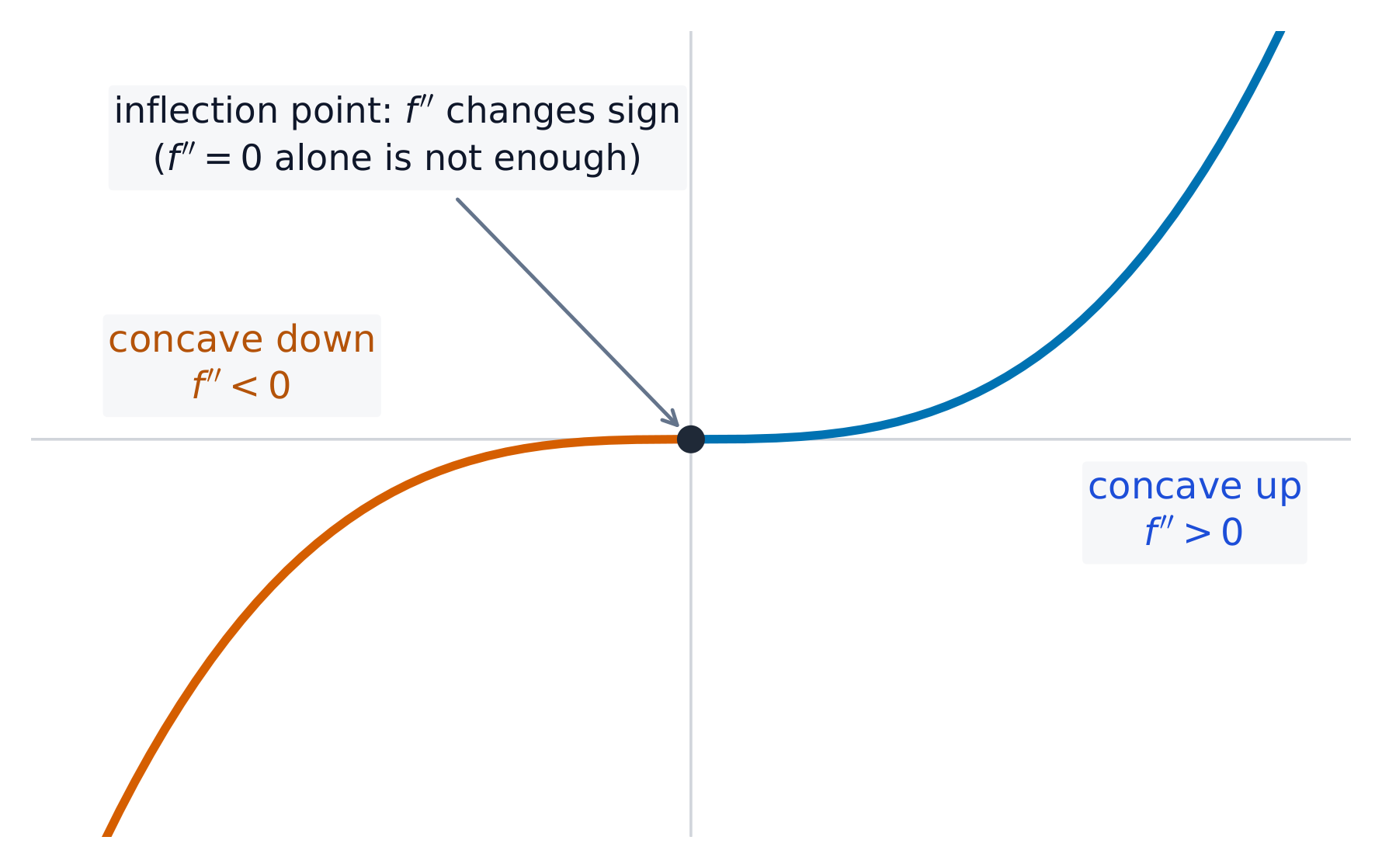
Concave down 凸 where f″ < 0 and concave up where f″ > 0; the inflection point is where f″ changes sign
A graph is concave up exactly where...
Difficulté 1/5 · 100 pièces + un petit bonus lors de la première réussite aujourd'hui
Concave up ⇔ $f''>0$ (slope increasing).
Concave up means the slope $f'$ is...
Difficulté 1/5 · 100 pièces + un petit bonus lors de la première réussite aujourd'hui
Concave up ⇔ $f'$ increasing ⇔ $f''>0$.
Concave down: $f'' < 0$
- Where $f''(x)<0$, the graph is concave down — shaped like a frown.
- The slope $f'$ is decreasing.
- Cap-shaped hills are concave down.
- Tangent lines lie above a concave-down curve.
Où $f''(x)<0$, the graph is concave ____ (cap-shaped).
Difficulté 1/5 · 100 pièces + un petit bonus lors de la première réussite aujourd'hui
Negative second derivative → concave down.
Inflection points: where the bend flips
- A point of inflection 拐点 is a point on the graph ($f$ continuous there) where concavity changes — from up to down or down to up.
- There, $f''$ changes sign (usually passing through $0$, sometimes undefined).
- Build a sign chart of $f''$, just like you did for $f'$, to find these.
- An inflection point is about the bend changing, not the slope.
Concave down then up
y = x³
This cubic bends like a cap for $x<0$ and a cup for $x>0$ — the flip at $0$ is a point of inflection.
An inflection point requires $f''$ to change sign, not just equal zero.
Difficulté 1/5 · 100 pièces + un petit bonus lors de la première réussite aujourd'hui
$y=x^4$ has $f''(0)=0$ but no sign change → not an inflection point.
Pour $f(x)=x^3$, $f''(x)=6x$. At what $x$ is the inflection point?
Difficulté 2/5 · 140 pièces + un petit bonus lors de la première réussite aujourd'hui
$f''=6x$ changes sign at $x=0$.
Pour $y=x^4$, is $x=0$ an inflection point?
Difficulté 1/5 · 100 pièces + un petit bonus lors de la première réussite aujourd'hui
$f''=12x^2\ge0$ on both sides — no sign change, so no inflection.
$f''(c)=0$ alone does not make $c$ an inflection point — $f''$ must actually change sign there. For $y=x^4$, $f''(0)=0$, but $f''\ge0$ on both sides (no sign change), so $x=0$ is not an inflection point. Check the sign on both sides, don't just solve $f''=0$.
Find the concavity and inflection point of $f(x)=x^3$.
- $f'(x)=3x^2$, $f''(x)=6x$.
- $f''<0$ for $x<0$ (concave down); $f''>0$ for $x>0$ (concave up).
- $f''$ changes sign at $x=0$ → inflection point at $(0,0)$.
A full sign chart. Find the intervals of concavity and the inflection points of $f(x)=x^4-4x^3$.
- $f'(x)=4x^3-12x^2$ and $f''(x)=12x^2-24x=12x(x-2)$, which is zero at $x=0$ and $x=2$.
- Test points: $f''(-1)=36>0$, $f''(1)=-12<0$, $f''(3)=36>0$. So the graph is concave up on $(-\infty,0)$ and $(2,\infty)$, and concave down on $(0,2)$.
- $f''$ changes sign at both, so the inflection points are $(0,0)$ and $(2,-16)$.
Where does $f(x)=x^3-6x^2+5$ have an inflection point?
Difficulté 1/5 · 100 pièces + un petit bonus lors de la première réussite aujourd'hui
f″(x) = 6x − 12, which changes sign at x = 2.
On which interval is $f(x)=x^4-6x^2$ concave down?
Difficulté 1/5 · 100 pièces + un petit bonus lors de la première réussite aujourd'hui
f″(x) = 12x² − 12 = 12(x − 1)(x + 1), negative between −1 and 1.
$f$ is continuous and $f''(x)$ changes from negative to positive at $x=1$. What does the graph do at $x=1$, and why is $f''(1)=0$ alone not enough?
The bend flips only when the second derivative changes sign.
f is continuous at c, and f double prime changes from negative to positive across c. What is the point on f?
Difficulté 1/5 · 100 pièces + un petit bonus lors de la première réussite aujourd'hui
A sign change of f double prime flips concavity.
Reading concavity from the graph of $f'$
- AP often shows the graph of $f'$, not $f$. Then $f$ is concave up where $f'$ is increasing, and concave down where $f'$ is decreasing.
- So inflection points of $f$ are at the peaks and valleys of the graph of $f'$. Justify with words like "$f'$ changes from increasing to decreasing at $x=3$".
The graph of $f'$ has a local maximum at $x=3$. What does this tell you about $f$?
Difficulté 1/5 · 100 pièces + un petit bonus lors de la première réussite aujourd'hui
f′ changes from increasing to decreasing there, so f″ changes from positive to negative: concavity flips.
Concavity is set by the sign of $f''$. Where $f''>0$ the graph is concave up (cup); where $f''<0$ it is concave down (cap). A point of inflection is where $f''$ changes sign — the bend flips. $f''=0$ is a candidate, but you must confirm a sign change.