Determining Intervals on Which a Function Is Increasing or Decreasing
Introduit| English | Sens |
|---|---|
| sign of the first derivative/saɪn ɒvðə fɜːst dɪˈrɪvətɪv/ | signe de la dérivée première |
| sign chart/saɪn tʃɑːt/ | tableau de signe |
The sign of $f'$ tells the story
- Where a curve rises or falls is written in the sign of the first derivative 一阶导数符号.
- $f'(x)>0$ on an interval → $f$ is increasing there (going uphill).
- $f'(x)<0$ → $f$ is decreasing (going downhill).
- So to map out where $f$ climbs and drops, you just track the sign of $f'$.
Montée où f′ > 0
y = ax³ + cx
The curve climbs where its slope is positive and falls where negative — the sign of $f'$ maps every stretch.
Which condition guarantees that a differentiable function is increasing on an interval?
Difficulté 1/5 · 100 pièces + un petit bonus lors de la première réussite aujourd'hui
Positive first derivative means increasing.
Build a sign chart
- Start with the domain: split at gaps and at critical points (domain inputs where $f'=0$ or is undefined).
- Draw a sign chart 符号表: mark the critical points, creating open intervals between them.
- Pick a test point in each interval and check the sign of $f'$ there.
- One sign per interval is enough — $f'$ can't change sign without passing through a critical point.
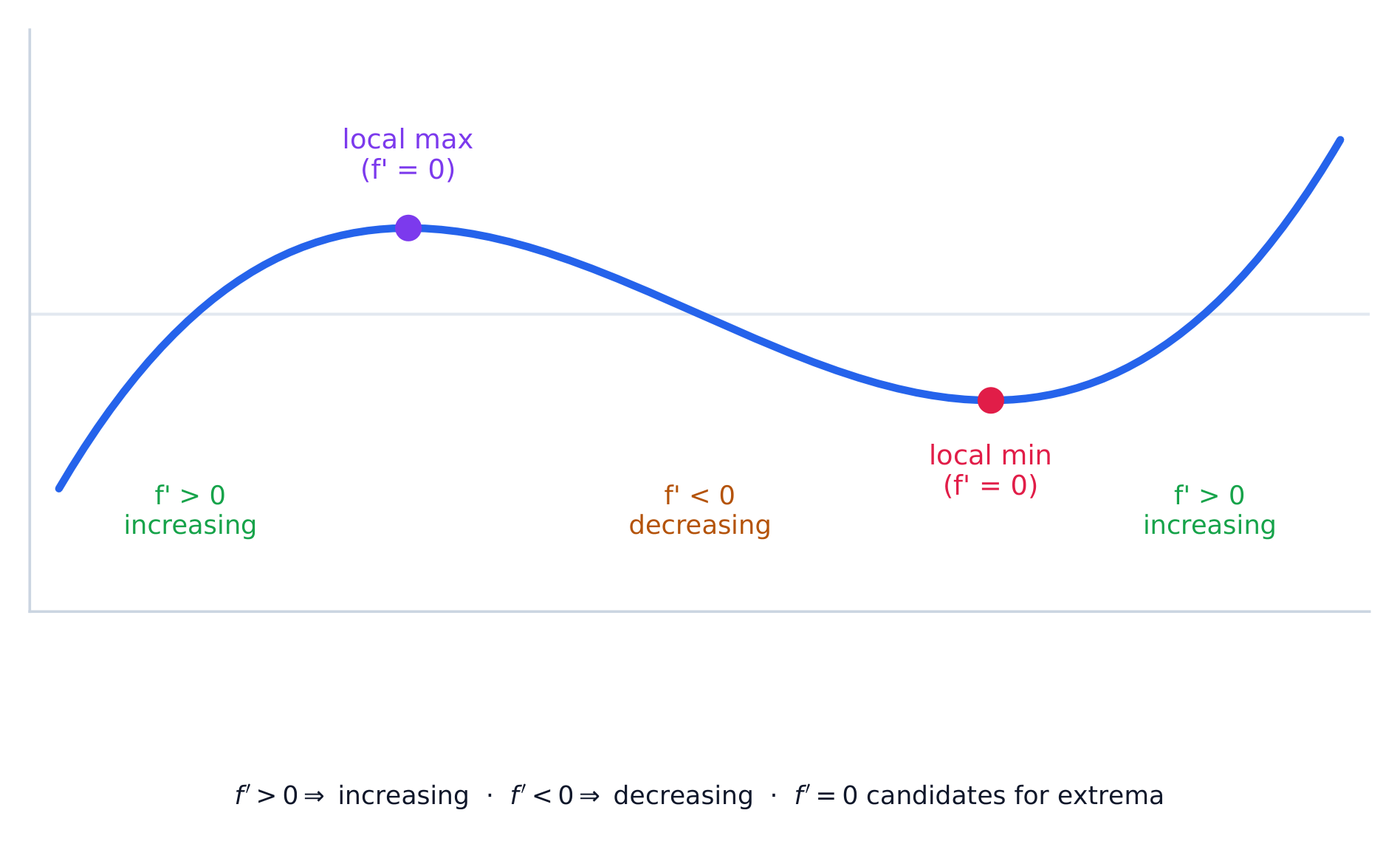
f′ > 0 where f increases and f′ < 0 where f decreases
Pour $f'(x)=3(x-1)(x+1)$, evaluate $f'(0)$ to test the middle interval.
Difficulté 2/5 · 140 pièces + un petit bonus lors de la première réussite aujourd'hui
$3(-1)(1)=-3<0$, so $f$ is decreasing on $(-1,1)$.
The critical points split the number line into intervals for a ____ chart of $f'$.
Difficulté 1/5 · 100 pièces + un petit bonus lors de la première réussite aujourd'hui
A sign chart tracks where $f'$ is positive or negative.
Read off the intervals
- Each interval where $f'>0$ is an interval of increase; each where $f'<0$ is an interval of decrease.
- Write them in interval notation: e.g. increasing on $(-\infty,-1)\cup(1,\infty)$.
- Use the function's domain as the outer boundaries.
- (Whether to include a critical point is a convention detail; the AP usually accepts open intervals.)
Pour $f(x)=x^3-3x$ (critical points $\pm1$), select tout intervals of increase.
Difficulté 2/5 · 140 pièces + un petit bonus lors de la première réussite aujourd'hui
$f'>0$ extérieure $[-1,1]$; decreasing in between.
Why it works
- Between two consecutive critical points, $f'$ keeps one sign — no sign flip without a zero or a break.
- So one test value settles the whole interval.
- This sign information is the foundation of the First Derivative Test (next lesson).
- Increasing/decreasing behavior is exactly what a rate function encodes.
A function that is negative (below the $x$-axis) can still be increasing.
Difficulté 1/5 · 100 pièces + un petit bonus lors de la première réussite aujourd'hui
Increasing depends on $f'>0$, not the sign of $f$.
One test point settles a whole interval because $f'$ cannot change sign without...
Difficulté 1/5 · 100 pièces + un petit bonus lors de la première réussite aujourd'hui
Within a domain interval where $f'$ exists and is never zero, the derivative cannot change sign. Split at domain gaps too.
Track the sign of $f'$, not the sign of $f$. A function can be negative yet increasing (e.g. rising from $-5$ toward $-1$). "Increasing" means the outputs are getting larger ($f'>0$), regardless of whether $f$ itself is above or below the $x$-axis.
Where is $f(x)=x^3-3x$ increasing?
- $f'(x)=3(x-1)(x+1)$; critical points $x=-1,1$.
- Test $x=-2$: $f'>0$. Test $x=0$: $f'=-3<0$. Test $x=2$: $f'>0$.
- Increasing on $(-\infty,-1)$ and $(1,\infty)$; decreasing on $(-1,1)$.
The sign of $f'$ determines monotonic behavior: $f'>0$ → increasing, $f'<0$ → decreasing. Split the domain at gaps and critical points, build a sign chart with one test point per interval, and read off the intervals of increase and decrease. Track the sign of $f'$, not of $f$.
Write from this case
- f prime is positive on (-1, 2) and negative on (2, 5).
- The critical point is at 2.
Where is f increasing, and where is it decreasing?
The derivative's sign is the direction.
f prime is negative on (2, 5). On that interval f is what?
Difficulté 1/5 · 100 pièces + un petit bonus lors de la première réussite aujourd'hui
A negative derivative means decreasing.