Applying the Power Rule
Introduit| English | Sens |
|---|---|
| power/ˈpaʊə/ | puissance |
| Power Rule/ˈpaʊə ruːl/ | règle de la puissance |
| integer/ˈɪntɪdʒə/ | entier |
A shortcut that replaces the limit
- Computing every derivative from the limit definition is slow. There's a pattern.
- For powers of $x$, one rule does it instantly: the Power Rule 幂法则.
-
$$\frac{d}{dx}\big[x^n\big]=n\,x^{\,n-1}$$
- "Bring the exponent down as a coefficient, then subtract one from the exponent."
Une puissance et sa pente tangente
y = x²
Pour $y=x^2$ the power rule gives slope $2x$ — move the point and check the tangent slope matches $2x$.
Watch it work
- $\dfrac{d}{dx}[x^3]=3x^2$ — the $3$ drops in front, the exponent goes $3\to2$.
- $\dfrac{d}{dx}[x]=1\cdot x^0=1$ — the derivative of $x$ is $1$.
- $\dfrac{d}{dx}[x^{10}]=10x^9$.
- It matches the limit definition (we found $\frac{d}{dx}[x^2]=2x$) but takes one line.
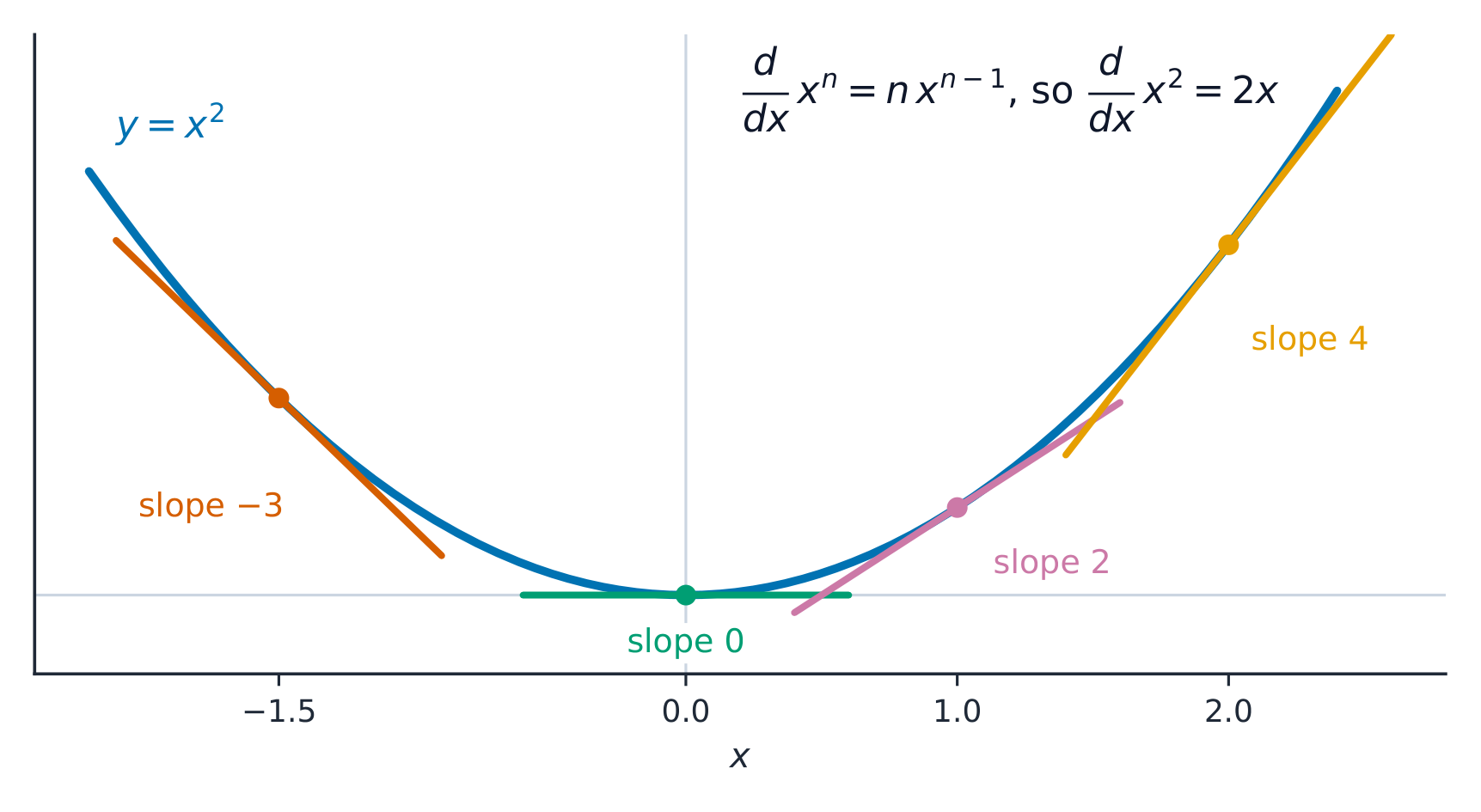
On y = x² the tangent slope at x is always 2x
What is $\dfrac{d}{dx}[x^5]$?
Difficulté 1/5 · 100 pièces + un petit bonus lors de la première réussite aujourd'hui
Bring down $5$, reduce exponent: $5x^{5-1}=5x^4$.
If $f(x)=x^4$, find $f'(2)$.
Difficulté 2/5 · 140 pièces + un petit bonus lors de la première réussite aujourd'hui
$f'(x)=4x^3$, so $f'(2)=4\cdot8=32$.
It works for any exponent
- $n$ can be a negative or a rational (fractional) exponent, not just a positive integer 整数.
- Negative: $\dfrac{d}{dx}[x^{-2}]=-2x^{-3}$.
- Rational: $\dfrac{d}{dx}\big[x^{1/2}\big]=\tfrac12 x^{-1/2}$.
- Apply the rule where the real power function is defined and differentiable; for $x^{1/2}$ this requires $x>0$, and negative powers exclude $0$.
$\dfrac{d}{dx}[x^{-2}]=-2x^{\square}$. The exponent $\square$ is ____.
Difficulté 1/5 · 100 pièces + un petit bonus lors de la première réussite aujourd'hui
Reduce $-2$ by one: $-2-1=-3$.
The Power Rule differentiates which of these directly (after rewriting)?
Difficulté 2/5 · 140 pièces + un petit bonus lors de la première réussite aujourd'hui
All are powers of $x$ after rewriting; $5^x$ is an exponential, not a power of $x$.
Rewrite first, then differentiate
- Radicals and reciprocals hide powers — rewrite them as $x^n$ before applying the rule.
- $\sqrt{x}=x^{1/2}$, so $\dfrac{d}{dx}[\sqrt x]=\tfrac12 x^{-1/2}=\dfrac{1}{2\sqrt x}$.
- $\dfrac{1}{x^3}=x^{-3}$, so $\dfrac{d}{dx}\!\left[\dfrac1{x^3}\right]=-3x^{-4}=-\dfrac{3}{x^4}$.
- Turning every term into a power is the key setup step.
Rewrite and differentiate: $\dfrac{d}{dx}[\sqrt x]$ equals...
Difficulté 1/5 · 100 pièces + un petit bonus lors de la première réussite aujourd'hui
$\sqrt x=x^{1/2}\Rightarrow \tfrac12 x^{-1/2}=\tfrac1{2\sqrt x}$.
The Power Rule applies to $2^x$, giving $x\cdot 2^{x-1}$.
Difficulté 1/5 · 100 pièces + un petit bonus lors de la première réussite aujourd'hui
The Power Rule needs a variable base with constant exponent; $2^x$ is an exponential (lesson 2.7).
The Power Rule is for a variable base with a constant exponent ($x^n$). It does not apply to a constant base with a variable exponent — $\frac{d}{dx}[2^x]\neq x\,2^{x-1}$. (That is an exponential, handled in lesson 2.7.) And don't forget to reduce the exponent: $\frac{d}{dx}[x^{-2}]=-2x^{-3}$, not $-2x^{-2}$.
Differentiate $g(x)=\sqrt[3]{x^2}+\dfrac{1}{x}$.
- Rewrite as powers: $g(x)=x^{2/3}+x^{-1}$.
- Power rule term by term: $\tfrac23 x^{-1/3}$ and $-1\cdot x^{-2}$.
- $g'(x)=\tfrac23 x^{-1/3}-x^{-2}=\dfrac{2}{3\sqrt[3]{x}}-\dfrac1{x^2}$.
The Power Rule $\frac{d}{dx}[x^n]=n\,x^{n-1}$ works for any constant real exponent on $x>0$, and elsewhere wherever that real power is defined and differentiable. Rewrite radicals and reciprocals as powers first, then bring the exponent down and reduce it by one. It replaces the limit definition for power functions.
Write from the data: find the power
- f(x) = x to the fourth.
- The derivative is wanted at x = 2.
What is f prime of 2?
4 times 2 cubed is 32.
The derivative of x to the fourth, at x = 2, is what?
Difficulté 1/5 · 100 pièces + un petit bonus lors de la première réussite aujourd'hui
4 x cubed at 2 is 32.