Ancêtre commun
Introduit| English | Sens |
|---|---|
| common ancestor/ˈkɒmən ˈænsestə/ | ancêtre commun |
| lineage/ˈlɪnɪɪdʒ/ | ligne évolutive |
All life is related
- Every living thing, from a bacterium to a blue whale, is connected.
- Trace any two species back far enough and their family lines meet.
- That meeting point is a shared ancestor.
- This idea — common ancestry — ties all of life into one tree.
The common ancestor
- A common ancestor 共同祖先 is an earlier species two others both descend from.
- Humans and chimps did not come from each other — they share an ancestor.
- The more recent that shared ancestor, the more closely related the species.
- Follow every lineage 谱系 back far enough, and they all connect.
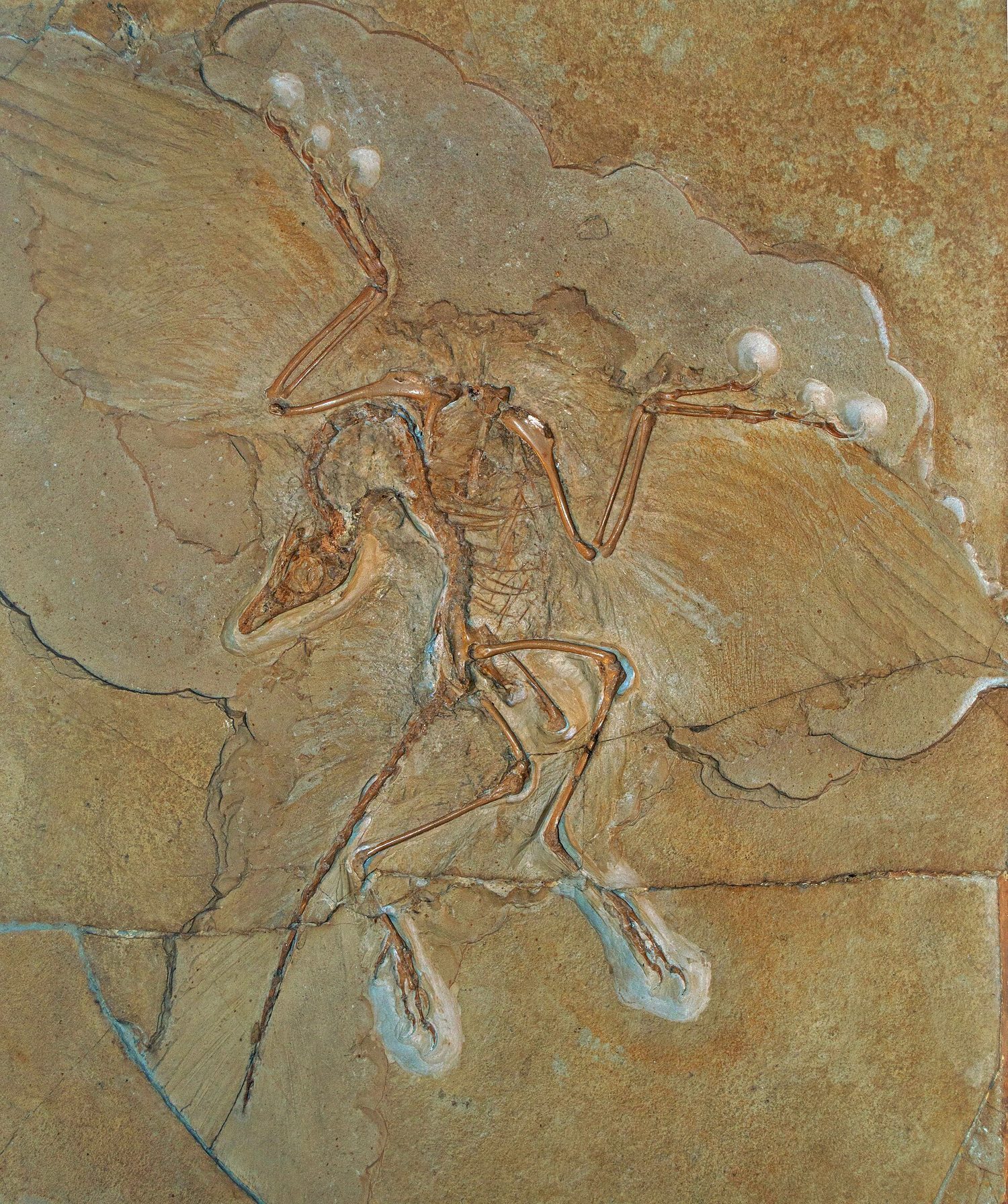
Archaeopteryx: transitional fossils link major groups and support common ancestry
Un ancêtre commun de deux espèces est…
Difficulté 1/5 · 100 pièces + un petit bonus lors de la première réussite aujourd'hui
Un ancêtre commun est une espèce antérieure dont descendent les deux espèces modernes.
Universal features
- Almost all living things share deep, basic features.
- They all use the same DNA genetic code.
- They all build proteins with ribosomes and run on ATP.
- These universal traits point to a single origin of life.
Remonter à un ancêtre commun
Reculer dans le temps - plus on remonte, plus les espècespartagent un ancêtre éloigné.
Quelle caractéristique est partagée par presque tous les êtres vivants, indiquant une origine commune ?
Difficulté 1/5 · 100 pièces + un petit bonus lors de la première réussite aujourd'hui
Presque toute la vie utilise le même code génétique, les mêmes ribosomes et l'ATP — signes forts d'une ascendance partagée.
Les espèces partageant un ancêtre commun plus lointain sont plus étroitement apparentées.
Difficulté 1/5 · 100 pièces + un petit bonus lors de la première réussite aujourd'hui
Faux. Plus le ancêtre commun est récent, plus la parenté est étroite.
The tree of life
- Because all life is related, we can draw it as one branching tree.
- Nearby branches are closely related; distant branches split long ago.
- The deeper a shared feature, the older the ancestor that had it.
- Every species is a twig on this single, ancient tree.
La ligne de descendance reliant un ancêtre à ses descendants est un ____.
Difficulté 1/5 · 100 pièces + un petit bonus lors de la première réussite aujourd'hui
Une lignée est la chaîne continue d'ancêtres et de descendants à travers le temps.
Sélectionnez toutes les affirmations vraies concernant l'ascendance commune.
Difficulté 2/5 · 140 pièces + un petit bonus lors de la première réussite aujourd'hui
Les humains n'ont pas évolué à partir de chimpanzés — les deux partagent un ancêtre. Les trois autres sont corrects.
Common ancestry does not mean one living species came from another. Humans did not evolve from chimpanzees. Instead, humans and chimps both descend from a shared ancestor that lived millions of years ago and was neither.
The universal genetic code:
- In a human, an oak tree, and a bacterium, the codon $\text{A–U–G}$ codes for the same amino acid.
- There is no chemical reason it had to be this way.
- The best explanation is that all three inherited the code from one common ancestor.
All life shares common ancestry: any two species trace back to a common ancestor, and a more recent shared ancestor means a closer relationship. Universal features — the same genetic code, ribosomes, and ATP — show that every lineage connects to one ancient origin. Related species share ancestors; they do not descend from one another.
Write from this case
- Bacteria, plants and humans use the same codon table for almost every amino acid.
- They also all have ribosomes.
Que suggère le code génétique partagé ?
Un code universel s'explique le plus simplement par héritage d'un seul ancêtre.
Qu'est-ce qu'un code génétique quasi universel soutient ?
Difficulté 1/5 · 100 pièces + un petit bonus lors de la première réussite aujourd'hui
Une machinerie partagée et héritée pointe vers une origine unique.