Permutations and combinations · Permutations et combinaisons
| English | Français |
|---|---|
| permutation/ˌpɜːmjuːˈteɪʃn/ | permutation |
| combination/ˌkɒmbɪˈneɪʃn/ | combinaison |
| factorial/fækˈtɔːrɪəl/ | factorielle |
| multiplication principle/ˌmʌltɪplɪˈkeɪʃn ˈprɪnsɪpl/ | principe de multiplication |
How many ways to arrange a bookshelf?
- You have 10 books and want to choose 3 to display. How many ways? If order matters, it's a permutation 排列. If you just want any 3, it's a combination 组合.
- Counting techniques are the foundation of probability — and they appear everywhere, from lottery odds to password security.
Combien de façons d'arranger une bibliothèque ?
- Vous avez 10 livres et voulez en choisir 3 à exposer. De combien de façons ? Si l'ordre compte, c'est une permutation 排列. Si vous voulez juste n'importe lesquels 3, c'est une combinaison 组合.
- Les techniques de comptage sont la base des probabilités — et elles apparaissent partout, des cotes de loterie à la sécurité des mots de passe.
Permutation or combination lab · Laboratoire sur les permutations et combinaisons
Choose whether order matters in a counting problem. · Choisissez si l'ordre importe dans un problème de dénombrement.
Permutations (order matters)
- A permutation is an arrangement where order matters: ${}^nP_r = \dfrac{n!}{(n-r)!}$.
- Example: arranging 3 books from 10: ${}^{10}P_3 = \dfrac{10!}{7!} = 10 \times 9 \times 8 = 720$.
Worked example. How many 3-letter codes can be made from 26 letters (no repeats)? ${}^{26}P_3 = 26 \times 25 \times 24 = 15\,600$.
Permutations: 3 books arrange in 3 × 2 × 1 = 6 different orders
Permutations (l'ordre compte)
- Une permutation est un arrangement où l'ordre compte : ${}^nP_r = \dfrac{n!}{(n-r)!}$.
- Exemple : arranger 3 livres parmi 10 : ${}^{10}P_3 = \dfrac{10!}{7!} = 10 \times 9 \times 8 = 720$.
Exemple résolu. Combien de codes de 3 lettres peut-on former avec 26 lettres (sans répétition) ? ${}^{26}P_3 = 26 \times 25 \times 24 = 15\,600$.
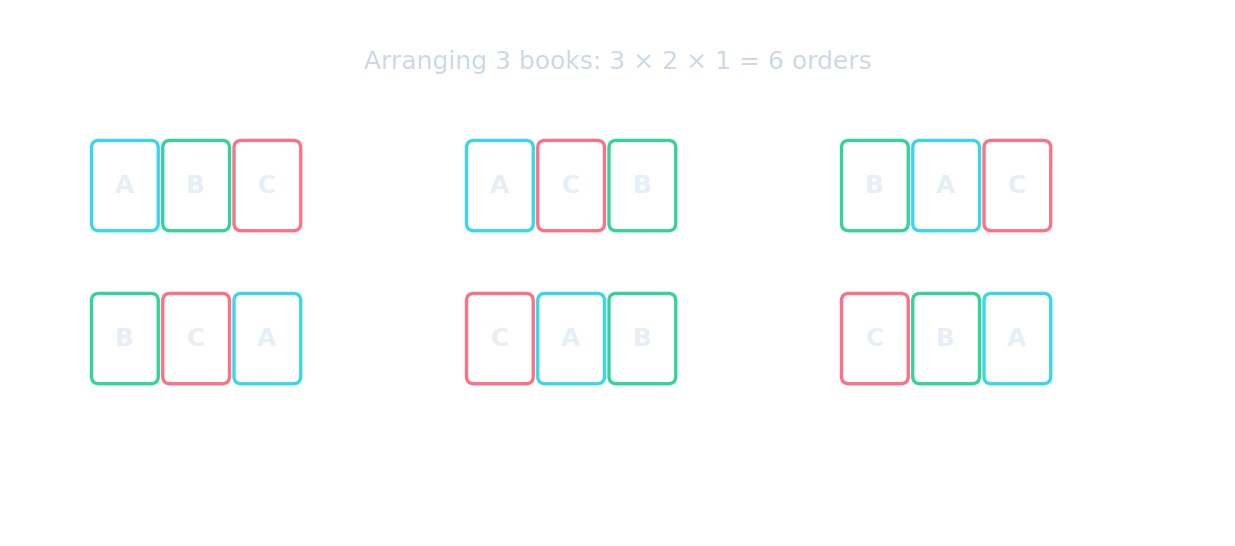
Permutations: 3 books arrange in 3 × 2 × 1 = 6 different orders
In a combination, the order of the chosen items: · Dans une combinaison, l'ordre des éléments choisis :
Combinations ignore order; permutations count order. · Les combinaisons ignorent l'ordre ; les permutations comptent l'ordre.
How many ways to arrange 3 books from 10 on a shelf (¹⁰P₃)? · Combien y a-t-il de façons d'arranger 3 livres parmi 10 sur une étagère (¹⁰P₃) ?
¹⁰P₃ = 10!/(10-3)! = 10!/7! = 10 × 9 × 8 = 720.
Combinations (order doesn't matter)
- A combination is a selection where order doesn't matter: ${}^nC_r = \dbinom{n}{r} = \dfrac{n!}{r!\,(n-r)!}$.
- Example: choosing 3 books from 10: ${}^{10}C_3 = \dfrac{10!}{3!\,7!} = \dfrac{720}{6} = 120$.
Permutation vs combination. Choosing a committee of 3 from 10 people is a combination (order doesn't matter). Choosing a president, vice-president, and secretary from 10 is a permutation (order matters — the roles are different).
Order matters for a permutation, but not for a combination
Combinaisons (l'ordre ne compte pas)
- Une combinaison est une sélection où l'ordre ne compte pas : ${}^nC_r = \dbinom{n}{r} = \dfrac{n!}{r!\,(n-r)!}$.
- Exemple : choisir 3 livres parmi 10 : ${}^{10}C_3 = \dfrac{10!}{3!\,7!} = \dfrac{720}{6} = 120$.
Permutation vs combination. Choisir un comité de 3 personnes parmi 10 est une combinaison (l'ordre ne compte pas). Choisir un président, un vice-président et un secrétaire parmi 10 est une permutation (l'ordre compte — les rôles sont différents).

L'ordre importe pour une permutation, mais pas pour une combinaison
How many ways are there to choose 2 from 5 (⁵C₂)? · Combien y a-t-il de façons de choisir 2 parmi 5 (⁵C₂) ?
⁵C₂ = 5!/(2!3!) = 120/(2×6) = 10.
⁵P₃ is greater than ⁵C₃. · ⁵P₃ est supérieur à C₃.
⁵P₃ = 60 (order matters), ⁵C₃ = 10 (order doesn't). Permutations always ≥ combinations. · ⁵P₃ = 60 (l'ordre compte), ⁵C₃ = 10 (l'ordre ne compte pas). Les permutations sont toujours ≥ aux combinaisons.
Arrangements with repeats
- To arrange a word with repeated letters, divide by the factorial 阶乘 of each repeat count.
- Example: NEEDLESS has 8 letters with 3 E's and 2 S's: arrangements $= \dfrac{8!}{3!\,2!} = \dfrac{40320}{12} = 3360$.
Arrangements avec répétitions
- Pour arranging un mot avec des lettres répétées, diviser par la factorielle 阶乘 de chaque nombre de répétitions.
- Exemple : NEEDLESS a 8 lettres avec 3 E's et 2 S's : arrangements $= \dfrac{8!}{3!\,2!} = \dfrac{40320}{12} = 3360$.
How many arrangements of the letters of NEEDLESS? (8 letters: E×3, S×2 → 8!/(3!2!)) · Combien y a-t-il d'arrangements des lettres de NEEDLESS ? (8 lettres : E×3, S×2 → 8!/(3!2!))
8!/(3!2!) = 40320/(6×2) = 40320/12 = 3360.
The multiplication principle 乘法原理
- If one choice can be made in $m$ ways and another in $n$ ways, both together can be made in $m \times n$ ways.
- Example: 3 shirts and 4 trousers → $3 \times 4 = 12$ outfits.
Le principe de multiplication 乘法原理
- Si un choix peut être fait de $m$ manières et un autre de $n$ manières, les deux ensemble peuvent être faits de $m \times n$ manières.
- Exemple : 3 chemises et 4 pantalons → $3 \times 4 = 12$ tenues.
You have 3 shirts and 4 trousers. How many outfits can you make? · Vous avez 3 chemises et 4 pantalons. Combien d'ensembles pouvez-vous former ?
3 × 4 = 12 outfits (multiplication principle). · 3 × 4 = 12 ensembles (principe multiplicatif).
You've got it
- permutation (order matters): ${}^nP_r = \dfrac{n!}{(n-r)!}$
- combination (order doesn't): ${}^nC_r = \dfrac{n!}{r!(n-r)!}$
- repeated letters: divide $n!$ by each repeat's factorial (NEEDLESS → $\dfrac{8!}{3!\,2!}$)
Vous avez compris
- permutation (order matters) : ${}^nP_r = \dfrac{n!}{(n-r)!}$
- combination (order doesn't) : ${}^nC_r = \dfrac{n!}{r!(n-r)!}$
- lettres répétées : diviser $n!$ par la factorielle de chaque répétition (NEEDLESS → $\dfrac{8!}{3!\,2!}$)