Lois de Newton du mouvement
Introduit| English | Sens |
|---|---|
| resultant force/rɪˈzʌltənt fɔːs/ | force résultante |
| weight/weɪt/ | poids |
| tension/ˈtenʃn/ | tension |
| inclined plane/ɪnˈklaɪnd pleɪn/ | plan incliné |
| connected particles/kəˈnektɪd ˈpɑːtɪklz/ | particules liées |
| inextensible/ˌɪnekˈstensɪbl/ | inextensible |
The law that launched rockets
- Every rocket, every car, every falling apple obeys the same rule: $F = ma$.
- Newton's second law is the foundation of all mechanics. Master it and you can predict the motion of anything.
Newton's second law
- The key law: resultant force 合力 = mass × acceleration:
- Weight 重力 is the force of gravity: $W = mg$ (take $g = 10\text{ m s}^{-2}$).
- Forces include weight, friction, tension 张力 in a string, and the push in a rod.
Worked example. A 4 kg box is pushed with a horizontal force of 20 N on a smooth surface. $F = ma \Rightarrow 20 = 4a \Rightarrow a = 5\text{ m s}^{-2}$.
Resultant force, not just any force. $F = ma$ uses the net (resultant) force. If there's friction, you must subtract it: $F_{\text{net}} = F_{\text{applied}} - F_{\text{friction}}$.
Force résultante
F = ma
La force résultante produit l'accélération. Des forces équilibrées ⇒ aucune accélération.
Une force résultante imprime à une masse de 5 kg une accélération de 2 m/s². Quelle est la force (F = ma), en N ?
Difficulté 2/5 · 140 pièces + un petit bonus lors de la première réussite aujourd'hui
F = ma = 5 × 2 = 10 N.
En prenant g = 10 m/s², quel est le poids d'un objet de 2 kg (W = mg), en N ?
Difficulté 2/5 · 140 pièces + un petit bonus lors de la première réussite aujourd'hui
W = mg = 2 × 10 = 20 N.
F = ma utilise la force résultante (nette), pas simplement une force unique.
Difficulté 1/5 · 100 pièces + un petit bonus lors de la première réussite aujourd'hui
F = ma nécessite la force nette. Si le frottement est présent, soustrayez-le d'abord de la force appliquée.
Slopes and inclined planes 斜面
- On an inclined plane: split forces along and perpendicular to the slope, then apply $F = ma$ along the slope.
- Component of weight along slope: $mg\sin\theta$. Component perpendicular: $mg\cos\theta$.
Pour analyser le mouvement sur un plan incliné, vous devez :
Difficulté 1/5 · 100 pièces + un petit bonus lors de la première réussite aujourd'hui
Résolvez le long de la pente (appliquez F = ma là-dedans) et perpendiculairement (pour la réaction normale).
Connected particles 连接质点
- For connected particles (joined by a string): apply $F = ma$ to each body, or to the whole system.
- The string has the same tension throughout (if light and inextensible 不可伸长).
- Both bodies have the same acceleration.
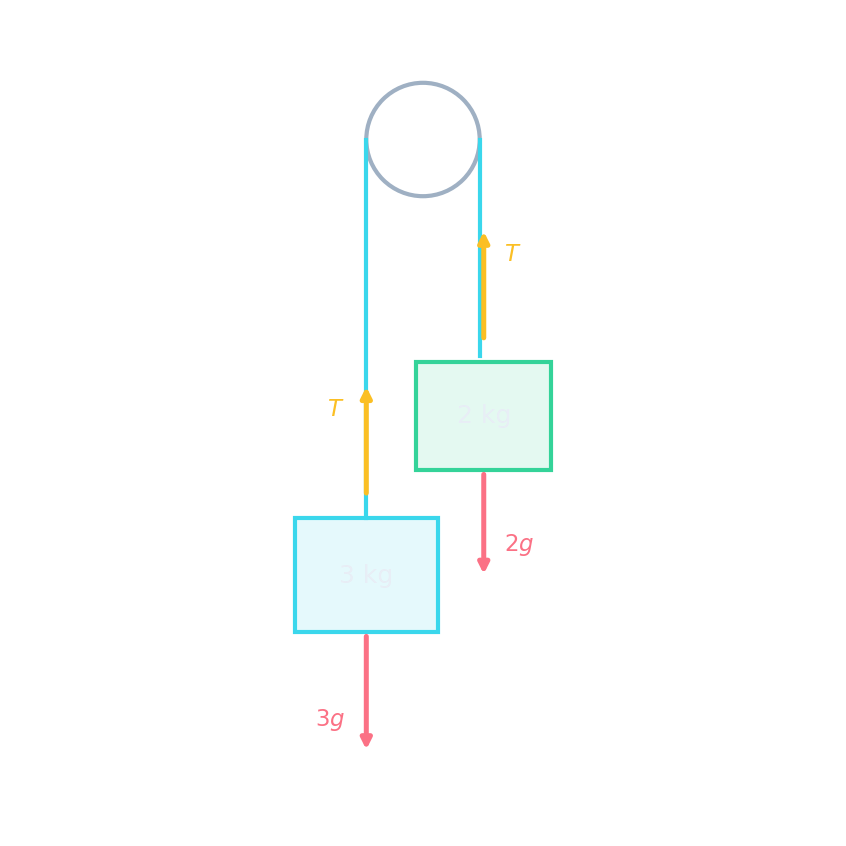
Connected particles share one tension T and one acceleration; apply F = ma to each mass.
Des masses de 3 kg et 2 kg sur une poulie lisse. Accélération = g/5. Avec g = 10, trouvez a (m/s²).
Difficulté 2/5 · 140 pièces + un petit bonus lors de la première réussite aujourd'hui
a = g/5 = 10/5 = 2 m/s².
Pour les masses de 3 kg et 2 kg sur une poulie (a = 2 m/s²), trouvez la tension T à partir de T − 2g = 2a (g = 10).
Difficulté 2/5 · 140 pièces + un petit bonus lors de la première réussite aujourd'hui
T − 2(10) = 2(2) → T = 20 + 4 = 24 N.
Worked example — connected particles
- A 3 kg and 2 kg mass are connected by a light string over a smooth pulley. Find the acceleration.
- For the 3 kg mass (moving down): $3g - T = 3a$.
- For the 2 kg mass (moving up): $T - 2g = 2a$.
- Adding: $3g - 2g = 5a \Rightarrow a = \dfrac{g}{5} = 2\text{ m s}^{-2}$.
- Newton's laws of motion give $F=ma$; forces may include thrust and air resistance.
You've got it
- F = ma; weight $W = mg$
- on a slope, resolve forces along and perpendicular to the slope
- for connected particles, apply $F = ma$ to each body or the whole system
Write from the data given
- A resultant force of 18 N acts on a 6 kg body.
- Find the acceleration.
Une force résultante de 18 N agit sur un corps de 6 kg sur une surface lisse. Quelle est l'accélération, et cette force correspond-elle au poids ?
La force divisée par la masse est l'accélération. 18 divisé par 6 donne 3.
Quelle est l'accélération ?
Difficulté 1/5 · 100 pièces + un petit bonus lors de la première réussite aujourd'hui
18 divisé par 6 donne 3 mètres par seconde au carré.