Integration · Intégration
| English | Français |
|---|---|
| integration/ˌɪntɪˈɡreɪʃn/ | intégration |
| constant of integration/ˈkɒnstənt ɒv ˌɪntɪˈɡreɪʃn/ | constante d'intégration |
| definite integral/ˈdefɪnət ˈɪntɪɡrəl/ | intégrale définie |
| volume of revolution/ˈvɒljuːm ɒv ˌrevəˈluːʃn/ | volume de révolution |
The area under the curve
- How much fuel does a rocket burn if its thrust varies over time? How much land does a curved field cover?
- Integration 积分 answers these questions — it finds the total accumulated quantity from a rate of change.
L'aire sous la courbe
- Combustion de carburant d'une fusée dont la poussée varie dans le temps ? Superficie d'un champ aux limites courbes ?
- L'intégration 积分 répond à ces questions — elle trouve la quantité totale accumulée à partir d'un taux de variation.
Indefinite integration
- Integration reverses differentiation:
- The $+\,C$ is the constant of integration 积分常数 — find it from a known point.
Worked example. $\int 3x^2\,dx = x^3 + C$. If the curve passes through $(1, 5)$: $1^3 + C = 5$, so $C = 4$ and $y = x^3 + 4$.
A definite integral 定积分 measures the shaded area between the curve and the x-axis
Intégration indéfinie
- L'intégration inverse la différentiation :
- Le $+\,C$ est la constante d'intégration 积分常数 — trouvez-la à partir d'un point connu.
Exemple résolu. $\int 3x^2\,dx = x^3 + C$. Si la courbe passe par $(1, 5)$ : $1^3 + C = 5$, donc $C = 4$ et $y = x^3 + 4$.
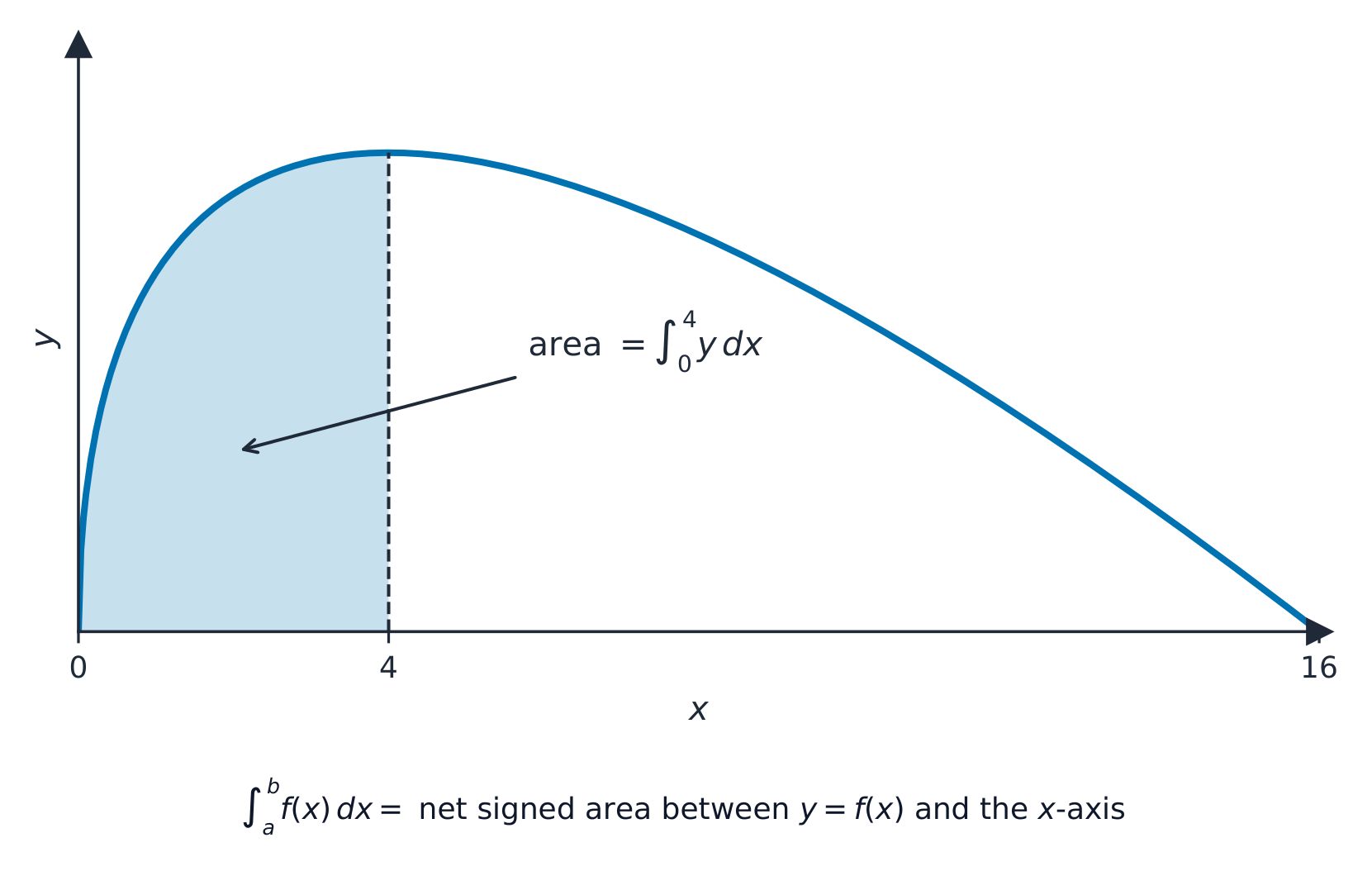
Une intégrale définie 定积分 (intégrale définie) mesure l'aire hachurée entre la courbe et l'axe des x
The area under the curve · L'aire sous la courbe
area = ∫ f(x) dx · aire = ∫ f(x) dx
Drag the limits a and b — the shaded area · aire between the curve and the x-axis is the definite integral. · Faites glisser les limites a et b — l'aire ombragée entre la courbe et l'axe des x est l'intégrale définie.
Why does an indefinite integral include "+ C"? · Pourquoi une intégrale indéfinie contient-elle "+ C" ?
Differentiating a constant gives 0, so the original could have had any constant — hence + C. · La dérivation d'une constante donne 0, donc l'original pouvait avoir n'importe quelle constante — d'où + C.
If dy/dx = 4x and the curve passes through (1, 7), what is C in y = 2x² + C? · Si dy/dx = 4x et la courbe passe par (1, 7), quelle est la valeur de C dans y = 2x² + C ?
y = 2x² + C. At (1, 7): 7 = 2(1)² + C → C = 5. · y = 2x² + C. En (1, 7) : 7 = 2(1)² + C → C = 5.
Definite integrals
- A definite integral gives a number: $\displaystyle\int_p^q f(x)\,dx = F(q) - F(p)$.
- The area under a curve from $p$ to $q$ is $\displaystyle\int_p^q y\,dx$ (for two curves, integrate top − bottom).
The definite integral $\int_0^3 x^2\,dx = \left[\dfrac{x^3}{3}\right]_0^3 = 9 - 0 = 9$. The shaded area is $9$ square units.
Area below the x-axis is negative. If the curve dips below the axis, the integral gives a negative value. To find the total area, split at the roots and take the absolute value of each part.
Intégrales définies
- Une intégrale définie donne un nombre : $\displaystyle\int_p^q f(x)\,dx = F(q) - F(p)$.
- L'aire sous une courbe de $p$ à $q$ est $\displaystyle\int_p^q y\,dx$ (pour deux courbes, intégrez haut − bas).

L'intégrale définie $\int_0^3 x^2\,dx = \left[\dfrac{x^3}{3}\right]_0^3 = 9 - 0 = 9$. L'aire hachurée est de $9$ unité carrée.
L'aire sous l'axe des x est négative. Si la courbe descend sous l'axe, l'intégrale donne une valeur négative. Pour trouver l'aire totale, séparez aux racines et prenez la valeur absolue de chaque partie.
Evaluate the definite integral of 2x from 0 to 3 (∫₀³ 2x dx). · Évaluez l'intégrale définie de 2x de 0 à 3 (∫₀³ 2x dx).
∫2x dx = x², so [x²]₀³ = 9 − 0 = 9. · ∫2x dx = x², donc [x²]₀³ = 9 − 0 = 9.
Evaluate ∫₀² 3x² dx. · Évaluez ∫₀² 3x² dx.
∫3x² dx = x³, so [x³]₀² = 8 − 0 = 8. · ∫3x² dx = x³, donc [x³]₀² = 8 − 0 = 8.
If a curve is below the x-axis, the definite integral gives a negative value. · Si une courbe est sous l'axe des x, l'intégrale définie donne une valeur négative.
Area below the x-axis contributes negatively to the integral. Take the absolute value to find the actual area. · L'aire sous l'axe des x contribue négativement à l'intégrale. Prenez la valeur absolue pour trouver l'aire réelle.
Volume of revolution 旋转体体积
- Volume of revolution about the $x$-axis: $V = \pi\displaystyle\int_p^q y^2\,dx$.
- Think of it as stacking infinitely thin discs of radius $y$ and thickness $dx$.
Rotating the region under a curve around the x-axis sweeps out a solid, summed as thin discs
Volume de révolution 旋转体体积
- Volume de révolution autour de l'axe des $x$ : $V = \pi\displaystyle\int_p^q y^2\,dx$.
- Pensez-y comme empilant des disques infiniment minces de rayon $y$ et d'épaisseur $dx$.

En tournant la région sous une courbe autour de l'axe des x, on balaye un solide, sommé comme des disques minces
The volume of revolution of y = x about the x-axis from 0 to 2 is π∫₀² x² dx. Find the value (without π). · Le volume de révolution de y = x autour de l'axe des x de 0 à 2 est π∫₀² x² dx. Trouvez la valeur (sans π).
∫₀² x² dx = [x³/3]₀² = 8/3 ≈ 2.67.
Worked example
- Find the area under $y = x^2$ from $x = 0$ to $x = 3$:
- $\displaystyle\int_0^3 x^2\,dx = \left[\dfrac{x^3}{3}\right]_0^3 = \dfrac{27}{3} - 0 = 9$.
- An improper integral has an infinite limit or an unbounded integrand.
Exemple résolu
- Trouvez l'aire sous $y = x^2$ de $x = 0$ à $x = 3$ :
- $\displaystyle\int_0^3 x^2\,dx = \left[\dfrac{x^3}{3}\right]_0^3 = \dfrac{27}{3} - 0 = 9$.
- Une intégrale impropre a une limite infinie ou un intégrande non borné.
You've got it
- integration reverses differentiation; remember the $+\,C$
- a definite integral $\int_p^q f(x)\,dx = F(q) - F(p)$ = the area under the curve
- volume of revolution about the $x$-axis $= \pi\int y^2\,dx$
- area below the axis is negative — split and take absolute values for total area
Vous avez compris
- L'intégration inverse la dérivation ; n'oubliez pas la constante $+\,C$
- une intégrale définie $\int_p^q f(x)\,dx = F(q) - F(p)$ = l'aire sous la courbe
- volume de révolution autour de l'axe des $x$ $= \pi\int y^2\,dx$
- l'aire sous l'axe est négative — séparez et prenez les valeurs absolues pour l'aire totale