Algebra (modulus and polynomials) · Algèbre (valeur absolue et polynômes)
| English | Français |
|---|---|
| modulus/ˈmɒdjʊləs/ | module |
| remainder theorem/rɪˈmeɪndə ˈθɪərəm/ | thorème du reste |
| polynomial/ˌpɒlɪˈnəʊmɪəl/ | polynomiale |
| degree/dɪˈɡriː/ | degré |
| factor theorem/ˈfæktə ˈθɪərəm/ | thorème du facteur |
The absolute value that saves bridges
- Engineers designing suspension cables need to know the maximum deviation from the ideal — whether above or below.
- The modulus 绝对值 (absolute value) measures distance from zero, ignoring direction. It appears everywhere: error bounds, tolerances, and inequalities.
La valeur absolue qui sauve les ponts
- Les ingénieurs conçoivant des câbles suspendus doivent connaître l'écart maximal par rapport à l'idéal — au-dessus ou en dessous.
- Le module 绝对值 (valeur absolue) mesure la distance à zéro, sans tenir compte de la direction. Il apparaît partout : limites d'erreur, tolérances et inégalités.
The modulus function
- The modulus $|x|$ is the size of a number, sign removed ($|x| \geq 0$). Its graph is a "V".
- Useful rules:
- $|a| = |b| \Leftrightarrow a^2 = b^2$,
- $|x - a| < b \Leftrightarrow a - b < x < a + b$.
The modulus function $y = |x - 2|$ creates a V-shape: everything below the axis is reflected above it.
Worked example. Solve $|2x - 3| = 7$. Either $2x - 3 = 7 \Rightarrow x = 5$, or $2x - 3 = -7 \Rightarrow x = -2$. Solutions: $x = 5$ or $x = -2$.
La fonction module
- Le module $|x|$ est la taille d'un nombre, signe retiré ($|x| \geq 0$). Son graphique est un « V ».
- Règles utiles :
- $|a| = |b| \Leftrightarrow a^2 = b^2$,
- $|x - a| < b \Leftrightarrow a - b < x < a + b$.
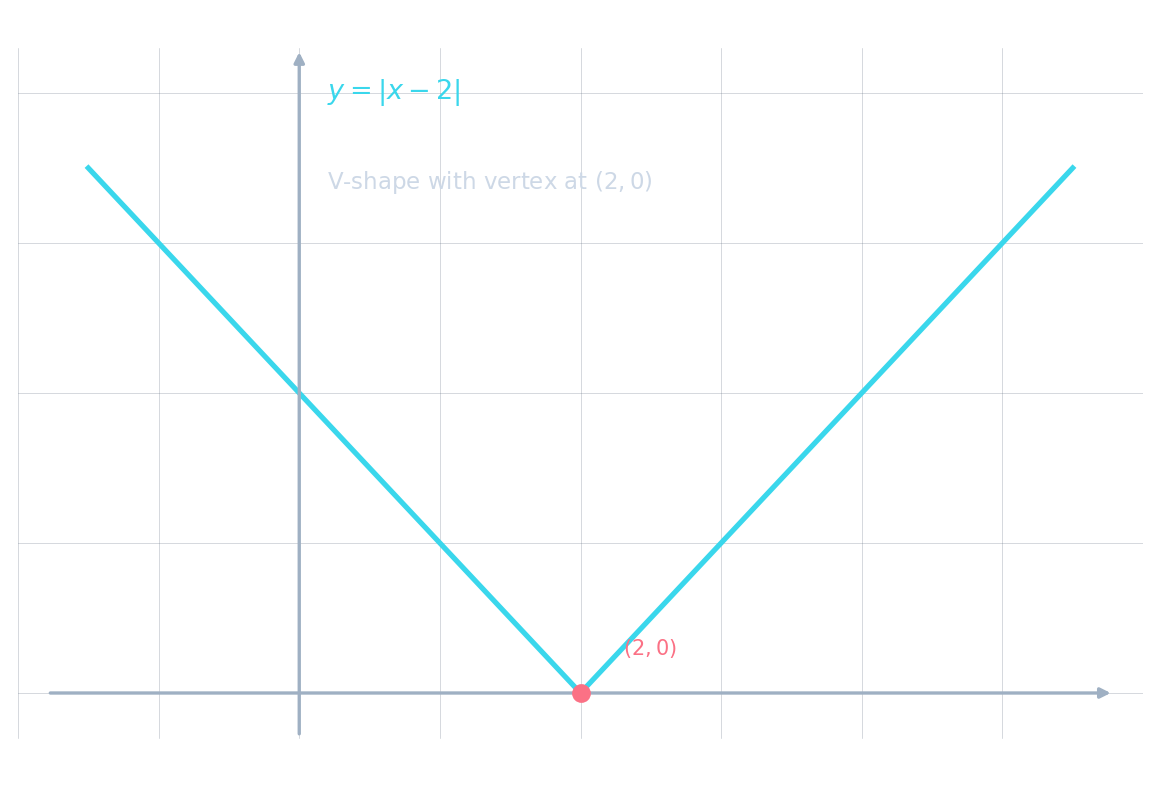
La fonction module $y = |x - 2|$ crée une forme en V : tout ce qui est sous l'axe est reflété au-dessus.
Exemple résolu. Résolvez $|2x - 3| = 7$. Soit $2x - 3 = 7 \Rightarrow x = 5$, soit $2x - 3 = -7 \Rightarrow x = -2$. Solutions : $x = 5$ ou $x = -2$.
The modulus function · La fonction valeur absolue
y = a|x − b| + c
The modulus makes a V-shape. Move its vertex · sommet with b and c; change how steep the arms are with a. · La valeur absolue forme une forme en V. Déplacez son sommet avec b et c ; modifiez la pente des bras avec a.
Solve |x − 2| < 3. The solution is −1 < x < ? What is the upper bound? · Résolvez |x − 2| < 3. La solution est −1 < x < ? Quelle est la borne supérieure ?
|x − 2| < 3 means 2 − 3 < x < 2 + 3, i.e. −1 < x < 5. · |x − 2| < 3 signifie 2 − 3 < x < 2 + 3, soit −1 < x < 5.
Solve |2x − 3| = 7. What is the larger solution? · Résolvez |2x − 3| = 7. Quelle est la plus grande solution ?
2x − 3 = 7 → x = 5; or 2x − 3 = −7 → x = −2. Larger is 5. · 2x − 3 = 7 → x = 5 ; ou 2x − 3 = −7 → x = −2. La plus grande est 5.
Factor & remainder theorems 余数定理
- A polynomial 多项式 is a sum of powers of $x$; its degree 次数 is the highest power.
- Remainder theorem: the remainder when $p(x) \div (x - a)$ is $p(a)$.
- Factor theorem 因式定理: $(x - a)$ is a factor exactly when $p(a) = 0$.
Don't confuse the two theorems. The remainder theorem gives the remainder for any divisor $(x - a)$. The factor theorem is a special case: when the remainder is zero, $(x - a)$ is a factor.
Taking the modulus folds the negative part of the line up into a V
Théorèmes du facteur et du reste 余数定理
- Un polynôme 多项式 est une somme de puissances de $x$ ; son degré 次数 est la puissance la plus élevée.
- Théorème du reste : le reste lorsque $p(x) \div (x - a)$ est $p(a)$.
- Théorème du facteur 因式定理 : $(x - a)$ est un facteur exactement quand $p(a) = 0$.
Ne confondez pas les deux théorèmes. Le théorème du reste donne le reste pour n'importe quel diviseur $(x - a)$. Le théorème du facteur est un cas particulier : lorsque le reste est zéro, $(x - a)$ est un facteur.
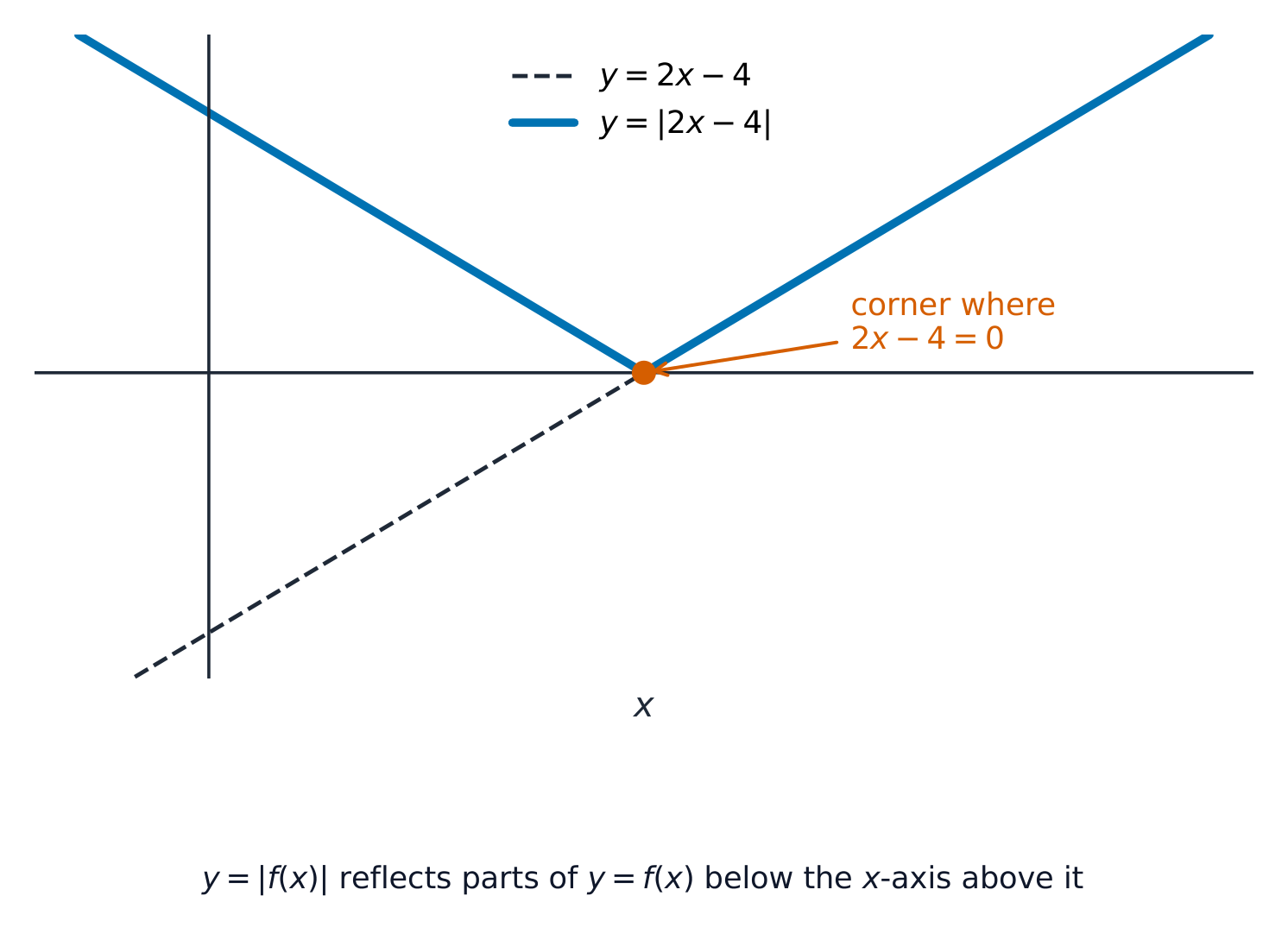
*Prendre le module plie la partie négative de la ligne vers le haut en un V
By the remainder theorem, what is the remainder when p(x) = x² + 3x + 2 is divided by (x − 1)? · D'après le théorème du reste, quel est le reste de la division de p(x) = x² + 3x + 2 par (x − 1) ?
Remainder = p(1) = 1 + 3 + 2 = 6. · Reste = p(1) = 1 + 3 + 2 = 6.
(x − a) is a factor of p(x) exactly when: · (x − a) est un facteur de p(x) exactement quand :
The factor theorem: (x − a) is a factor if and only if p(a) = 0. · Théorème du facteur : (x − a) est un facteur si et seulement si p(a) = 0.
Worked example — factor theorem
- Show that $(x - 2)$ is a factor of $p(x) = x^3 - 5x^2 + 2x + 8$.
- $p(2) = 8 - 20 + 4 + 8 = 0$. Since $p(2) = 0$, $(x - 2)$ is a factor.
- Divide: $x^3 - 5x^2 + 2x + 8 = (x - 2)(x^2 - 3x - 4) = (x - 2)(x - 4)(x + 1)$.
Opposite signs of f(a) and f(b) trap a root between a and b
Exemple résolu — théorème du facteur
- Montrez que $(x - 2)$ est un facteur de $p(x) = x^3 - 5x^2 + 2x + 8$.
- $p(2) = 8 - 20 + 4 + 8 = 0$. Puisque $p(2) = 0$, $(x - 2)$ est un facteur.
- Divisez : $x^3 - 5x^2 + 2x + 8 = (x - 2)(x^2 - 3x - 4) = (x - 2)(x - 4)(x + 1)$.
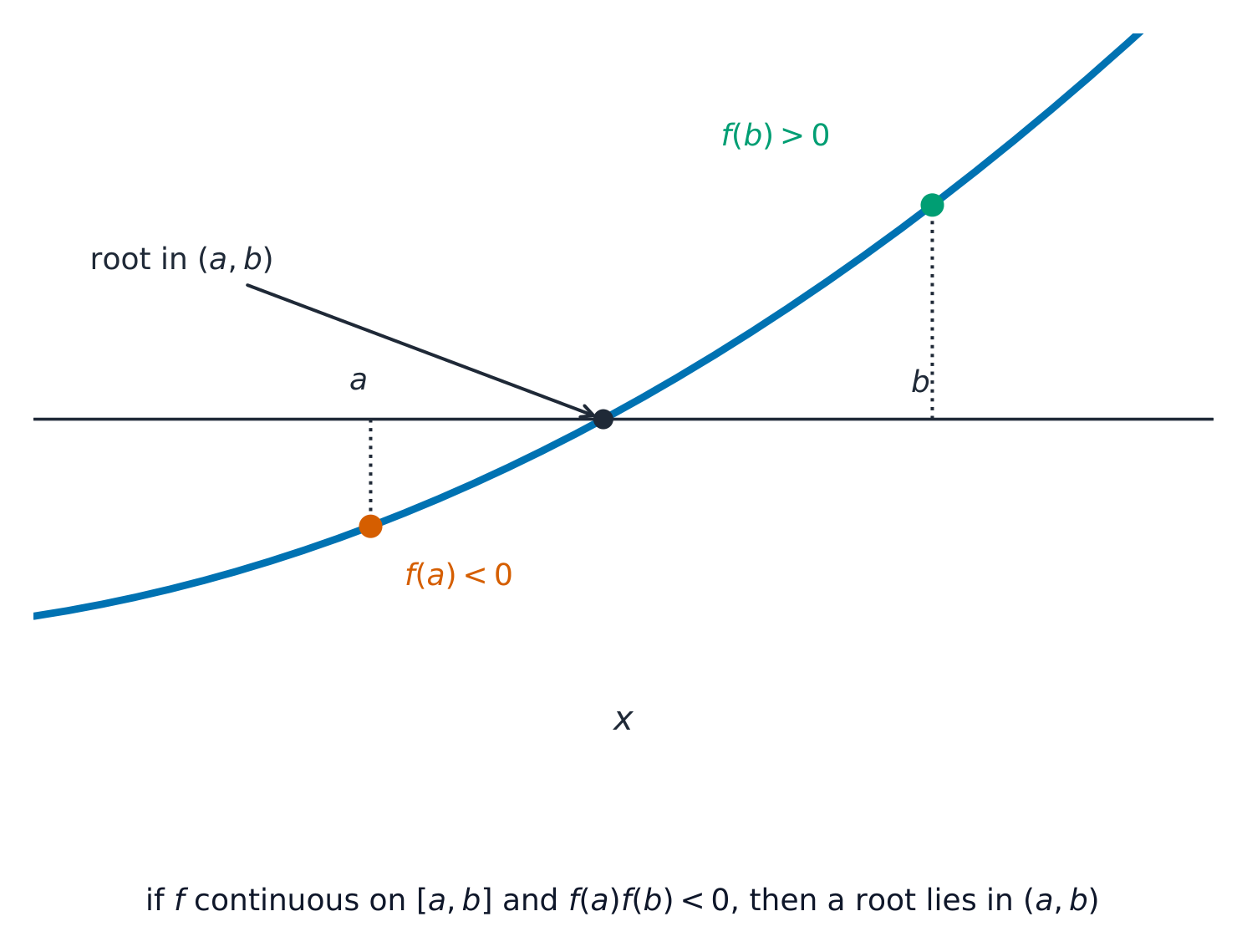
Signes opposés de f(a) et f(b) piégent une racine entre a et b
If p(3) = 0, then (x − 3) is a factor of p(x). · Si p(3) = 0, alors (x − 3) est un facteur de p(x).
By the factor theorem, p(a) = 0 means (x − a) is a factor. · D'après le théorème du facteur, p(a) = 0 signifie que (x − a) est un facteur.
Given p(x) = x³ − 6x² + 11x − 6 and p(1) = 0, factorise: p(x) = (x − 1)(x² + bx + c). What is c? · Étant donné p(x) = x³ − 6x² + 11x − 6 et p(1) = 0, factorisez : p(x) = (x − 1)(x² + bx + c). Quelle est c ?
Dividing x³ − 6x² + 11x − 6 by (x − 1) gives x² − 5x + 6, so c = 6. · En divisant x³ − 6x² + 11x − 6 par (x − 1), on obtient x² − 5x + 6, donc c = 6.
Solving polynomial equations
- Use the factor theorem to find one root, then divide to reduce the degree.
- A cubic has at most 3 real roots; a quartic at most 4.
- Sketch the graph to check: the number of $x$-axis crossings matches the number of real roots.
- Differentiate a fraction with the quotient rule.
Résolution d'équations polynomiales
- Utilisez le théorème du facteur pour trouver une racine, puis divisez pour réduire le degré.
- Un cubique a au maximum 3 racines réelles ; un quartique en a au maximum 4.
- Esquissez le graphique pour vérifier : le nombre de croisements avec l'axe des $x$ correspond au nombre de racines réelles.
- Dérivez une fraction avec la règle du quotient.
You've got it
- $|x|$ removes the sign; $|x - a| < b \Leftrightarrow a - b < x < a + b$
- remainder when $p(x) \div (x-a)$ is $p(a)$
- factor theorem: $(x-a)$ is a factor $\Leftrightarrow p(a) = 0$
- find one root, divide, then solve the remaining quadratic
Vous avez compris
- $|x|$ retire le signe ; $|x - a| < b \Leftrightarrow a - b < x < a + b$
- reste lorsque $p(x) \div (x-a)$ est $p(a)$
- théorème du facteur : $(x-a)$ est un facteur $\Leftrightarrow p(a) = 0$
- trouvez une racine, divisez, puis résolvez le quadratique restant