Differentiation · Dérivation
| English | Français |
|---|---|
| differentiation/ˌdɪfəˌrenʃɪˈeɪʃn/ | la différentiation |
| power rule/ˈpaʊə ruːl/ | règle de puissance |
| chain rule/tʃeɪn ruːl/ | règle de composition |
| derivative/dɪˈrɪvətɪv/ | dérivée |
| stationary point/ˈsteɪʃənəri pɔɪnt/ | point stationnaire |
| second derivative/ˈsekənd dɪˈrɪvətɪv/ | dérivée seconde |
| optimisation/ˌɒptɪmaɪˈzeɪʃn/ | optimisation |
The speed of change
- How fast is a rocket accelerating at the exact moment its fuel runs out? How steep is a roller coaster at its highest point?
- Differentiation 微分 answers these questions — it finds the instantaneous rate of change at any point on a curve.
La vitesse de changement
- À quelle vitesse une fusée accélère-t-elle au moment précis où son carburant s'épuise ? Quelle est la pente d'un montagnes russes à son point le plus haut ?
- La différentiation 微分 répond à ces questions — elle trouve le taux de changement instantané en tout point d'une courbe.
The power rule 幂法则 and chain rule 链式法则
- Differentiation finds the gradient of a curve at each point — the derivative 导数 $f'(x)$ or $\dfrac{dy}{dx}$.
- The power rule: $\dfrac{d}{dx}(x^n) = n x^{n-1}$ (any rational $n$).
- Chain rule for a function inside a function: $\dfrac{d}{dx}f(g(x)) = f'(g(x))\cdot g'(x)$.
The derivative $\dfrac{dy}{dx} = 2x$ gives the gradient at any point: at $x = 2$, the gradient is $4$.
Worked example. $y = (3x+1)^4$. Let $u = 3x+1$, so $y = u^4$. Chain rule: $\dfrac{dy}{dx} = 4u^3 \cdot 3 = 12(3x+1)^3$.
Règle de la puissance 幂法则 et règle de chaîne 链式法则
- La différentiation trouve la pente d'une courbe en chaque point — la dérivée 导数 $f'(x)$ ou $\dfrac{dy}{dx}$.
- La règle de la puissance : $\dfrac{d}{dx}(x^n) = n x^{n-1}$ (pour tout rationnel $n$).
- Règle de chaîne pour une fonction dans une fonction : $\dfrac{d}{dx}f(g(x)) = f'(g(x))\cdot g'(x)$.
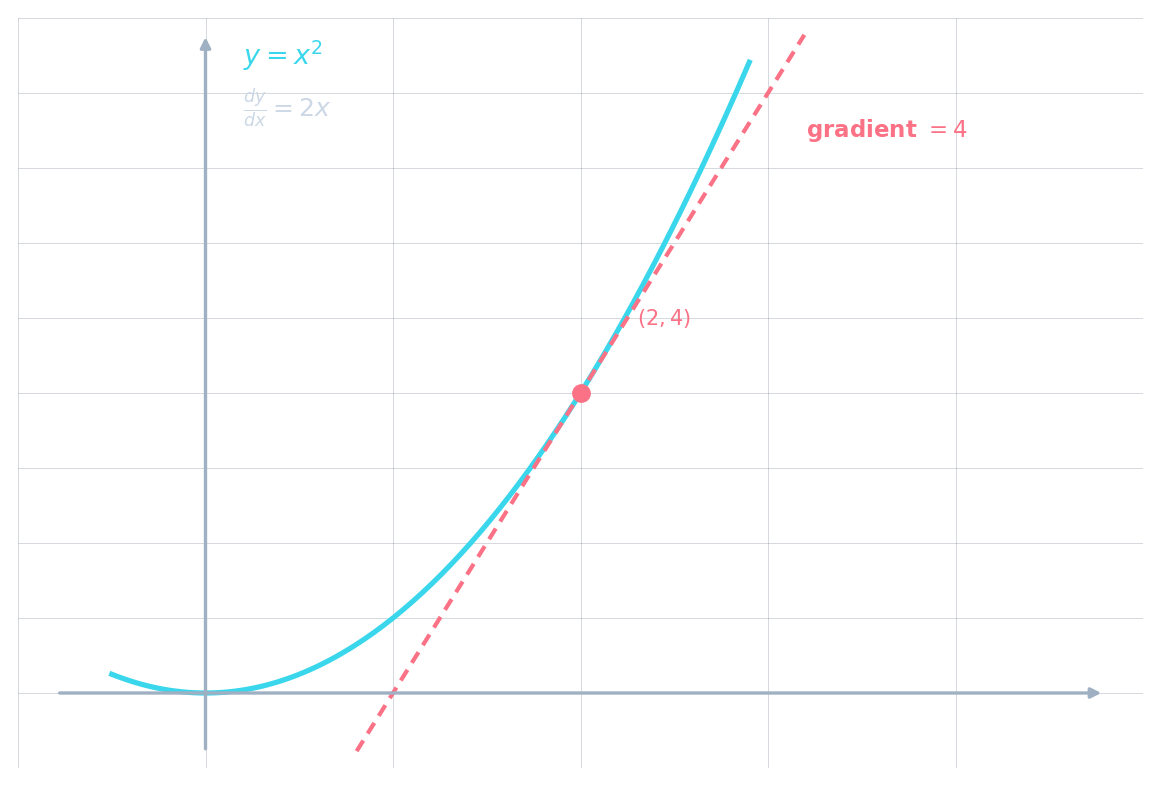
La dérivée $\dfrac{dy}{dx} = 2x$ donne la pente en tout point : au point $x = 2$, la pente est $4$.
Exemple résolu. $y = (3x+1)^4$. Posons $u = 3x+1$, donc $y = u^4$. Règle de chaîne : $\dfrac{dy}{dx} = 4u^3 \cdot 3 = 12(3x+1)^3$.
The gradient at a point · La pente en un point
gradient = dy/dx = f ′(x) · pente = dy/dx = f ′(x)
Slide the point along the curve — the tangent · tangente's slope IS the gradient f ′(x) there. · Faites glisser le point le long de la courbe — la pente de la tangente EST la pente f ′(x) à cet endroit.
If y = x³, then dy/dx = 3x². What is the gradient at x = 2? · Si y = x³, alors dy/dx = 3x². Quelle est la pente en x = 2 ?
dy/dx = 3x² = 3 × 2² = 3 × 4 = 12.
If y = (2x + 1)³, then dy/dx = 6(2x + 1)². What is dy/dx at x = 1? · Si y = (2x + 1)³, alors dy/dx = 6(2x + 1)². Quelle est dy/dx en x = 1 ?
At x = 1: dy/dx = 6(2(1) + 1)² = 6(3)² = 6 × 9 = 54. · En x = 1 : dy/dx = 6(2(1) + 1)² = 6(3)² = 6 × 9 = 54.
Stationary points 驻点
- A stationary point is where $\dfrac{dy}{dx} = 0$ (the tangent is flat).
- Test with the second derivative 二阶导数:
- $f''(x) > 0$ → minimum,
- $f''(x) < 0$ → maximum.
- Also: $\dfrac{dy}{dx} > 0$ → increasing; $< 0$ → decreasing.
Don't forget the chain rule. When differentiating $(ax+b)^n$, you must multiply by the derivative of the inside: $\dfrac{d}{dx}(ax+b)^n = an(ax+b)^{n-1}$, not just $n(ax+b)^{n-1}$.
At a maximum or minimum the gradient dy/dx is zero
Points stationnaires 驻点
- Un point stationnaire est là où $\dfrac{dy}{dx} = 0$ (la tangente est plate).
- Tester avec la deuxième dérivée 二阶导数 :
- $f''(x) > 0$ → minimum,
- $f''(x) < 0$ → maximum.
- Aussi : $\dfrac{dy}{dx} > 0$ → croissant ; $< 0$ → décroissant.
N'oubliez pas la règle de chaîne. En différentiant $(ax+b)^n$, vous devez multiplier par la dérivée de l'intérieur : $\dfrac{d}{dx}(ax+b)^n = an(ax+b)^{n-1}$, pas juste $n(ax+b)^{n-1}$.
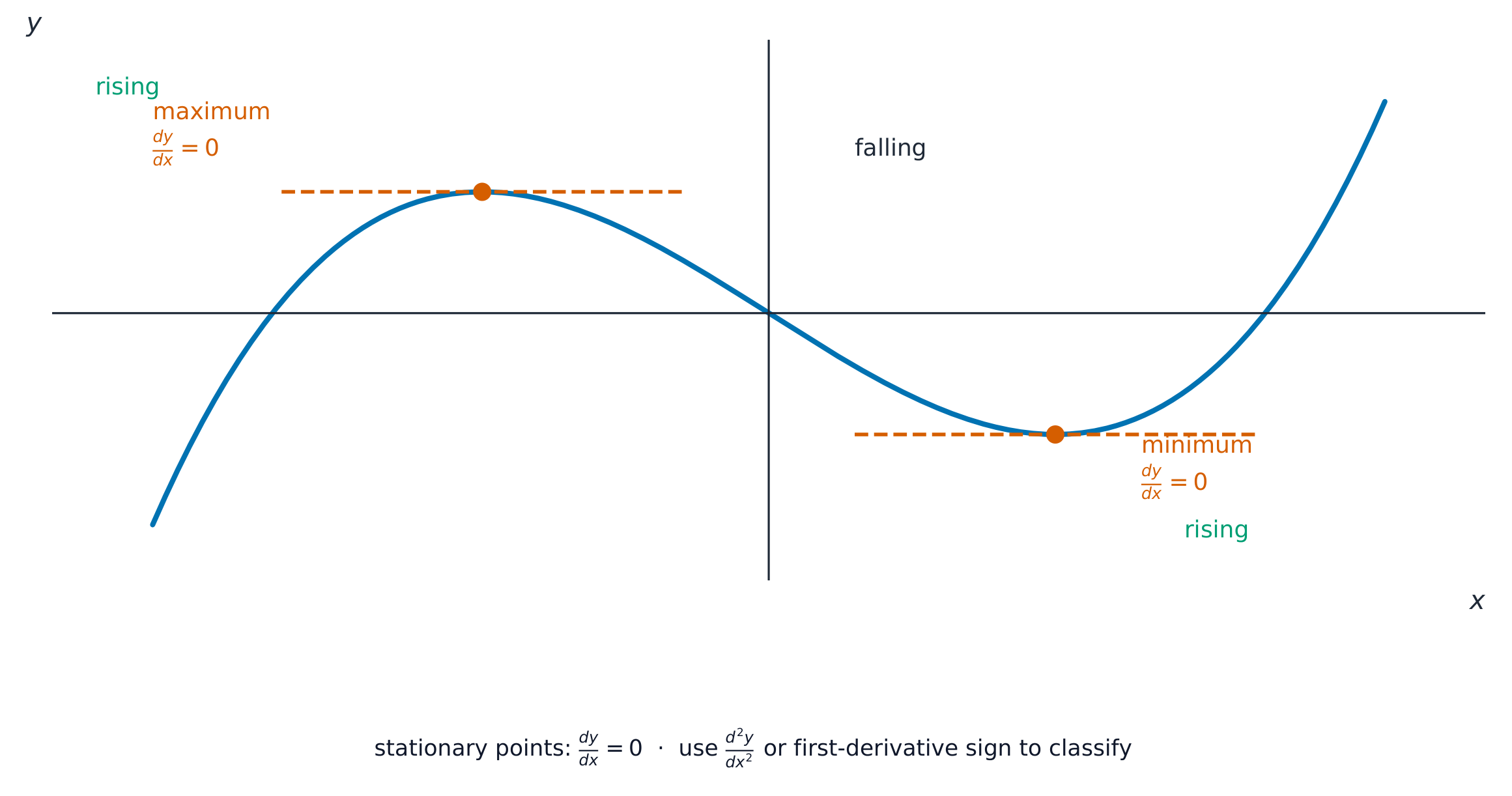
Au maximum ou minimum, la pente dy/dx est zéro
The curve y = x² − 6x + 5 has a stationary point. At what x value? · La courbe y = x² − 6x + 5 a un point stationnaire. À quelle valeur de x ?
dy/dx = 2x − 6 = 0 gives x = 3. · dy/dx = 2x − 6 = 0 donne x = 3.
At a stationary point, if the second derivative f″(x) > 0, the point is a: · En un point stationnaire, si la dérivée seconde f″(x) > 0, le point est un :
f″ > 0 means the curve bends upward — a minimum; f″ < 0 gives a maximum. · f″ > 0 signifie que la courbe s'incurve vers le haut — un minimum ; f″ < 0 donne un maximum.
If dy/dx > 0 for all x in an interval, the function is increasing on that interval. · Si dy/dx > 0 pour tout x dans un intervalle, la fonction est croissante sur cet intervalle.
A positive derivative means the function is rising — it is increasing. · Une dérivée positive signifie que la fonction monte — elle est croissante.
For y = x³ − 6x² + 9x + 2, the second derivative at x = 3 is: · Pour y = x³ − 6x² + 9x + 2, la dérivée seconde en x = 3 est :
d²y/dx² = 6x − 12. At x = 3: 6(3) − 12 = 18 − 12 = 6 > 0, so it's a minimum. · d²y/dx² = 6x − 12. En x = 3 : 6(3) − 12 = 18 − 12 = 6 > 0, c'est donc un minimum.
Worked example — finding stationary points
- $y = x^3 - 6x^2 + 9x + 2$.
- $\dfrac{dy}{dx} = 3x^2 - 12x + 9 = 3(x-1)(x-3)$.
- Stationary points at $x = 1$ and $x = 3$.
- $\dfrac{d^2y}{dx^2} = 6x - 12$: at $x=1$, $f'' = -6 < 0$ (maximum); at $x=3$, $f'' = 6 > 0$ (minimum).
Exemple résolu — trouver les points stationnaires
- $y = x^3 - 6x^2 + 9x + 2$.
- $\dfrac{dy}{dx} = 3x^2 - 12x + 9 = 3(x-1)(x-3)$.
- Points stationnaires à $x = 1$ et $x = 3$.
- $\dfrac{d^2y}{dx^2} = 6x - 12$ : au point $x=1$, $f'' = -6 < 0$ (maximum) ; au point $x=3$, $f'' = 6 > 0$ (minimum).
Applications of differentiation
- Optimisation 最优化: find the maximum profit or minimum cost by setting $\dfrac{dy}{dx} = 0$.
- Rates of change: velocity is the derivative of displacement; acceleration is the derivative of velocity.
- Curve sketching: stationary points and the sign of $\dfrac{dy}{dx}$ reveal the shape.
- The derivative also gives the gradient of normals (perpendicular to the tangent).
Applications de la différentiation
- Optimisation 最优化 : trouver le profit maximal ou le coût minimal en posant $\dfrac{dy}{dx} = 0$.
- Taux de variation : la vitesse est la dérivée du déplacement ; l'accélération est la dérivée de la vitesse.
- Esquisse de courbe : les points stationnaires et le signe de $\dfrac{dy}{dx}$ révèlent la forme.
- La dérivée donne également la pente des normales (perpendiculaires à la tangente).
You've got it
- power rule: $\dfrac{d}{dx}(x^n) = n x^{n-1}$; chain rule for nested functions
- stationary point: $\dfrac{dy}{dx} = 0$
- second-derivative test: $f'' > 0$ minimum, $f'' < 0$ maximum
- increasing when $\dfrac{dy}{dx} > 0$; decreasing when $\dfrac{dy}{dx} < 0$
Vous avez compris
- règle de la puissance : $\dfrac{d}{dx}(x^n) = n x^{n-1}$ ; règle de chaîne pour les fonctions imbriquées
- point stationnaire : $\dfrac{dy}{dx} = 0$
- test de la deuxième dérivée : $f'' > 0$ minimum, $f'' < 0$ maximum
- croissant quand $\dfrac{dy}{dx} > 0$ ; décroissant quand $\dfrac{dy}{dx} < 0$