Trigonometry · Trigonométrie
| English | Français |
|---|---|
| trigonometric/ˌtrɪɡənəʊˈmetrɪk/ | trigonométrique |
| asymptotes/ˈæsɪmptəʊts/ | asymptotes |
| identities/aɪˈdentɪtiz/ | identités |
The mathematics of cycles
- Tides, sound waves, alternating current, planetary orbits — all described by trigonometric 三角的 functions.
- The sine and cosine waves are the building blocks of periodic motion. Master them and you can model anything that repeats.
Les mathématiques des cycles
- Marées, ondes sonores, courant alternatif, orbites planétaires — tout cela est décrit par les fonctions trigonométriques 三角的.
- Les ondes sinusoïdales et cosinusoïdales sont les briques fondamentales du mouvement périodique. Maîtrisez-les et vous pourrez modéliser tout ce qui se répète.
Graphs of sin, cos and tan
- $\sin$ and $\cos$ wave between $-1$ and $1$ and repeat every $360^\circ$ (or $2\pi$ radians).
- $\tan$ repeats every $180^\circ$ (or $\pi$ radians) and has vertical asymptotes 渐近线 at $90^\circ$ and $270^\circ$.
The unit circle: $\cos\theta$ is the $x$-coordinate, $\sin\theta$ is the $y$-coordinate. Since $x^2 + y^2 = 1$, we get $\cos^2\theta + \sin^2\theta \equiv 1$.
Graphes de sin, cos et tan
- $\sin$ et $\cos$ oscillent entre $-1$ et $1$ et se répètent tous les $360^\circ$ (ou $2\pi$ radians).
- $\tan$ se répète tous les $180^\circ$ (ou $\pi$ radians) et présente des asymptotes verticales 渐近线 aux $90^\circ$ et $270^\circ$.
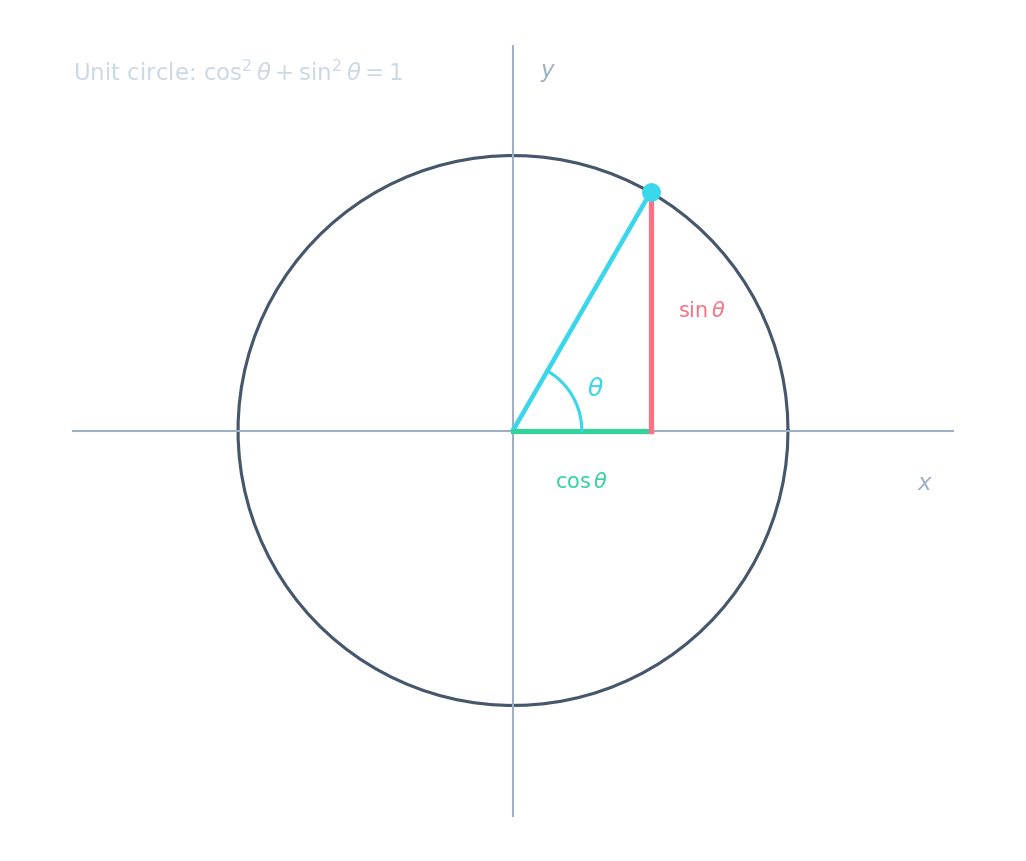
Le cercle unité : $\cos\theta$ est la coordonnée $x$, $\sin\theta$ est la coordonnée $y$. Puisque $x^2 + y^2 = 1$, nous obtenons $\cos^2\theta + \sin^2\theta \equiv 1$.
The unit circle · Le cercle unité
(cos θ, sin θ)
Spin the angle θ around the circle: the horizontal leg is cos θ and the vertical leg is sin θ. · Faites tourner l'angle θ autour du cercle : le côté horizontal est cos θ et le côté vertical est sin θ.
Exact values
- Learn these without a calculator:
| $\theta$ | $0^\circ$ | $30^\circ$ | $45^\circ$ | $60^\circ$ | $90^\circ$ |
|---|---|---|---|---|---|
| $\sin$ | $0$ | $\tfrac12$ | $\tfrac{1}{\sqrt2}$ | $\tfrac{\sqrt3}{2}$ | $1$ |
| $\cos$ | $1$ | $\tfrac{\sqrt3}{2}$ | $\tfrac{1}{\sqrt2}$ | $\tfrac12$ | $0$ |
| $\tan$ | $0$ | $\tfrac{1}{\sqrt3}$ | $1$ | $\sqrt3$ | undefined |
Memory trick. The sine values follow the pattern $\dfrac{\sqrt{0}}{2}, \dfrac{\sqrt{1}}{2}, \dfrac{\sqrt{2}}{2}, \dfrac{\sqrt{3}}{2}, \dfrac{\sqrt{4}}{2}$ for $0°, 30°, 45°, 60°, 90°$. Cosine is the reverse.
A Ferris wheel: a point on the rim moves up and down like a sine curve
Valeurs exactes
- Apprenez celles-ci sans calculatrice :
| $\theta$ | $0^\circ$ | $30^\circ$ | $45^\circ$ | $60^\circ$ | $90^\circ$ |
|---|---|---|---|---|---|
| $\sin$ | $0$ | $\tfrac12$ | $\tfrac{1}{\sqrt2}$ | $\tfrac{\sqrt3}{2}$ | $1$ |
| $\cos$ | $1$ | $\tfrac{\sqrt3}{2}$ | $\tfrac{1}{\sqrt2}$ | $\tfrac12$ | $0$ |
| $\tan$ | $0$ | $\tfrac{1}{\sqrt3}$ | $1$ | $\sqrt3$ | indéfini |
Astuce mnémotechnique. Les valeurs de sin suivent le motif $\dfrac{\sqrt{0}}{2}, \dfrac{\sqrt{1}}{2}, \dfrac{\sqrt{2}}{2}, \dfrac{\sqrt{3}}{2}, \dfrac{\sqrt{4}}{2}$ pour $0°, 30°, 45°, 60°, 90°$. Cosinus est l'inverse.

Une grande roue : un point sur le pourtour monte et descend comme une courbe sinusoïdale
Sine & cosine graphs · Graphiques du sinus et du cosinus
Drag the amplitude, period and shifts of y = a·sin(bx + c) + d and watch the curve change against the base wave. · Faites glisser l'amplitude, la période et les décalages de y = a·sin(bx + c) + d et observez comment la courbe change par rapport à l'onde de base.
What is the exact value of sin 30°? · Quelle est la valeur exacte de sin 30° ?
sin 30° = 1/2 = 0.5.
What is the value of tan 45°? · Quelle est la valeur de tan 45° ?
tan 45° = 1.
What is the exact value of cos 60°? · Quelle est la valeur exacte de cos 60° ?
cos 60° = 1/2 = 0.5.
Key identities 恒等式
- The two fundamental identities: $\tan\theta \equiv \dfrac{\sin\theta}{\cos\theta}$ and $\sin^2\theta + \cos^2\theta \equiv 1$.
- These let you convert between functions and simplify expressions.
$\sin^2\theta + \cos^2\theta \equiv 1$, not $(\sin\theta + \cos\theta)^2 = 1$. The identity is about the sum of the squares, not the square of the sum. This is a common exam mistake.
sin and cos wave between -1 and 1; tan breaks at 90 and 270 degrees
Identités clés 恒等式
- Les deux identités fondamentales : $\tan\theta \equiv \dfrac{\sin\theta}{\cos\theta}$ et $\sin^2\theta + \cos^2\theta \equiv 1$.
- Elles permettent de convertir entre les fonctions et de simplifier les expressions.
$\sin^2\theta + \cos^2\theta \equiv 1$, pas $(\sin\theta + \cos\theta)^2 = 1$. L'identité porte sur la somme des carrés, pas le carré de la somme. C'est une erreur fréquente aux examens.

sin et cos oscillent entre -1 et 1 ; tan brise à 90 et 270 degrés
For any angle θ, what does sin²θ + cos²θ equal? · Pour tout angle θ, que vaut sin²θ + cos²θ ?
This is the identity sin²θ + cos²θ ≡ 1. · Ceci est l'identité sin²θ + cos²θ ≡ 1.
Which identity is correct? · Quelle identité est correcte ?
tan θ ≡ sin θ / cos θ; and sin²θ + cos²θ ≡ 1. · tan θ ≡ sin θ / cos θ ; et sin²θ + cos²θ ≡ 1.
Solving trig equations
- To solve a trig equation: reduce it to one function (often a quadratic in $\sin$ or $\cos$), then find every solution in the given interval.
- Use the graph's symmetry: if $\sin\theta = k$ has solution $\theta = \alpha$, then $\theta = 180^\circ - \alpha$ is also a solution.
- Solve trigonometrical equations; use the inverse functions $\sin^{-1},\cos^{-1},\tan^{-1}$ (inverse trigonometric relations), which give principal values.
Résolution d'équations trigonométriques
- Pour résoudre une équation trigonométrique : réduisez-la à une seule fonction (souvent un quadratique en $\sin$ ou $\cos$), puis trouvez toutes les solutions dans l'intervalle donné.
- Utilisez la symétrie du graphique : si $\sin\theta = k$ a une solution $\theta = \alpha$, alors $\theta = 180^\circ - \alpha$ est aussi une solution.
- Résolvez les équations trigonométriques ; utilisez les fonctions réciproques $\sin^{-1},\cos^{-1},\tan^{-1}$ (relations trigonométriques inverses), qui donnent les valeurs principales.
If sin θ = 0.5 and 0° ≤ θ ≤ 360°, then θ = 30° is the only solution. · Si sin θ = 0.5 et 0° ≤ θ ≤ 360°, alors θ = 30° est la seule solution.
sin θ = 0.5 also has solution θ = 180° − 30° = 150° in the given range. · sin θ = 0.5 admet également comme solution θ = 180° − 30° = 150° dans l'intervalle donné.
You've got it
- $\sin, \cos$ stay in $[-1, 1]$, repeat every $360^\circ$; know the $30/45/60$ exact values
- identities: $\tan\theta \equiv \dfrac{\sin\theta}{\cos\theta}$, $\sin^2\theta + \cos^2\theta \equiv 1$
- solve by reducing to one trig function, then finding all solutions in the interval
Vous avez compris
- $\sin, \cos$ restent dans $[-1, 1]$, se répètent tous les $360^\circ$ ; connaissez les valeurs exactes $30/45/60$
- identités : $\tan\theta \equiv \dfrac{\sin\theta}{\cos\theta}$, $\sin^2\theta + \cos^2\theta \equiv 1$
- résoudre en réduisant à une seule fonction trigonométrique, puis trouver toutes les solutions dans l'intervalle