Rational functions and graphs · Fonctions rationnelles et graphes
| English | Français |
|---|---|
| polynomial/ˌpɒlɪˈnəʊmɪəl/ | polynomiale |
| vertical asymptote/ˈvɜːtɪkl ˈæsɪmptəʊt/ | asymptote verticale |
| oblique asymptote/əˈbliːk ˈæsɪmptəʊt/ | asymptote oblique |
| denominator/dɪˈnɒmɪneɪtə/ | dénominateur |
| rational function/ˈræʃənl ˈfʌŋkʃn/ | fonction rationnelle |
| remainder/rɪˈmeɪndə/ | reste |
| quotient/ˈkwəʊʃənt/ | quotient |
The graph that breaks the rules
- Most functions you've met are polynomials 多项式 — smooth, continuous, defined everywhere. But divide one polynomial by another and you get something wilder: vertical asymptotes 垂直渐近线, oblique asymptotes 斜渐近线, and behaviour that changes dramatically near the zeros of the denominator 分母.
- Rational functions 有理函数 are the gateway to understanding more complex curves.
Le graphique qui brise les règles
- La plupart des fonctions que vous avez rencontrées sont des polynômes 多项式 — lisses, continues, définies partout. Mais diviser un polynôme par un autre donne quelque chose de plus complexe : des asymptotes verticales 垂直渐近线, des asymptotes obliques 斜渐近线, et un comportement qui change radicalement près des zéros du dénominateur 分母.
- Les fonctions rationnelles 有理函数 sont la porte d'entrée vers la compréhension de courbes plus complexes.
What is a rational function?
- A rational function is a fraction of two polynomials: $f(x) = \dfrac{P(x)}{Q(x)}$.
- The denominator's zeros give vertical asymptotes (where the function shoots to $\pm\infty$).
Worked example. $f(x) = \dfrac{x^2 - 1}{x - 2}$. Vertical asymptote at $x = 2$. Dividing: $f(x) = x + 2 + \dfrac{3}{x-2}$. The oblique asymptote is $y = x + 2$.
Qu'est-ce qu'une fonction rationnelle ?
- Une fonction rationnelle est une fraction de deux polynômes : $f(x) = \dfrac{P(x)}{Q(x)}$.
- Les zéros du dénominateur donnent des asymptotes verticales (où la fonction tend vers $\pm\infty$).
Exemple résolu. $f(x) = \dfrac{x^2 - 1}{x - 2}$. Asymptote verticale en $x = 2$. En divisant : $f(x) = x + 2 + \dfrac{3}{x-2}$. L'asymptote oblique est $y = x + 2$.
Rational functions · Fonctions rationnelles
y = a/(x − b) + c
A rational function has asymptotes the curve approaches but never touches. · Une fonction rationnelle a des asymptotes que la courbe approche mais ne touche jamais.
A rational function is a fraction of two polynomials. · Une fonction rationnelle est une fraction de deux polynômes.
That is the definition — one polynomial over another. · C'est la définition — un polynôme sur un autre.
Oblique (slant) asymptotes
- When the top has higher degree than the bottom, the graph has an oblique (slant) asymptote — find it by polynomial long division.
- The remainder 余数 term vanishes as $x \to \infty$, leaving the quotient 商 as the asymptote.
The curve hugs the vertical asymptote x = 2 and the oblique asymptote y = x + 2 far from the origin.
Don't forget the remainder. When dividing, the function equals the quotient plus the remainder over the divisor. The asymptote is just the quotient — the remainder tells you which side of the asymptote the curve approaches from.
Asymptotes obliques (ou de glissement)
- Lorsque le numérateur a un degré supérieur à celui du dénominateur, la courbe possède une asymptote oblique — on la trouve par division euclidienne de polynômes.
- Le terme reste 余数 s'annule lorsque $x \to \infty$, laissant le quotient 商 comme asymptote.
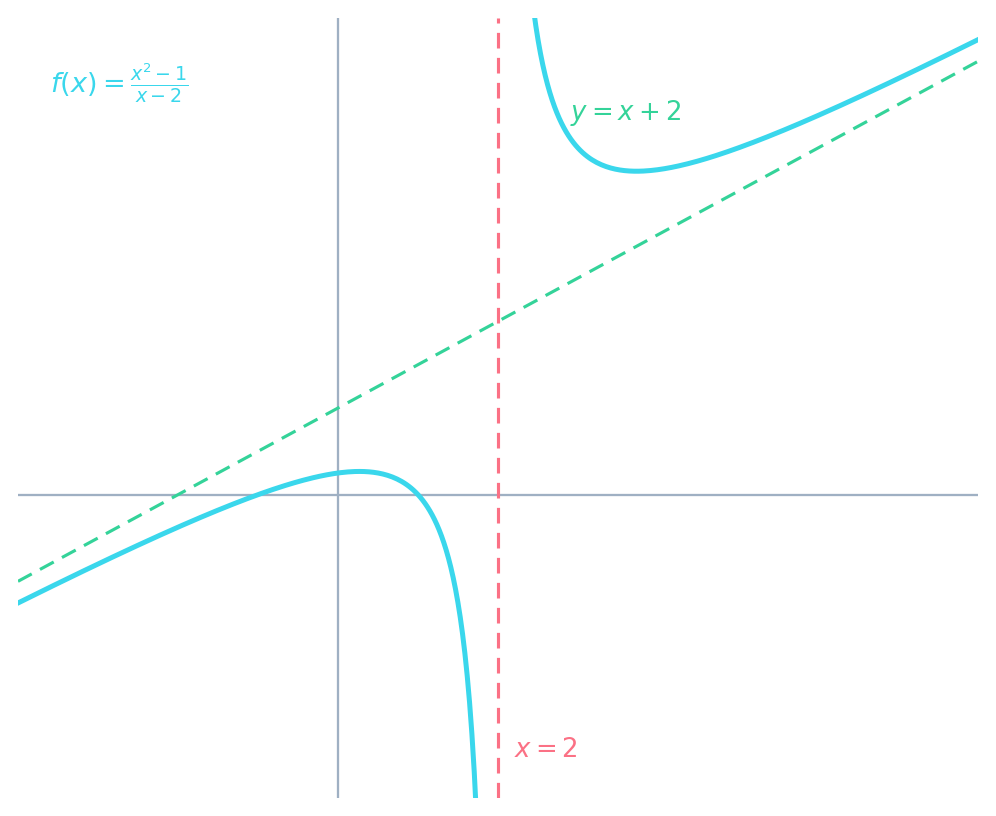
La courbe épouse l'asymptote verticale x = 2 et l'asymptote oblique y = x + 2 loin de l'origine.
N'oubliez pas le reste. Lors de la division, la fonction est égale au quotient plus le reste sur le diviseur. L'asymptote n'est que le quotient ; le reste indique de quel côté de l'asymptote la courbe approche.
A rational function has an oblique (slant) asymptote when the degree of the top is: · Une fonction rationnelle a une asymptote oblique (en pente) lorsque le degré du numérateur est :
When the numerator's degree exceeds the denominator's, dividing out leaves a slant line the curve approaches. · Lorsque le degré du numérateur dépasse celui du dénominateur, la division laisse une ligne oblique que la courbe approche.
You find an oblique asymptote by: · Vous trouvez une asymptote oblique en :
Polynomial division gives the straight-line part the curve approaches far from the origin. · La division polynomiale donne la partie linéaire que la courbe approche loin de l'origine.
For f(x) = (x²−1)/(x−2), divide to get f(x) = x + 2 + 3/(x−2). The oblique asymptote is y = x + ? · Pour f(x) = (x²−1)/(x−2), diviser pour obtenir f(x) = x + 2 + 3/(x−2). L'asymptote oblique est y = x + ?
The quotient is x + 2, so the oblique asymptote is y = x + 2. · Le quotient est x + 2, donc l'asymptote oblique est y = x + 2.
Related graphs
- You should relate $y = f(x)$ to:
- $y^2 = f(x)$ — only exists where $f(x) \geq 0$, symmetric about the $x$-axis.
- $y = \dfrac{1}{f(x)}$ — zeros become asymptotes, asymptotes become zeros.
- $y = |f(x)|$ — reflects negative parts above the $x$-axis.
- $y = f(|x|)$ — reflects the right half to the left.
Courbes associées
- Vous devez relier $y = f(x)$ à :
- $y^2 = f(x)$ — existe uniquement là où $f(x) \geq 0$, symétrique par rapport à l'axe $x$.
- $y = \dfrac{1}{f(x)}$ — les zéros deviennent des asymptotes, les asymptotes deviennent des zéros.
- $y = |f(x)|$ — reflète les parties négatives au-dessus de l'axe $x$.
- $y = f(|x|)$ — reflète la moitié droite vers la gauche.
For y = 1/f(x), the zeros of f(x) become vertical asymptotes. · Pour y = 1/f(x), les zéros de f(x) deviennent des asymptotes verticales.
Where f(x) = 0, 1/f(x) is undefined — giving a vertical asymptote. · Lorsque f(x) = 0, 1/f(x) n'est pas défini — ce qui donne une asymptote verticale.
The graph of y = |f(x)| is obtained from y = f(x) by: · Le graphique de y = |f(x)| est obtenu à partir de y = f(x) en :
The modulus reflects any part of the graph below the x-axis to above it. · La valeur absolue reflète toute partie du graphique située sous l'axe des x vers le dessus.
Worked example — sketching $y = \dfrac{1}{f(x)}$
- If $f(x) = x^2 - 4$ (roots at $\pm 2$, minimum at $(0, -4)$):
- $\dfrac{1}{f(x)}$ has vertical asymptotes at $x = \pm 2$.
- The minimum of $f$ at $-4$ becomes a local maximum of $\dfrac{1}{f}$ at $-\dfrac{1}{4}$.
- Find the set of values a rational function takes using the discriminant, and its turning points.
Exemple résolu — tracer $y = \dfrac{1}{f(x)}$
- Si $f(x) = x^2 - 4$ (racines en $\pm 2$, minimum en $(0, -4)$) :
- $\dfrac{1}{f(x)}$ a des asymptotes verticales en $x = \pm 2$.
- Le minimum de $f$ en $-4$ devient un maximum local de $\dfrac{1}{f}$ en $-\dfrac{1}{4}$.
- Trouver l'ensemble des valeurs prises par une fonction rationnelle utilise le discriminant, ainsi que ses points stationnaires.
You've got it
- a rational function = polynomial ÷ polynomial
- top degree > bottom degree → an oblique asymptote (found by division)
- learn the related graphs: $y^2 = f$, $1/f$, $|f|$, $f(|x|)$
Vous avez compris
- une fonction rationnelle = polynôme ÷ polynôme
- degré du haut > degré du bas → une asymptote oblique (trouvée par division)
- apprendre les courbes associées : $y^2 = f$, $1/f$, $|f|$, $f(|x|)$