Planning a synthetic route · Planification d'une voie synthétique
| English | Français |
|---|---|
| target molecule/ˈtɑːɡɪt ˈmɒlɪkjuːl/ | molécule cible |
| starting material/ˈstɑːtɪŋ məˈtɪərɪəl/ | matière première |
| reagent/rɪˈeɪdʒənt/ | réactif |
| by-product/baɪ ˈprɒdʌkt/ | sous-produit |
| yield/jiːld/ | rendement |
From start to target
- A target molecule 目标分子 is built in several steps.
- The trick is to work backwards from the target.
- You also analyse a given route step by step.
Du départ au produit cible
- Une molécule cible 目标分子 est construite en plusieurs étapes.
- Le truc consiste à travailler à rebours depuis le produit cible.
- Vous analysez également un parcours donné étape par étape.
Synthetic route planning lab · Lab de planification de voie synthétique
Follow how a target molecule is planned backwards then made forwards. · Suivez comment une molécule cible est planifiée à rebours puis fabriquée vers l'avant.
A good synthetic route uses few steps and gives a high overall yield. · Une bonne voie synthétique utilise peu d'étapes et donne un rendement global élevé.
Fewer steps means less loss of product. · Moins d'étapes signifie moins de perte de produit.
Planning a route
- compare the target with the starting material 起始材料 — what changed (the group, the number of carbons)?
- work backwards: which single reaction could make the target, and from what?
- repeat until you reach the starting material.
- write each step with its reagent 试剂 and conditions.
- To add a carbon, the KCN step is the key (the only chain-lengthening AS reaction).
Plan a synthesis backwards — from the target, step by step, to the starting material
Medicines are built up by multi-step organic synthesis.
Planifier un parcours
- comparer le produit cible avec le matériel de départ 起始材料 — qu'a changé (le groupe, le nombre de carbones) ?
- travailler à rebours : quelle réaction unique pourrait produire le produit cible, et à partir de quoi ?
- répéter jusqu'à atteindre le matériel de départ.
- écrire chaque étape avec son réactif 试剂 et conditions.
- Pour ajouter un carbone, l'étape KCN est cruciale (la seule réaction AS d'allongement de chaîne).
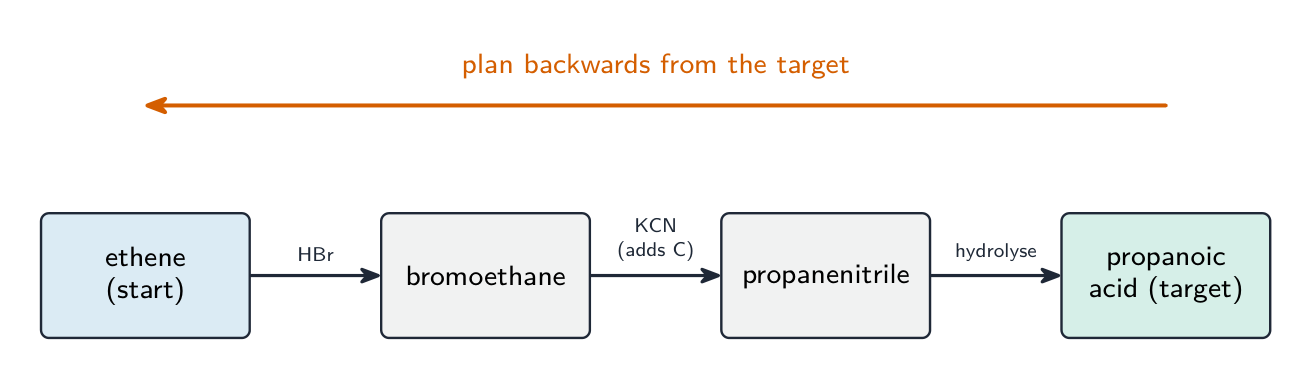
Planifier une synthèse à rebours — du produit cible, étape par étape, vers le matériel de départ

Les médicaments sont construits par une synthèse organique multi-étapes.
The best way to plan a multi-step synthesis is to: · La meilleure façon de planifier une synthèse multi-étape est de :
Working backwards from the target finds which reaction makes it, and from what, step by step. · Travailler à rebours à partir de la cible trouve quelle réaction la produit et à partir de quoi, étape par étape.
If your route needs to add a carbon atom, the key step is: · Si votre voie doit ajouter un atome de carbone, l'étape clé est :
KCN is the only AS reaction that lengthens the carbon chain. · KCN est la seule réaction AS qui allonge la chaîne carbonée.
Match each synthesis idea. · Associez chaque idée de synthèse.
Each item links the term to its correct meaning. · Chaque élément relie le terme à sa signification correcte.
Analysing a route
- For each step, state the type of reaction (oxidation, reduction, substitution, addition, elimination) and the reagent.
- Think about by-products 副产物 — e.g. making an amine from a halogenoalkane also gives further-substituted amines, so the yield 产率 of the simple amine is low.
Analyser un parcours
- Pour chaque étape, indiquer le type de réaction (oxydation, réduction, substitution, addition, élimination) et le réactif.
- Penser aux sous-produits 副产物 — par exemple, la fabrication d'une amine à partir d'un halogénure d'alcanes produit aussi des amines substituées ultérieurement, donc le rendement 产率 de l'amine simple est faible.
When analysing each step of a given route, you should state: · Lors de l'analyse de chaque étape d'une voie donnée, vous devez indiquer :
Identify the reaction type (oxidation, substitution, etc.) and the reagent/conditions for each step. · Identifiez le type de réaction (oxydation, substitution, etc.) et le réactif/conditions pour chaque étape.
Why is the yield of a simple amine from a halogenoalkane low? · Pourquoi le rendement d'une amine simple à partir d'un halogénure d'alkyle est-il faible ?
The amine is itself a nucleophile, so it reacts again — a by-product mixture lowers the yield. · L'amine est elle-même un nucléophile, elle réagit donc à nouveau — un mélange de sous-produits réduit le rendement.
Judging a route
- Prefer routes with few steps and high yield, using safe, cheap reagents.
- Each extra step loses product, so the overall yield falls quickly.
Juger un parcours
- Privilégier les parcours avec peu d'étapes et rendement élevé, utilisant des réactifs sûrs et bon marché.
- Chaque étape supplémentaire entraîne une perte de produit, donc le rendement global chute rapidement.
You've got it
- plan by working backwards from the target (compare groups and carbon count)
- write each step's reagent + conditions; use KCN to add a carbon
- to analyse a route, give each step's reaction type and reagent, and watch for by-products
Vous avez compris
- planifiez en travaillant en arrière depuis la cible (comparez les groupes et le nombre de carbones)
- écrivez pour chaque étape le réactif + conditions ; utilisez KCN pour ajouter un carbone
- pour analyser une voie, donnez le type de réaction et le réactif de chaque étape, et faites attention aux sous-produits